




Justice of the Peace in Dominica
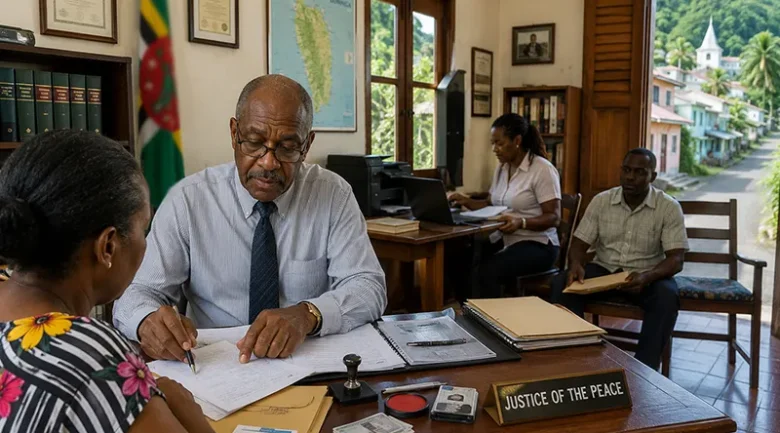
A Justice of the Peace (JP) in the Commonwealth of Dominica is a pillar of the community and a critical cog in the nation’s legal machinery. Often described as a “lay magistrate,” the JP serves as an accessible, local-level representative of the judiciary. Their role is characterised by a unique blend of administrative authentication and quasi-judicial authority, designed to bridge the gap between the formal court system and the daily needs of the citizens.
In Dominica, being appointed as a Justice of the Peace is considered a high civic honour. It is a position typically reserved for retired senior public servants, religious leaders, and individuals of “unquestionable integrity” who have demonstrated long-term commitment to their local parish. As of recent, the role has taken on even greater importance as the government decentralises public services and integrates digital litigation systems into the traditional judicial workflow.
Historical Evolution and Legal Foundation
The office of the Justice of the Peace in Dominica is an inheritance from the English Common Law system, which can be traced back to the Justice of the Peace Act 1361 under King Edward III. Originally established to “keep the peace” (guard the Sovereign’s peace), the role was transplanted to the Caribbean during the colonial era to manage local legal affairs in rural areas where full-time judges were scarce.
In modern Dominica, the authority of the JP is enshrined in the Magistrates Code of Procedure Act (Cap. 4:20) and supported by the Criminal Law and Procedure Act. While the formal court system (the Magistrate’s Courts and the High Court) handles complex litigation and criminal trials, the JP provides the essential front-line legal services required for the stability of civil society.
The 2026 context is particularly noteworthy because the current President of Dominica, Her Excellency Sylvanie Burton, has a background as a JP. Her tenure has brought a renewed focus on the importance of these local officials in upholding the rule of law at the grassroots level, particularly within the Kalinago Territory and other rural communities.
The Appointment Process
Unlike Attorneys-at-Law, who qualify through education and bar admission, a Justice of the Peace is appointed through a rigorous vetting process based on character and community standing.
Selection and Recommendation
The process typically begins with a recommendation from the Cabinet, often initiated by a Member of Parliament or a local village council. The candidate must be a citizen of Dominica, usually over the age of 30, and must possess a clean police record. The government seeks individuals who are upstanding, meaning they are financially stable, socially respected, and possess a fundamental understanding of the laws they will be tasked with assisting with.
The Presidential Commission
Following the Cabinet’s recommendation, the Dominican President issues a formal commission. As an appointee of the President, a JP is technically an officer of the state and remains in office for life, or until they resign or have their commission revoked for misconduct. Once appointed, their name is published in the Official Gazette, and they are formally enrolled in the Registry of the High Court.
Training and Orientation
The Judicial Education Institute (JEI) of the Eastern Caribbean Supreme Court has introduced mandatory orientation programs for newly appointed JPs. These sessions focus on:
- Sentencing Principles: Understanding the limits of their power in minor offenses.
- Ethics and Bias: Ensuring that family ties (prevalent in small Dominican communities) do not interfere with judicial duties.
- Technology: Training on the Electronic Litigation Portal to process warrants and documents digitally.
Core Administrative Functions
For most Dominicans, interactions with a JP are purely administrative. Because they are widely distributed across the island’s ten parishes, they are often the most accessible official for authenticating documents.
Witnessing Marriage Applications
Under the Marriage Act, any couple (national or non-national) wishing to obtain a marriage license must complete Form G. This form requires the signature of a witness who is a Magistrate, a Notary Public, or a Justice of the Peace. The JP’s role is to verify applicants’ identities and ensure they are entering the union of their own free will.
Statutory Declarations and Affidavits
A JP is authorized to administer oaths and affirmations. This is crucial for:
- Name Changes: Witnessing the declarations required for a Deed Poll.
- Proof of Life: Confirming for social security or overseas pension funds that a recipient is still alive.
- Passport Applications: Verifying the identity of an applicant for the Dominica Passport Office.
Certification of Documents
While international documents often require the seal of a Notary Public, a JP is the standard official for domestic certifications. They can certify that a copy of an original document (such as a birth certificate or utility bill) is a true and correct copy, which is required when opening bank accounts or applying for government grants.
Quasi-Judicial and Law Enforcement Powers
The “Justice” in their title is not just for show; JPs possess significant powers that assist the Commonwealth of Dominica Police Force (CDPF) in maintaining public order.
Issuing Warrants
In urgent situations where a Magistrate is unavailable, such as late at night or on weekends, a JP has the legal authority to sign Search Warrants and Arrest Warrants. This power is governed by the Criminal Law and Procedure Act, which requires the JP to take an “Information” from a police officer under oath before signing. This serves as a vital check and balance, ensuring that the police have a legal basis to enter a citizen’s home or deprive them of liberty.
The Granting of Bail
Under the Bail Act of 2020 and its subsequent 2026 refinements, JPs play a role in the “First Appearance” process. For minor, non-violent offences, a JP may preside over the granting of bail to an accused person. This prevents the unnecessary detention of citizens for petty crimes and helps reduce overcrowding at the Stock Farm Prison.
Substituting for a Magistrate
In extraordinary circumstances, such as when a Magistrate is ill, or a district is cut off by weather (common during the Atlantic hurricane season), the Chief Magistrate can authorise two Justices of the Peace to sit together as a bench to hear summary matters. While this is rare in Roseau, it is a critical resilience feature of the Dominican justice system for remote areas like Grand Bay or Marigot.
Role in the Citizenship by Investment (CBI) Program
Today, Dominica’s Citizenship by Investment (CBI) program is one of the most strictly regulated in the world, overseen by the Eastern Caribbean Citizenship by Investment Regulatory Authority (ECCIRA). The Justice of the Peace plays a small but vital role in this multi-billion dollar industry.
Newly approved citizens must execute an Oath of Allegiance. While many international applicants use Notaries in their home countries, those residing in Dominica or visiting the island to finalise their status often seek out a local JP. The JP witnesses the applicant’s oath to be faithful to the Commonwealth of Dominica, providing the final human verification step before the Certificate of Naturalization is issued.
Ethical Standards and the Code of Conduct
Because a JP is a volunteer and often a member of the community they serve, the risk of conflict of interest is high. To mitigate this, a formal Code of Conduct was reinforced to ensure the office remains untainted by corruption.
Prohibition of Fees
A Justice of the Peace is strictly prohibited from charging a fee for their services. The office is a voluntary service to the state. Accepting donations or tips in exchange for a signature is a criminal offence and grounds for immediate removal from the Roll of Notaries.
Integrity and Impartiality
The JP must act without fear or favour. In the close-knit society of Dominica, this often means a JP must recuse themselves if a family member or close business associate requires a warrant or a document authenticated. The recent standards emphasise that even the appearance of bias is enough to invalidate a JP’s action.
Confidentiality
JPs are often privy to sensitive personal information, wills, divorce declarations, or police investigations. They are legally bound to maintain the confidentiality of all information that comes to them by virtue of their office.
Modernisation: The JP in the Digital Age
The National Digital Transformation Strategy (2022–2026) has significantly altered how JPs operate. Historically, a JP was found by knocking on their front door or finding them at a village shop. Today, the system is becoming more formalised:
- Digital Stamps: The government is piloting cryptographically secure digital seals for JPs, allowing them to witness documents submitted to the Electronic Litigation Portal without the need for physical paper.
- Virtual Witnessing: For certain non-contentious administrative documents, the 2026 regulations allow for witnessing via secure video link, provided the JP has previously verified the individual’s biometric data.
- Centralized Registry: The Ministry of Justice now maintains an online, searchable database of all active JPs, organized by parish, making it easier for citizens to find an authorized official near them.
JP vs. Notary vs. Commissioner of Oaths: A Comparison
| Feature | Justice of the Peace (JP) | Notary Public | Commissioner of Oaths |
| Legal Training | Usually a layperson. | Almost always an Attorney. | Officer of the court. |
| Cost | Free (Voluntary). | Fee-based. | Small fee/Free at Registry. |
| Primary Power | Keeping the peace/Warrants. | International authentication. | Domestic court affidavits. |
| Authority Scope | Domestic only. | Globally recognized. | Domestic only. |
| Key Act | Magistrates Act (Cap 4:20). | Notaries Public Act. | Comm. for Oaths Act. |
How to Access a Justice of the Peace
If you require the services of a Justice of the Peace, follow these practical steps:
- Check the Registry: Visit the High Court Registry website to find the list of JPs currently commissioned in your parish (e.g., St. George, St. Andrew, etc.).
- Contact the Police Station: If you cannot find a JP, the local police station usually has the contact information for the JPs they use for warrants.
- Prepare Your Identification: You must bring a valid photo ID. In Dominica, the Social Security Card or the Dominican Passport are the gold standard.
- Do Not Sign in Advance: This is the most common mistake. A JP cannot witness a signature they did not see happen. If you have already signed the document, you will likely be asked to re-print it and sign it in their presence.
The Guardian of the Community
The Justice of the Peace remains a vital safety valve for the Dominican legal system. By providing a free, local, and trusted method for authenticating documents and supporting law enforcement, they ensure that the King’s Peace (or the State’s Peace) is maintained even in the smallest hamlets of the Nature Island. As Dominica continues to modernise, the JP stands as a reminder that the law is not just something practised in high-rise courtrooms in Roseau, but a living tradition upheld by the most respected citizens in every village.


