

Commissioner of Oaths in Dominica
A Commissioner of Oaths in Dominica is a public official authorised by the state to verify the execution of legal documents and to administer formal oaths or affirmations. Their function is essential for the valid submission of various legal instruments, ensuring that the person signing a document understands its legal weight and has sworn to the truth of its contents. In the Commonwealth of Dominica, this role is primarily governed by the Commissioners for Oaths Act (Cap. 1:17).
Unlike a general witness, a Commissioner of Oaths has a statutory duty to confirm the identity of the signatory and to ensure that the document is being signed voluntarily. This process provides a layer of legal protection against fraud and is a prerequisite for many administrative and judicial proceedings on the island.
Legal Authority and Appointment
The authority to appoint Commissioners for Oaths in Dominica rests with the Chief Justice of the Eastern Caribbean Supreme Court (ECSC). Under the regional judicial system, the Chief Justice may commission any fit and proper person to hold this office. While many individuals apply for this status, it is most commonly held by senior civil servants or experienced legal clerks who require this authority to perform their daily duties.
In a practical sense, all Attorneys-at-Law admitted to the bar in Dominica are considered officers of the court and automatically possess the power to act as ex-officio Commissioners for Oaths. This means that if you require a document commissioned, visiting any private law firm in Roseau or Portsmouth is typically the most efficient route, as any practising lawyer can perform the function without needing a separate appointment.
Primary Duties and Responsibilities
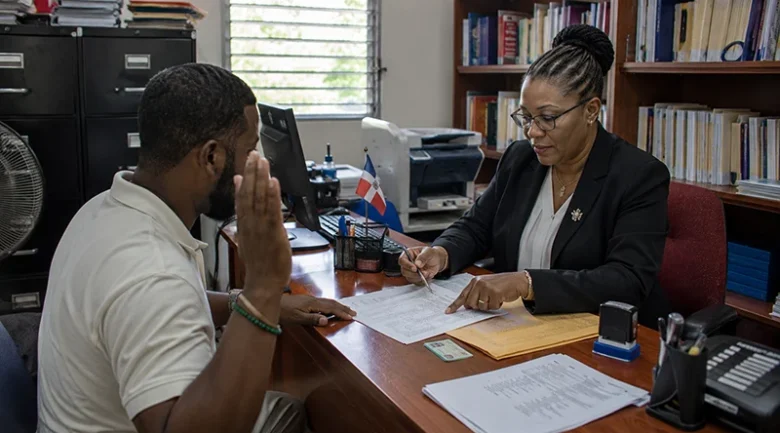
The core responsibility of a Commissioner is administering oaths and affirmations for affidavits. An affidavit is a written statement of facts used in court proceedings; to be admissible, it must be sworn before a Commissioner. The Commissioner’s role is to witness the signatory swearing-in (often using a religious text) or affirming (a non-religious equivalent) that the statements contained within the affidavit are true.
Beyond court documents, Commissioners for Oaths handle Statutory Declarations. These are used for a wide range of administrative tasks, such as changing a name, confirming marital status for a marriage license, or providing proof of address. In matters of property, they play a vital role in the Title by Registration Act, witnessing the signatures on Memoranda of Transfer and other land-related instruments that must be filed with the Land Registry.
Role in Citizenship by Investment (CBI)
Currently, one of the most common reasons individuals interact with a Commissioner of Oaths is through Dominica’s Citizenship by Investment program. Once an applicant is approved in principle, they must execute an Oath of Allegiance to the Commonwealth of Dominica. Under the regulations, this oath must be signed in the presence of an authorised official, which includes a Justice of the Peace, a Notary Public, or a Commissioner of Oaths.
The Commissioner’s task here is to verify the applicant’s identity against their passport and witness the physical signing of the oath. Because many CBI applicants are located abroad, the Dominican government often accepts oaths commissioned by equivalent officials in other jurisdictions (such as a Solicitor in the UK or a Notary in the US), provided the document is properly apostilled or legalized for use in Dominica.
Distinctions: Commissioner vs. Notary vs. JP
While the terms are often used interchangeably, there are distinct legal differences between a Commissioner of Oaths, a Notary Public, and a Justice of the Peace (JP) in Dominica:
- Scope of Recognition: A Commissioner of Oaths is primarily a domestic official. Their authority is recognized within Dominica and for documents intended for the High Court. In contrast, a Notary Public (appointed by the President of Dominica) has international standing; their seal is recognized by foreign governments and international banks for cross-border transactions.
- Breadth of Power: A Justice of the Peace typically has the narrowest scope of the three regarding document verification but possesses broader civic powers, such as the authority to issue certain warrants or witness arrests in local community matters. A Notary Public has the broadest power, able to authenticate and certify copies of original documents, a power that a standard Commissioner of Oaths generally does not possess.
Practical Guidelines for the Public
If you need to see a Commissioner of Oaths in Dominica, you must bring a valid form of government-issued photo identification, such as a passport, driver’s license, or social security card. It is a strict legal requirement that you do not sign the document beforehand. The Commissioner must see you sign the document in their presence to verify that the signature is yours and was made on the date stated.
Most Commissioners will charge a small, standardized fee for their service, though many attorneys include this as part of a larger legal service. If you are appearing at The Registry Division on Dame Mary Eugenia Charles Boulevard, official clerks are often available to act as Commissioners for documents that are being filed directly with the court.


