

Marriage Licence in Dominica
A Marriage Licence in Dominica is a statutory authorisation issued by the state that legally empowers an appointed marriage officer to solemnise a marriage within the Commonwealth of Dominica without the publication of traditional banns or a public notice of marriage. The framework governing the application, processing, and granting of a marriage licence is regulated primarily by the Marriage Act (Chapter 35:01) of the Laws of Dominica, as amended by the Marriage (Amendment) Act (Act 21 of 2013).
Administered strictly by the Ministry of Governance, Public Service Reform, Citizen Empowerment, Social Justice and Ecclesiastical Affairs, the licensing framework serves both residents and non-nationals travelling to the island for destination weddings. By ensuring all couples fulfill precise legal, age, and marital status thresholds before the wedding ceremony occurs, the process protects the legal validity of the union under domestic and international law.
Statutory Framework and Legal Requirements
The issuance of a marriage licence in Dominica is a strictly legal process governed by criteria set out in two core statutes: the Marriage Act (Chap. 35:01) and the Marriage (Prohibited Degrees of Relationship) Act (Chap. 35:02).
Age Limits and Statutory Consent
- The Legal Minimum: Under Section 10 of the Marriage Act, the absolute minimum age permitted for any person to marry in Dominica is 16 years. Any ceremony involving a person below this age threshold is classified as legally null and void.
- Minor Consent Thresholds: While individuals who have reached 16 can legally marry, any applicant who has not yet reached 18 is legally classified as a minor and must obtain formal, signed consent from a parent or guardian.
- Hierarchy of Consent: Consent must be granted by the father if he is alive. If deceased, permission must be granted by the legally appointed guardian(s). If no guardian exists, the unmarried biological mother must provide written authorization. For instances where none of these parties are available, consent must be requested via a formal petition to a Magistrate or a Judge of the Eastern Caribbean Supreme Court. Widows or widowers under 18 are exempt from this requirement and may marry without parental permission.
Prohibited Relationships and Legal Impediments
The Marriage (Prohibited Degrees of Relationship) Act (Chap. 35:02) outlines strict categories of biological and affinal relationships that are prohibited from marrying due to consanguinity (blood ties). Furthermore, a marriage licence will not be issued if either applicant is currently bound by an active, undissolved marriage or civil union. Polygamy or bigamy is a criminal offense under the laws of Dominica.
Types of Licences, Fees, and Residency Rules
The Marriage (Amendment) Act 2013 updated the administrative fee structure and introduced flexible processing rules to handle diverse residency timelines.
| Licence Category | Target Group | Mandatory Residency Period | Statutory Government Fee |
| Standard Licence | Residents / Citizens of Dominica | Continuous local residency required during the publication of notice | $300.00 XCD |
| Special Marriage Licence | Non-Residents / Tourists / Cruise Passengers | No minimum residency requirement (May apply immediately upon arrival) | $500.00 XCD / $185.00 USD |
| Weekend / Holiday Processing | Any applicant requiring out-of-office hour processing | Subject to standard or special category timelines | $504.00 XCD / $185.00 USD |
The No Residency Window
The introduction of the Special Marriage Licence explicitly removed historical residency bottlenecks for destination tourism. Couples traveling to Dominica can apply for and receive their licence on the same day they land on the island, provided all documentation is verified and the non-residency fee is cleared at the state treasury.
Mandatory Documentation and Application Process
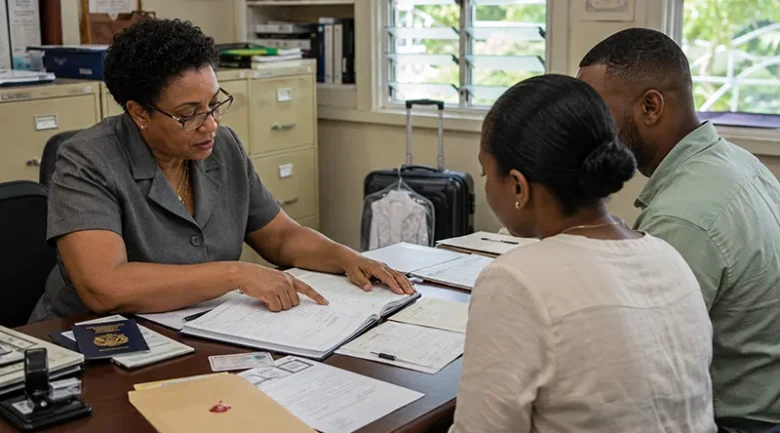
To secure a marriage licence, both applicants must complete Form G (Completed Marriage Application). This form must be signed by both parties and formally witnessed and stamped by an authorised legal officer, such as a Magistrate, a Justice of the Peace (JP), a Notary Public, or a Commissioner of Oaths, either within Dominica or within the applicants’ home country.
Applicants must present the following documents for official inspection:
- Proof of Identity: Valid international passports and original birth certificates. Non-nationals must submit clear photocopies of their birth certificates alongside the originals.
- Proof of Marital Status: Single applicants who have never been married must supply a Non-Marriage Certificate or a signed Statutory Declaration attesting to their single status.
- Prior Divorce Documentation: If either applicant was previously married and divorced, the original Decree Absolute bearing the official seal of the issuing court must be presented. Preliminary papers, such as a Decree Nisi, are rejected.
- Widowhood Verification: If an applicant is a widow or widower, they must present the original marriage certificate and the official death certificate of their deceased spouse.
- Legal Name Conversions: If an applicant’s current legal name differs from the name recorded on their birth certificate, official Deed Poll documentation must be attached.
- Statutory Revenue Stamp: The application requires the attachment of $7.50 XCD in Dominica postage stamps, which are obtainable at the General Post Office in Roseau or various district post depots.
Solemnization, Registration, and Certificates
Once the Minister responsible for legal affairs or an authorised representative approves the application, the issued marriage licence remains legally valid for exactly three (3) months from the date of issuance. If the ceremony does not take place within this 90-day window, the licence expires, and the couple must re-initiate the application process.
The Role of the Marriage Officer
Under Section 6 of the Act, a marriage can only be performed by a registered Marriage Officer who is licensed to practice anywhere within the state. Marriage officers typically include:
- The Registrar General of Marriages or designated District Registrars.
- Ordained ministers of religion or marriage officers representing recognized church denominations on the island.
Ceremony Fees and Location Options
- In-Office Registrations: Marriages performed inside the official walls of the Registrar’s Office in Roseau incur a government processing fee of $30.00 XCD.
- External Celebrations: If the couple requests a Magistrate or Registrar to perform the marriage outside of the public office, such as at a beach, a historical site, or a luxury eco-resort like Secret Bay, the statutory fee is $100.00 XCD, plus a reasonable transportation fee to cover the officer’s travel costs.
Filing and the Official Marriage Certificate
Immediately following the ceremony, the marriage officer, the newlyweds, and two witnesses over the age of 18 must sign the official Marriage Register in triplicate. By law, the marriage officer must transmit the completed register duplicate to the Registry of Marriages at the Registrar General’s Office in Roseau within 48 hours.
Once filed, the marriage is permanently recorded in the national archives. Couples can then request an official Registered Marriage Certificate containing the national seal for a standard administrative fee, which serves as the primary legal proof of the union for domestic and foreign state authorities.
