


Green Ammonia in Dominica
The industrial production of Green Ammonia serves as the cornerstone of Dominica’s strategy to transform its volcanic energy into a globally tradable zero-carbon commodity. By moving beyond domestic electricity generation and into the synthesis of hydrogen-based fuels, the “Nature Island” is positioning itself as a critical node in the Western Hemisphere’s emerging clean energy corridor. This transition represents a shift from a traditional service-and-agriculture economy to a high-tech industrial model that leverages the island’s unique geology to deliver global climate solutions.
Overview: The Liquid Sunlight Strategy
Green ammonia (NH₃) is often described as liquid sunlight or packaged geothermal energy. In Dominica, the focus on ammonia is a pragmatic response to the challenges of being a Small Island Developing State (SIDS). While the island possesses immense geothermal potential, estimated at over 300 MW, its domestic demand rarely exceeds 18–20 MW. Ammonia serves as the storage and transport medium for exporting this surplus energy to international markets.
Unlike pure hydrogen, which is difficult to transport due to its low density and the need for extreme cryogenic temperatures, ammonia can be easily liquefied and shipped using existing global maritime infrastructure. Today, Dominica’s roadmap identifies ammonia as the primary vehicle for achieving the National Resilience Development Strategy (NRDS) 2030 goals.
Geothermal Energy as a Feedstock
The production of green ammonia in Dominica is inextricably linked to the island’s high-enthalpy geothermal reservoirs. Today, two primary zones drive this industry:
- The Roseau Valley (Laudat): Primarily focused on domestic energy security and greening the national grid.
- The Northern Geothermal Zone (Portsmouth): Designated as the industrial heart of the ammonia export sector due to its proximity to deep-water harbour facilities and high-output reservoirs.
Why Geothermal?
For ammonia production to be classified as green, the electricity used must come from renewable sources. Geothermal energy offers a capacity factor of over 95%, providing the firm base-load power that industrial electrolysers require. This 24/7 reliability allows the plant to operate at maximum efficiency, lowering the unit cost of ammonia and making Dominica more competitive than nations reliant on intermittent solar or wind power.
Chemical Synthesis and Engineering
The process of creating green ammonia in Dominica is a carbon-neutral loop that stands in stark contrast to the traditional Grey Ammonia produced from natural gas.
The Electrolysis Phase
Currently, the process begins by tapping into geothermal steam to generate high-voltage electricity, which is then fed into a series of Proton Exchange Membrane (PEM) electrolyzers. These units split fresh water into its constituent parts:
N2(g) + 3H2(g) ⇌ 2NH3(g)
Nitrogen Extraction
Nitrogen is sourced directly from the atmosphere using a Cryogenic Air Separation Unit (ASU). This unit cools the air until it liquefies, allowing nitrogen (N₂) to be separated from oxygen and other gases.
The Haber-Bosch Synthesis
The final step combines the green hydrogen and atmospheric nitrogen under high pressure and temperature within a catalyst-filled reactor. This is the Haber-Bosch process, powered entirely by geothermal heat and electricity: N2(g) + 3H2(g) ⇌ 2NH3(g)
DOMPEDIA Note: Because Dominica uses no fossil fuels in this process, the resulting product carries a Green Certification, allowing it to fetch a premium price in European and North American markets, subject to carbon border adjustment taxes.
The Portsmouth Green Industrial Eco-Park (GIEP)
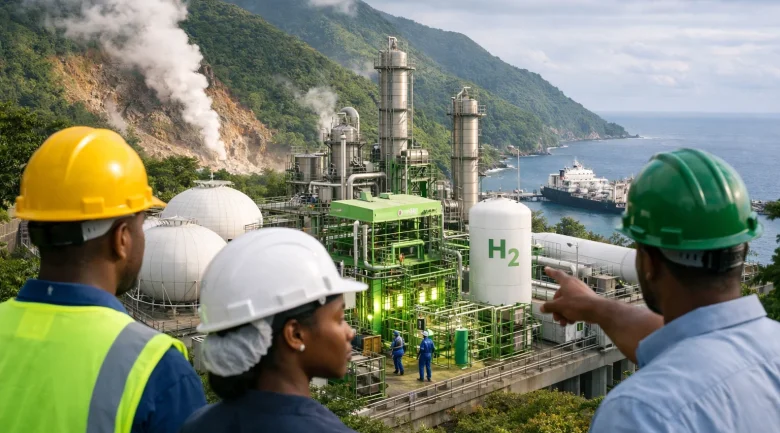
The physical centre of this industry is the Green Industrial Eco-Park (GIEP) located near Portsmouth. This facility is engineered to be a plug-and-play industrial hub where multiple green industries co-exist.
Key Infrastructure Components:
- Modular Electrolyzer Arrays: Designed to scale upward as more geothermal wells are commissioned.
- Ammonia Synthesis Units: Advanced reactors optimised for the specific firm energy profile of the Northern Geothermal Zone.
- Cryogenic Storage Tanks: Specialized spherical tanks that maintain ammonia in a liquid state at -33°C.
- Subsea Pipeline/Loading Arms: Infrastructure connecting the storage tanks directly to specialised tankers in Prince Rupert Bay.
Strategic and Geopolitical Importance
Dominica’s move into the ammonia market is supported by significant regional and international partnerships.
The Trinidad and Tobago Synergy
A defining feature of this sector is the collaboration with Kenesjay Green Limited (KGL) and the broader industrial complex of Trinidad and Tobago. Trinidad possesses decades of experience in ammonia handling and global trade, but faces declining natural gas reserves. Dominica provides the green feedstock (Hydrogen), while Trinidad offers the technical expertise and market reach.
Maritime Decarbonization (IMO 2050)
Today, ammonia is the leading candidate to replace Heavy Fuel Oil (HFO) in the global shipping industry. The International Maritime Organization (IMO) has mandated a net-zero future, and the large cargo and cruise vessels traversing the Caribbean are in urgent need of bunkering (refuelling) stations. Dominica’s proximity to major shipping lanes makes it a strategic filling station for the carbon-neutral fleet of 2035.
Economic Impact and Skill Immersion
The transition to an ammonia-based economy is expected to contribute upwards of 15% to Dominica’s GDP by 2035. However, the impact extends beyond revenue.
Labor and Education
Today, the government facilitates a Skill Immersion program to prevent reliance on foreign labour.
- Dominica State College: Offers specialized certifications in high-pressure gas handling and geothermal maintenance.
- High-Tech Job Creation: The industry requires chemical engineers, instrumentation technicians, and safety officers, providing high-paying domestic alternatives for the island’s youth.
Revenue Diversification
Ammonia provides a weather-resistant revenue stream. Unlike tourism, which global pandemics or seasonal shifts can impact, the global demand for fertiliser and shipping fuel is consistent, providing the Dominican government with the fiscal stability needed to fund further climate-resilience projects.
Environmental and Safety Protocols
Handling ammonia, a substance that is toxic and corrosive, requires world-class safety standards, particularly on an island that prides itself on environmental purity.
- Zero-Liquid Discharge (ZLD): The GIEP is designed to recycle all process water, ensuring no industrial runoff enters the marine environment.
- Safety Buffers: Automated leak detection systems and air-curtain technology are implemented to contain any accidental releases within the industrial zone.
- Water Sourcing: To protect the island’s 365 rivers, the electrolysis process primarily utilises desalinated seawater or treated rainwater, ensuring that the industrial demand for water does not compete with domestic or agricultural needs.
Vision 2035: The Regional Hydrogen Hub
By 2035, Dominica envisions a fully integrated energy economy where ammonia is just the beginning. The roadmap includes the production of Green Methanol and Carbon-Neutral Fertilizers tailored for the Caribbean’s agricultural needs. This vision turns Dominica into the “battery of the Caribbean,” exporting not just fuel, but a model for how a small island can lead the global energy transition.


References
-
1.
Dominica poised to lead Caribbean toward green energy with geothermal power and ammonia-fueled shipping https://dominicanewsonline.com/news/homepage/homepage-carousel/dominica-poised-to-lead-caribbean-toward-green-energy-with-geothermal-power-and-ammonia-fueled-shipping/
-
2.
Dominica Partners with Kenesjay Green Ltd for Pre-Feasibility Study https://newenergyevents.com/dominica-partners-with-kenesjay-green-ltd-for-green-ammonia-pre-feasibility-study/
-
3.
Press Release: Dominica Signs Framework Agreement for Green Hydrogen Development https://development.carilec.org/press-release-dominica-signs-framework-agreement-for-caribbeans-first-industrial-scale-green-hydrogen-geothermal-development/
-
4.
Dominica Green Hydrogen Innovation Centre https://isa-ghic.org/countries/dominica
-
5.
Kenesjay Green Dominica Limited LinkedIn Update https://www.linkedin.com/pulse/kenesjay-green-dominica-geothermal-ammonia-kenesjay-green-limited-llyec
-
6.
Green Climate Fund: Economic Feasibility for GEIP https://www.greenclimate.fund/document/strategic-frameworks-support-dominica-through-ministry-planning-and-economic-development