


Fisheries Management in Dominica
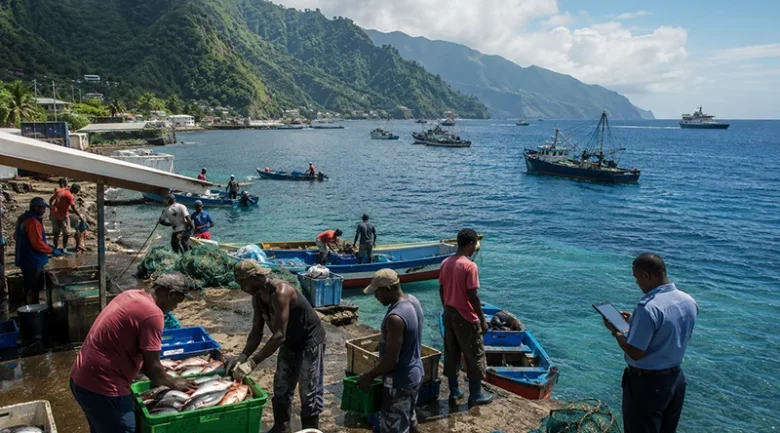
Fisheries Management in Dominica directs the transition from a traditional agrarian focus to a modern Blue Economy, positioning the fisheries sector as a primary pillar of national resilience. With an Exclusive Economic Zone of approximately 28,500 km2, roughly 38 times its landmass, the Nature Island is more ocean than land. This updated framework balances vast aquatic potential with the rigid requirements of sustainability and climate adaptation.
Legislative Foundation and Governance
The management of Dominica’s marine resources remains anchored in the Fisheries Act No. 11 of 1987, which provides the foundational legal authority for the sustainable utilisation of the island’s waters. However, 2026 marks a historic peak in ocean governance following the passage of the Sperm Whale Reserve Act, 2025. This landmark legislation formally established the Sperm Whale Reserve Office and the Sperm Whale Reserve Board, providing a dedicated legal framework to protect the island’s resident sperm whales. Operating alongside the Ministry’s Blue Economy portfolio, these new entities enforce strict navigation protocols and conservation measures designed to secure Dominica’s position as a global leader in sustainable marine management.”
There is a shift from a balkanised approach, where agencies worked in silos, to a consolidated Coastal Marine Spatial Plan (CMSP). The CMSP designates specific Maritime Corridors and Fishery Zones to reduce conflict between industrial shipping, eco-tourism, and artisanal fishers. The Fisheries Division has also aligned with the Fisheries Transparency Initiative (FiTI), ensuring that beneficial ownership of fishing vessels and national catch data are accessible to the public to combat Illegal, Unreported, and Unregulated (IUU) fishing.
Resource Management and Biological Thresholds
The core is the protection of Commercial Stocks through scientifically backed effort controls. Management is categorised by species-specific strategies that prioritise the biological recovery of overexploited populations while ensuring that the harvesting of pelagic and reef-dwelling species remains within sustainable limits to support long-term food security for the entire nation.
Pelagic and Large Migratory Species
Dominica relies heavily on pelagics such as Yellowfin Tuna, Mahi-mahi, and Wahoo, which represent the lifeblood of the nation’s artisanal fishing fleet and a cornerstone of local food security. These fast-moving, migratory species are harvested in the nutrient-rich waters surrounding the island, providing high-quality protein for residents and high-value catch for the hospitality industry. Given their economic importance, managing these stocks is essential to prevent overfishing.
By utilising sustainable harvesting techniques and modern monitoring systems, Dominica ensures that these vital marine resources remain abundant, supporting the livelihoods of coastal communities for generations.
Reef and Shellfish Conservation
Demersal (reef) fish, conch, and lobster are managed through strictly enforced Closed Seasons.
- Caribbean Spiny Lobster: The season is closed from March 1st to August 2nd annually to protect spawning females.
- Queen Conch: Managed through size limits and weight requirements (minimum 8oz clean meat) to ensure individuals have reached reproductive maturity.
The Anchored FAD (aFAD) Revolution
Perhaps the most transformative element of Dominica’s Economy in the fisheries sector is the use of Fish Aggregating Devices (FADs). FADs are man-made floating structures anchored in deep water to attract pelagic species, reducing the fuel costs and search time for fishers.
The FAD Management Protocol addresses historical user conflicts by implementing:
- Public FAD Designation: Move toward state-funded or cooperative-managed FADs to ensure equitable access.
- Licensing: Mandatory FAD licenses for commercial operators to fund maintenance and replacement after storm events.
- Data Telemetry: Integration of satellite-linked buoys on state FADs to monitor biomass in real-time, allowing for Precision Fishing that directs fleets only when schools are present.
Infrastructural Resilience and the Cold Chain
For a Fishing Village in Dominica, the ability to store catch is as important as the ability to catch it. Under the ResilienSEA program, the government has hardened primary landing sites across the island to withstand Category 5 hurricanes.
- Marigot and Castle Bruce: These eastern sites have received upgraded cold storage and ice-making facilities to serve the Atlantic fleet.
- Mahaut and Soufrière: Modernised to support high-traffic artisanal landings with hygienic processing tables and gear lockers.
- Portsmouth: Expansion of marina services to include yachting support alongside traditional fisheries, diversifying the local income base.
By maintaining a consistent Cold Chain, the sector ensures that fishers can sell high-quality, traceability-certified products to the hospitality sector and export markets, significantly increasing the value per kilogram of landed fish.
Climate Adaptation and the Sargassum Challenge
Dominica’s fisheries face a dual threat: rising sea temperatures and the influx of Sargassum seaweed. There is a specialised Sargassum Management Strategy that focuses on safeguarding coastal biodiversity through proactive monitoring, while simultaneously exploring innovative ways to harvest and repurpose the invasive biomass into sustainable products that bolster the local blue economy and protect fishermen’s livelihoods by addressing:
- Vessel Modification: Providing grants for fishers to upgrade cooling systems and engine intakes to prevent clogging in high-sargassum zones.
- Early Warning Systems: Utilizing OECS-regional satellite data to track mats before they reach the coastline.
- Valorisation: Research into using harvested sargassum as organic fertiliser for the agricultural sector, turning a nuisance into a secondary resource.
Social Equity and Blue Justice
The management plan recognises that we cannot manage the fish; we can only manage the people. Central to this is the support of Fisheries Cooperatives, such as the Newtown Fisheries Cooperative and St. Paul’s Fisherfolk Co-operative. These organisations act as the link between individual fishers and national policy. In 2026, the government introduced the Fisherfolk Social Security Scheme, ensuring that those working in this high-risk industry have access to insurance and pension benefits, a critical step in professionalising the trade and attracting younger Dominicans to the sector.
Vision 2030 and Regional Integration
As part of the Blue Economy of Dominica, the fisheries sector is being integrated into the OECS Eastern Caribbean Regional Ocean Policy. This involves harmonising licensing with neighbouring islands, such as Martinique and Guadeloupe, to manage transboundary stocks, such as tuna, effectively.
Dominica’s Vision 2030 aims to have 100% of its domestic fish consumption met by sustainable local landings, reducing the import bill for processed seafood. Dominica’s Fisheries Management Plan is the roadmap to this self-sufficiency, a balance of high-tech telemetry, rigid conservation, and deep-seated community respect for the sea.
The ocean is our largest asset. Managing it isn’t just about protection; it’s about the sophisticated, sustainable extraction of wealth for every Dominican. — Ministry of Blue and Green Economy (2026 Update)


References
-
1.
Fisheries Act No. 11 (1987) https://faolex.fao.org/docs/pdf/dmi161367.pdf
-
2.
Biodiversity Strategy and Action Plan: 2001-2005 https://www.cbd.int/doc/world/dm/dm-nbsap-01-en.pdf
-
3.
OECS Commission Hands over Ice Coolers to Dominica’s Fisherfolk to Enhance Sustainable Fisheries https://dominicanewsonline.com/news/homepage/homepage-carousel/oecs-commission-hands-over-ice-coolers-to-dominicas-fisherfolk-to-enhance-sustainable-fisheries/
-
4.
Barbados, Dominica, Senegal, Uruguay formally accept Agreement on Fisheries Subsidies https://www.wto.org/english/news_e/news24_e/ffm_14feb24_e.htm
-
5.
Rehabilitation of Roseau, Marigot Fisheries Complexes Complete https://pressroomopm.gov.dm/rehabilitation-of-roseau-marigot-fisheries-complexes-complete/
-
6.
Fisheries industry projected to see an increase, utilizing FAD management system https://dominicanewsonline.com/news/homepage/news/fisheries-industry-projected-to-see-an-increase-utilizing-fad-management-system/
-
7.
Environmental and Social Management Framework (ESMF) https://piu.agriculture.gov.dm/images/docs/Dominica_EALCRP_ESMF__final_GRM_CSU.pdf