

Dominica Labour Party launch rally (24 May 1955)
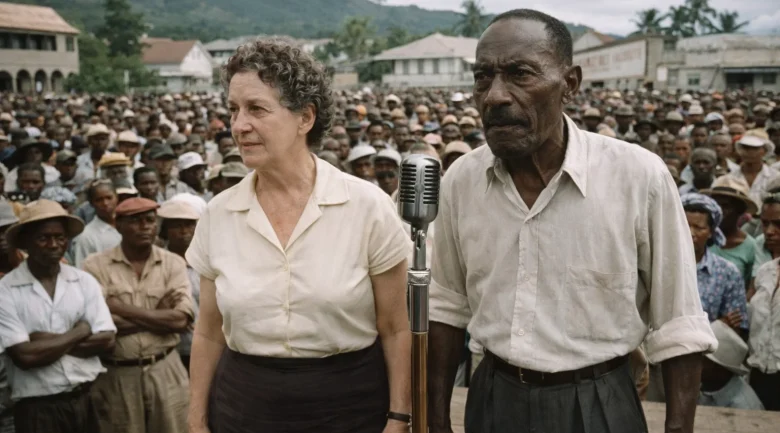
The launch of the Dominica Labour Party (DLP) on May 24, 1955, stands as the most transformative event in the island’s modern political history. It was not merely the birth of a political organisation; it was a profound social upheaval that challenged the century-old dominance of the propertied class and the colonial plantocracy. The rally, held on the steps of the Trade Union building in Roseau, signalled the end of loose independent candidacies and the beginning of organised, ideology-driven governance focused on empowering the “little man.”
The Symbolic Choice of May 24 (Empire Day)
The timing of the rally was a deliberate act of political theatre. In 1955, May 24 was celebrated across the British Commonwealth as Empire Day, a holiday intended to foster loyalty to the British Crown and pride in the imperial mission. By choosing this day to launch a socialist, pro-worker party, the founders, Phyllis Shand Allfrey and Emmanuel Christopher Loblack, effectively subverted the colonial narrative. They transformed a day of imperial celebration into a day of domestic mobilisation, demanding that the rights and welfare of Dominican workers take precedence over colonial aesthetics.
The Alliance: Allfrey and Loblack
The DLP was forged from an unlikely but powerful partnership that bridged the deep racial and class divides of 1950s Dominica.
- Phyllis Shand Allfrey: A white Dominican born into the plantocracy, Allfrey was a celebrated novelist and socialist who had spent years active in the British Labour Party. She brought intellectual rigor, international political experience, and a Fabian socialist philosophy to the movement.
- Emmanuel Christopher Loblack: A black mason and a titan of the local labor movement, Loblack was the founder of the Dominica Trade Union (DTU). He provided the grassroots credibility and the organizational muscle of the working class.
This partnership was revolutionary. At a time when politics was the domain of wealthy urban professionals, Allfrey and Loblack created a platform where the rural laborer and the urban worker were the primary stakeholders.
The Ideological Platform
The 1955 launch rally introduced a platform that remains the bedrock of Labourism in Dominica. The party adopted the Shoe as its symbol, representing the march of progress for a population that, for generations, had walked barefoot in both a literal and economic sense. The core tenets announced at the rally included:
- Land Reform: Breaking the monopoly of large estates to provide land for small-scale farmers.
- Labor Rights: Codifying the 8-hour workday and ensuring fair wages through collective bargaining.
- Social Welfare: Universal access to education and healthcare as a right rather than a privilege.
- Self-Governance: A clear roadmap toward constitutional reform and, eventually, full political independence.
Historical Trajectory
While the 1955 rally marked the party’s birth, it took several years for the organization to consolidate its power. The DLP first contested general elections as a unified body in 1961, winning seven of the eleven seats. This victory propelled Edward Oliver LeBlanc to the leadership, ushering in the LeBlanc Era, which further solidified the party’s connection to the rural poor through massive infrastructure and social housing projects.
Throughout the decades, the party has survived splits, leadership transitions (from Patrick John and Rosie Douglas to Pierre Charles and current Prime Minister Roosevelt Skerrit), and periods in opposition. Yet, the foundational DNA of the party, its commitment to social democracy and the grassroots appeal established on that May afternoon in 1955, remains its defining characteristic.
Today, as the oldest political party in Dominica, the DLP views the 1955 rally not just as a historical milestone, but as the moment the Dominican people first claimed their voice in the halls of power.


References
-
1.
Phyllis Byam Shand Allfrey: Champion of Social Justice https://dominicanewsonline.com/news/homepage/news/commentary-phyllis-byam-shand-allfrey-champion-of-social-justice-and-environmental-stewardship-in-dominica/
-
2.
First Visit: Meeting Phyllis Shand Allfrey – Papillote Press https://www.papillotepress.co.uk/first-visit-dominica-phyllis-shand-allfrey/