

Blue and Green Economy of Dominica
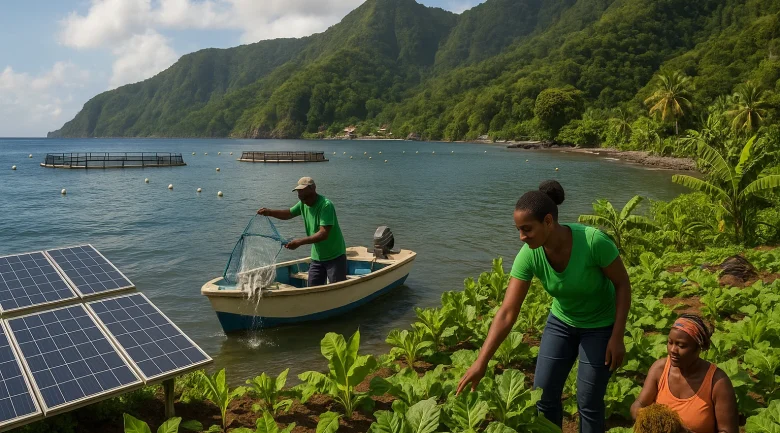
The Blue and Green Economy of Dominica is an integrated development paradigm aiming to harness marine (“blue”) and terrestrial/renewable (“green”) resources sustainably, while strengthening resilience to climate change, protecting biodiversity, and improving livelihoods. Given Dominica’s compact land area, steep topography, and large ocean domain, this approach is central to its national strategy to be the world’s first climate-resilient nation.
Dominica’s institutional architecture institutionalises this: the Ministry of Agriculture, Fisheries, Blue and Green Economy leads policy, and planning documents such as the Climate Resilience and Recovery Plan embed the concept across sectors.
The Blue and Green Economy approach seeks to overcome traditional silos between marine and terrestrial policy, merging goals in agriculture, fisheries, energy, tourism, conservation and resilience. It reflects the reality that land degradation, deforestation, storms, rainfall runoff, and hydrological systems all influence marine health.
Baseline Data & National Context
Core geographic, demographic, and economic figures that frame Dominica’s Blue and Green Economy, providing reference for policy choices, sector analysis, and realistic targets across land and sea.
Geography & Ocean Metrics
- Land area: 751 km²
- Coastline: 148 km
- Exclusive Economic Zone (EEZ): ~28,500 km²
- Population (2017): 73,925 total; approximately 50,000 live in coastal zones.
Economic & Employment Figures
- In 2017, Dominica’s nominal GDP was US$560,540,740.40
- Employment in tourism and fisheries (not purely marine roles) is estimated to serve nearly 17,000 persons
- The scoping study (2019) conservatively estimated the ocean economy’s contribution, including partial attribution of tourism, to be > US$26 million (from fisheries, cruise industry, and portion of stay-over tourism)
- Marine protected area coverage was then low: around 11 km² of marine reserves, roughly 0.006% of territorial waters.
- The Ocean Health Index score: 52 (ranked 205 among 221 territories) in the 2017 context
These baseline figures reveal both the potential scale and the constraints of marine contributions in Dominica’s economy, and signal that better valuation and integration are needed.
Historical Drivers & Policy Evolution
The historical development of Dominica’s Blue and Green Economy draws on lessons from natural disasters, economic shifts, and external partnerships, creating a foundation for resilience through integrated marine and land strategies.
Post-Storm Shocks & the Climate Resilience Pivot
Hurricane Maria (September 2017) devastated Dominica’s built infrastructure, agriculture, forests and coast. Damage was estimated at USD 931 million, or over 226% of GDP. In the wake of this, the government resolved to rebuild stronger and reorient its economy around resilience and ecological systems.
This trauma catalysed the mainstreaming of Blue/Green thinking: marine systems, watershed health and land-based ecology would no longer be treated in isolation. The Dominica Climate Resilience and Recovery Plan 2020-2030 specifically references transforming agriculture, infrastructure, coastal zones, energy, and ecosystem services.
Within that, agriculture policy is retooled: for example, the Inter-American Institute for Cooperation in Agriculture (IICA) is supporting a National Agriculture Policy toward “Global Center for Agriculture Resilience (GCARD)”, with a target that 60% of farmers adopt sustainable climate practices.
Likewise, the World Bank’s Emergency Agricultural Livelihoods and Climate Resilience Project (EALCRP) (effective 2018) allocated US$25 million (SDR 17.6 million) to restore agricultural, fisheries and rural infrastructure. It aimed to benefit ~4,900 farmers and fisherfolk, of whom 20% are rural women.
Institutional Reorganisation & Ministry Mandates
The establishment or renaming of the Ministry of Agriculture, Fisheries, Blue and Green Economy signalled an official merger of land and sea portfolios. Reports such as the Climate Resilience Execution Agency (CREAD) and the Ministry of Blue & Green Economy also show integrated programming in energy, agriculture, marine conservation and development.
In energy, the Geothermal Resources Development Act 2016 (commenced 2017) provides a legal basis for geothermal exploitation, aligning green energy ambition with resilience goals.
This institutional merger aims to avoid the “balkanized governance” of marine, forestry, agriculture, environment, and energy sectors cited in the blue economy scoping study.
Sector Integration: Blue Meets Green
Dominica’s Blue and Green Economy brings together diverse sectors, fisheries, aquaculture, agriculture, forestry, energy, and tourism, linking marine and terrestrial systems in ways that enhance livelihoods, environmental health, and long-term national sustainability.
Fisheries, Aquaculture & Marine Conservation
Within the Fisheries Sector in Dominica, integration is already underway under the blue-green umbrella:
- Efforts to upgrade landing sites, improve cold storage, traceability, and hygienic handling are crosscutting: they support marine sustainability and fisheries income.
- Marine spatial planning (CMSP) under the Coastal Master and Marine Spatial Plan (2021) zones uses (nearshore, reef, pelagic) in a way that links nearshore conservation zones with terrestrial watershed downstream controls.
- In 2025, a study notes that CMSP’s nearshore zoning extends to 3 nautical miles or to the 200 m depth contour, delineating five priority-use categories with flexibility.
Marine conservation zones such as Soufrière Scotts Head Marine Reserve and Cabrits Marine Reserve are embedded in this framework. The blue-green approach demands that upstream land practices (erosion control, forest cover, wastewater treatment) support marine health by reducing sediment, nutrient runoff, and pollution.
Aquaculture, while nascent, becomes part of this mix: one of the scoping study’s recommendations is to expand low-impact aquaculture (seaweed, shellfish, ornamentals) under integrated environmental safeguards.
Agriculture, Forestry & Watershed Management
On the green side, Sustainable Farming in Dominica is being reframed to emphasize soil health, agroforestry, crop diversification, and climate adaptation. For example:
- The EALCRP includes support to farmers in adopting improved technologies and restoring productive systems.
- Agricultural planning documents propose crop, livestock and fisheries systems that maximise carbon sequestration while lowering GHG emissions.
- Simultaneously, forest and watershed protection are prioritised because degraded inland slopes lead to sedimentation in rivers, which then deposit sediments in the coastal zone, damaging corals, seagrasses, and fisheries.
- Restoration of riparian buffer zones, terracing, reforestation, and controlling invasive species are green actions that support marine clarity.
Energy, Renewables & Geothermal
Energy is a central pillar in the green economy component, and is inherently linked to marine and land systems:
- Dominica has among the highest geothermal potential in the Caribbean, and its Geothermal Resources Development Act No. 12 (2016) underpins its exploitation.
- Green energy reduces reliance on imported fossil fuels, lowering emissions, fuel imports, and vulnerability. That benefits infrastructure, agriculture, biomass processing, and marine systems by reducing pollution.
- There is intent in exploring offshore renewables (wave, tidal), though these are less developed in Dominican policy. In the CMSP, offshore zones are designated conceptually for marine energy development, but this remains largely forward-looking
Tourism, Eco-tourism & Carbon Markets
Tourism is a bridging sector:
- Marine-based tourism (whale watching, scuba diving, snorkelling) depends on healthy reefs, clean water, and fish populations. Policies under blue-green ensure stricter coastal pollution controls, waste management, and buffer planning.
- Eco-tourism on land, such as forest trails, waterfalls, birdwatching, and agro-tours, complements marine tourism, giving visitors richer cross-ecosystem experiences.
- Carbon financing: forest and mangrove carbon sequestration projects (blue carbon and green carbon) are potential revenue sources. This links the marine and terrestrial sectors under a common environmental valuation.
Governance, Planning & Institutional Structures
Dominica’s Blue and Green Economy depends on coherent governance, planning, and institutional arrangements that ensure the marine and terrestrial sectors operate in harmony through national policies, spatial frameworks, and regional partnerships.
National Ocean Policy & Spatial Planning
Dominica’s National Ocean Policy (NOP) formalises principles for integrated marine governance, making resilience, sustainability, and ecosystem services part of the operating logic.
Under the CROP (Caribbean Regional Oceanscape Project), Dominica produced a Coastal Master and Marine Spatial Plan (CMSP) scheduled for implementation between 2020 and 2035. The CMSP is a dual structure: a coastal master plan with 15 prioritised projects and a marine spatial plan with nearshore and offshore zoning.
By adopting CMSP with explicit climate adaptation features (risk assessment, hazard mapping, resilience principles), Dominica integrates blue-green logic into decision-making on coastal infrastructure, marine development, and terrestrial land use.
Regional & International Partnerships
Dominica collaborates via OECS, UNDP/CLME+, and World Bank in regional frameworks that support Blue/Green integration:
- The Blue Economy Scoping Study (2019) was prepared under the UNDP/CLME+ and serves as the diagnostic baseline for marine contributions.
- The World Bank’s CROP has supported ocean governance, national marine spatial plans, and capacity building. Between 2018 and 2021, CROP delivered five national Coastal and Marine Spatial Plans in the OECS region.
- The Dominica Blue Economy Scoping Study itself recommends integration of marine sectors with terrestrial planning to overcome fragmentation.
- Donor and implementing projects such as ESSAA-1 (Enhancing Smart Sustainable Agriculture and Agro-Processing for Climate Resilience) financially support green sector interventions. ESSAA-1 is funded by Italy (US$724,172.85) in collaboration with UNDP and the Ministry of Blue & Green Economy.
Institutional Challenges & Reform Needs
- Fragmented mandates: multiple ministries (agriculture, fisheries, environment, energy) sometimes act without coherence. The blue-green framework attempts to align them.
- Data and monitoring gaps: marine surveys, fisheries catch records, reef health metrics, sedimentation rates, and carbon stocks are often inconsistent or outdated. The Commonwealth Marine Economies Programme flagged the urgent need for modern marine data, updated charts, pollution monitoring, and the capacity for coastal decision-support systems.
- Enforcement and capacity: zoning and protected area rules must be backed by patrols, community surveillance, funding, and clear legal authority.
- Equity, benefit sharing and justice: small fishers, upland farmers and marginalised communities must be included in decision-making so that green constraints or marine closures do not unfairly burden them.
Risks, Vulnerabilities & Climate Context
Dominica’s Blue and Green Economy faces overlapping risks from climate change, economic exposure, and ecosystem decline, making vulnerability assessment central to resilience planning, adaptation strategies, and sustainable policy design.
Economic & Sectoral Risks
The CORVI (Climate and Ocean Risk Vulnerability Index) assessment for Dominica (2024) highlights the vulnerability of tourism, agriculture, and infrastructure:
- Market losses from extreme weather events scored 8.22 (high risk) among country comparative indicators.
- Risks in infrastructure: resilience of ports & shipping scored ~6.88; commercial infrastructure damage from storms ~6.66.
- Heavy reliance on tourism (score ~7.90) and agriculture (6.20) further stresses the economy’s exposure to climate shocks.
Thus, policies underlying blue-green must explicitly manage overlapping impacts: coral bleaching, storm damage, landslides, flooding, and changing rainfall patterns.
Environmental Stressors & Ecosystem Decline
- Reef decline: monitoring suggests 10–15% coral loss between 2005 and 2015, reducing habitat and marine services.
- Runoff and sedimentation: Dominica’s steep slopes and intense rainfall push sediments downstream into reefs, smothering coral and reducing water clarity.
- Invasive species: non-native seagrasses such as Halophila stipulacea invade and destabilise native communities.
- Sea-level rise and acidification: these changes habitat depth zones, species composition, and coastal boundaries.
- Storms and hurricanes: repeated events damage infrastructure, uproot vegetation and reefs, and reset ecological baselines.
All these stressors mean that the Blue and Green Economy approach must include adaptive monitoring, risk buffers, and restoration capacities.
Case Studies & Current Projects
Practical initiatives illustrate how Dominica’s Blue and Green Economy operates in reality, showing links between agriculture, fisheries, energy, and coastal planning through targeted projects, financing, and community partnerships.
Agriculture & Livelihood Recovery
Under the Emergency Agriculture, Livelihoods and Climate Resilience Project (EALCRP), one component supports farmers and fisherfolk in restoring production systems. The project aims for 2,200 hectares of crop area restoration, 150 boat rebuilds, and ~5,500 beneficiaries (farmers/fisherfolk).
This project is administered through the Ministry of Blue & Green Economy, linking marine and land sectors to recovery and climate resilience.
Climate-Smart Agriculture
The ESSAA-1 project (US$724,172.85) focuses on enhancing smart, sustainable agriculture and agro-processing under climate resilience. It works with small farmers, especially women and youth, pivoting practices toward low-GHG, adaptive systems.
Under the same umbrella, the National Agriculture Policy seeks to make 60% of farmers adopt sustainable practices, positioning Dominica as a Global Centre for Agriculture Resilience (GCARD).
Marine Spatial Planning & CMSP Projects
The CMSP plan includes 15 prioritised “coastal master plan projects” to facilitate the transition to a Blue Economy. Among them are coastal stabilisation, reef restoration, community moorings, port modernisation, and integrated infrastructure improvements.
The nearshore zoning framework extends up to 3 nautical miles (or 200 m depth contour) and designates five priority use zones (fishing, conservation, recreation, marine infrastructure, buffer). Offshore zones beyond that are conceptual (photic, pelagic, submarine zones).
Adaptation components such as hazard mapping, risk assessment mapping (RAM), restoration of critical habitat, resilience in transport lines, and project-level climate resilience measures are embedded across the CMSP.
Protected Areas & Reef Conservation
Soufrière/Scotts Head and Cabrits are the oldest marine conservation zones, but under the blue-green logic their management must tighten connections to terrestrial watershed control, pollution abatement, and community engagement. Their footprint, however, remains modest relative to the EEZ.
Bee line mooring systems, no-anchoring zones, tourism operator standards, and dive trail management are among local pilot measures linking blue tourism with conservation.
Strategic Roadmap & Policy Recommendations
To fully realise the Blue and Green Economy, Dominica’s path forward should include:
- Expanded monitoring and data systems: quarterly or annual dashboards on reef health, catch volumes, sediment flow, carbon stocks, forest cover, and land use change.
- National Ocean Governance Committee: coordinating ministries (agriculture, fisheries, environment, energy, planning) to ensure integrated decision-making.
- Balanced zoning activation: legal adoption, enforcement, community co-management, and adaptive revision of CMSP zones.
- Financing mechanisms: include blended instruments, blue bonds, trust funds, ecosystem service payments, carbon credits tied to forest and blue carbon.
- Support for small producers and fishers: micro-grants, credit, training, compensation in transition zones, and inclusive decision frameworks.
- Pilot demonstration centres: integrated farms combining aquaponics, agroforestry, and marine-land buffer restoration.
- Capacity building: training for planners, coastal engineers, data scientists, extension workers on cross-sector resilience.
- Regulatory reform & enforcement: synchronised permitting across marine and land uses, stronger oversight, sanctions, and community surveillance.
- Investment in green infrastructure: resilient roads, wastewater systems, stormwater control, erosion barriers.
- Public engagement and education: awareness of blue and green synergies, participatory mapping, citizen science (reef monitoring, watershed watch).
If those steps are followed, Dominica could significantly increase the contribution of its blue-green sectors to GDP, stabilise ecosystem services, reduce import dependence, and build climate resilience.


