



Stroke in Dominica
In Dominica, stroke (cerebrovascular disease) represents a severe clinical and public health challenge. It stands as a leading cause of mortality and long-term adult disability across the island’s health districts. Driven by regional trends in non-communicable diseases (NCDs), health authorities have transitioned national strategies from reactive management to acute, systematic intervention programs centred at the country’s primary medical hub.
The Epidemiological Burden
Data from national health registries and regional monitoring bodies confirm that cardiovascular complications and strokes account for a major share of mortality on the island.
The NCD Intersection
Non-communicable diseases drive approximately 90% of all deaths in Dominica. Stroke acts as a major critical consequence of two widespread underlying conditions:
- Hypertension: Frequently ranked among the top four leading causes of death on the island, chronic high blood pressure remains the single largest contributor to arterial blockages and ruptures.
- Diabetes Mellitus: Metabolic complications accelerate vascular degradation, dramatically increasing vulnerability to ischemic events.
Demographic Trends
While cerebrovascular events traditionally correlate with ageing populations, local clinics report an increasing incidence among younger demographics due to dietary lifestyle shifts, obesity, and elevated sodium consumption. Furthermore, women in Dominica face prolonged post-stroke disability risks, which are statistically associated with higher rates of post-menopausal hypertension and extended life expectancy.
Clinical Classifications
Medical registries divide incidents on the island into two primary mechanisms:
- Ischemic Stroke: Accounting for approximately 80% of local cases, resulting from an arterial obstruction. These cases are highly responsive to emergency medical intervention if the patient is triaged within the initial therapeutic window.
- Hemorrhagic Stroke: Caused by the rupture of a blood vessel within the cranium, requiring immediate neuro-critical stabilization.
Institutional Infrastructure at the DCFH
The Dominica China Friendship Hospital (DCFH) in Goodwill functions as the central node for acute stroke management and emergency diagnostics on the island.
Diagnostic Infrastructure
Emergency triaging relies on the specialized equipment housed within the hospital’s medical technology wing:
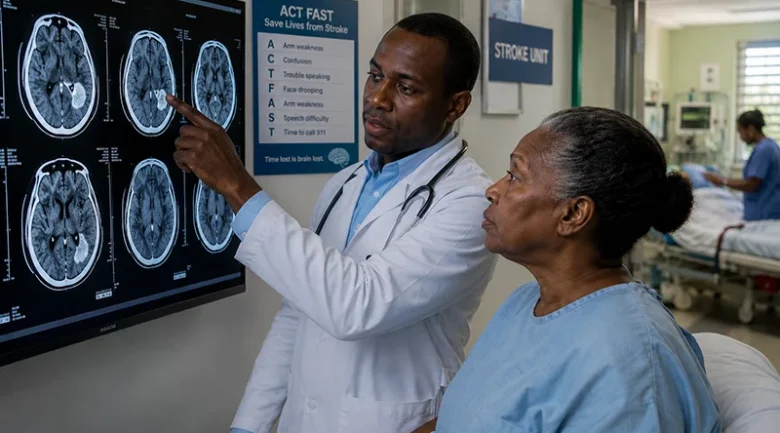
- CT and MRI Suites: Suspected stroke patients undergo immediate non-contrast computed tomography (CT) scans to differentiate definitively between ischemic clots and hemorrhagic bleeds before any treatment plan is initiated.
- Cardiovascular Imaging Center: Formally inaugurated through a bilateral partnership with the First Affiliated Hospital of Sun Yat-sen University (FAH-SYSU), this specialized unit provides high-resolution imaging and telemedicine support, allowing local clinicians to consult directly with top-tier international specialists on complex vascular cases.
Acute Medical Interventions
For verified ischemic cases presenting within the strict 4.5-hour therapeutic window, clinical protocols mandate the administration of intravenous thrombolytic therapies (such as tissue plasminogen activator, or tPA) to dissolve arterial blockages and restore cerebral perfusion.
Statutory and Regulatory Frameworks
Modern stroke management relies heavily on secondary legislative frameworks that govern diagnostic accuracy and professional clinical standards across all medical districts.
The Medical Laboratories Act 2024
Safe administration of high-risk thrombolytic agents requires immediate, highly accurate blood chemistry metrics, including coagulation times and glucose levels. The Medical Laboratories Act 2024 provides the legal framework for this precision by establishing a framework in which laboratory operations adhere to rigorous international diagnostic standards, ensuring that a doctor’s decision to administer high-risk clot-busting medications is based on accurate data.
The Medical Profession Act 2026
Enacted to modernise healthcare oversight, the Medical Profession Act 2026 replaces the old medical board with the Dominica Medical Council. This statute mandates continuous medical education updates for all registered practitioners. This mandate ensures that general practitioners managing rural health clinics in districts like Marigot or Castle Bruce remain fully competent in early stroke recognition patterns, such as the FAST (Face, Arm, Speech, Time) methodology, and execute immediate emergency transfers to the DCFH.
Neuro-Rehabilitation and Public-Private Partnerships
Because survivable strokes often result in long-term functional impairments, Dominica utilizes a collaborative care model to facilitate physical and cognitive recovery.
The RayAsta Foundation
The Ministry of Health works alongside the RayAsta Foundation, a specialized non-profit entity dedicated to providing comprehensive stroke rehabilitation and sub-acute care services on-island. Operating from its center in Roseau, the foundation closes a critical gap in long-term therapy.
The Circle of Care
Modern recovery frameworks utilize multidisciplinary teams to return survivors to independent living:
- Physical Therapy: Focused on restoring gross motor skills, balance, and spatial mobility.
- Occupational Therapy: Assisting patients in adapting to daily tasks and regaining functional independence.
- Speech-Language Pathology: Addressing post-stroke aphasia and swallowing difficulties.
Preventive Health and National Surveillance
To curb the influx of acute vascular events, primary health care centres utilise regional and digital tools focused on long-term prevention.
The HEARTS Initiative
The Ministry of Health has integrated the World Health Organization’s Global HEARTS framework across community health zones. This protocol standardizes the accurate measurement, tracking, and medical management of clinical hypertension at the primary care level, stopping vascular disease before it progresses to a catastrophic stroke stage.
Digital Surveillance
Epidemiological tracking utilizes the District Health Information Software 2 (DHIS2) platform. This digital database allows public health officers to map non-communicable disease patterns and demographic hot-spots, enabling the government to deploy targeted screening clinics and preventive educational interventions directly to high-risk communities.
Stroke Defense Comparison
| Component | Historical Framework | Current Framework (2026) |
| Diagnostics | Basic imaging with localized delays | High-speed CT/MRI supported by specialized imaging centers |
| Therapeutics | General supportive care | Intravenous thrombolysis within the therapeutic window |
| Oversight Legislation | Minimal standardized laboratory governance | Medical Laboratories Act 2024 and Medical Profession Act 2026 |
| Rehabilitation Access | Limited private options or general nursing care | Structured neuro-rehabilitation via the RayAsta Partnership |
| Data Tracking | Retrospective paper ledger registries | Real-time digital monitoring via DHIS2 infrastructure |


References
-
1.
Stroke the Leading Cause of Death in Dominica Data Shows https://dominicanewsonline.com/news/homepage/news/health/stroke-the-leading-cause-of-death-in-dominica-data-shows/
-
2.
Our World in Data - Dominica Health Profile https://ourworldindata.org/profile/health/dominica
-
3.
WHO Mortality Database - Dominica https://platform.who.int/mortality/countries/country-details/MDB/dominica
-
4.
Borgen Project - Top Diseases in Dominica https://borgenproject.org/top-diseases-in-dominica/
-
5.
World Health Statistics Indicators https://data.humdata.org/dataset/who-data-for-dominica/resource/353dfe94-3428-4c14-b4b4-fde05687db41
-
6.
Rayasta Foundation Unveils Comprehensive Stroke Care Services in Dominica https://emonewsdm.com/rayasta-foundation-unveils-comprehensive-stroke-care-services-in-dominica/
- 7.
-
8.
Managing Acute Ischaemic Stroke in a Small Island Developing State: Meeting the Guidelines in Barbados https://pmc.ncbi.nlm.nih.gov/articles/PMC5964927/
This part of the article including others are very non-factual – all made up!
“Advanced Diagnostics
Dominica’s Hospital infrastructure of the DCFH allows for immediate triage.
CT and MRI Suites: Upon arrival, a suspected stroke patient is fast-tracked for a non-contrast CT scan. This is the critical fork in the road that distinguishes between a clot (ischemic) and a bleed (hemorrhagic).
AI Integration: Through partnerships with the China Institute for Cardiovascular Imaging, the DCFH utilises AI-assisted software to identify Large Vessel Occlusions (LVOs) faster than the human eye, alerting surgeons to the need for aggressive intervention.”
Thank you, Marshall.
We appreciate you taking the time to point this out. We will review and correct the section immediately, as accuracy is very important to us. If you are willing, we would greatly appreciate any corrections or suggested rewrites you may have. We would be happy to credit you for your contribution.
Thank you again for helping us improve the quality of our content.