


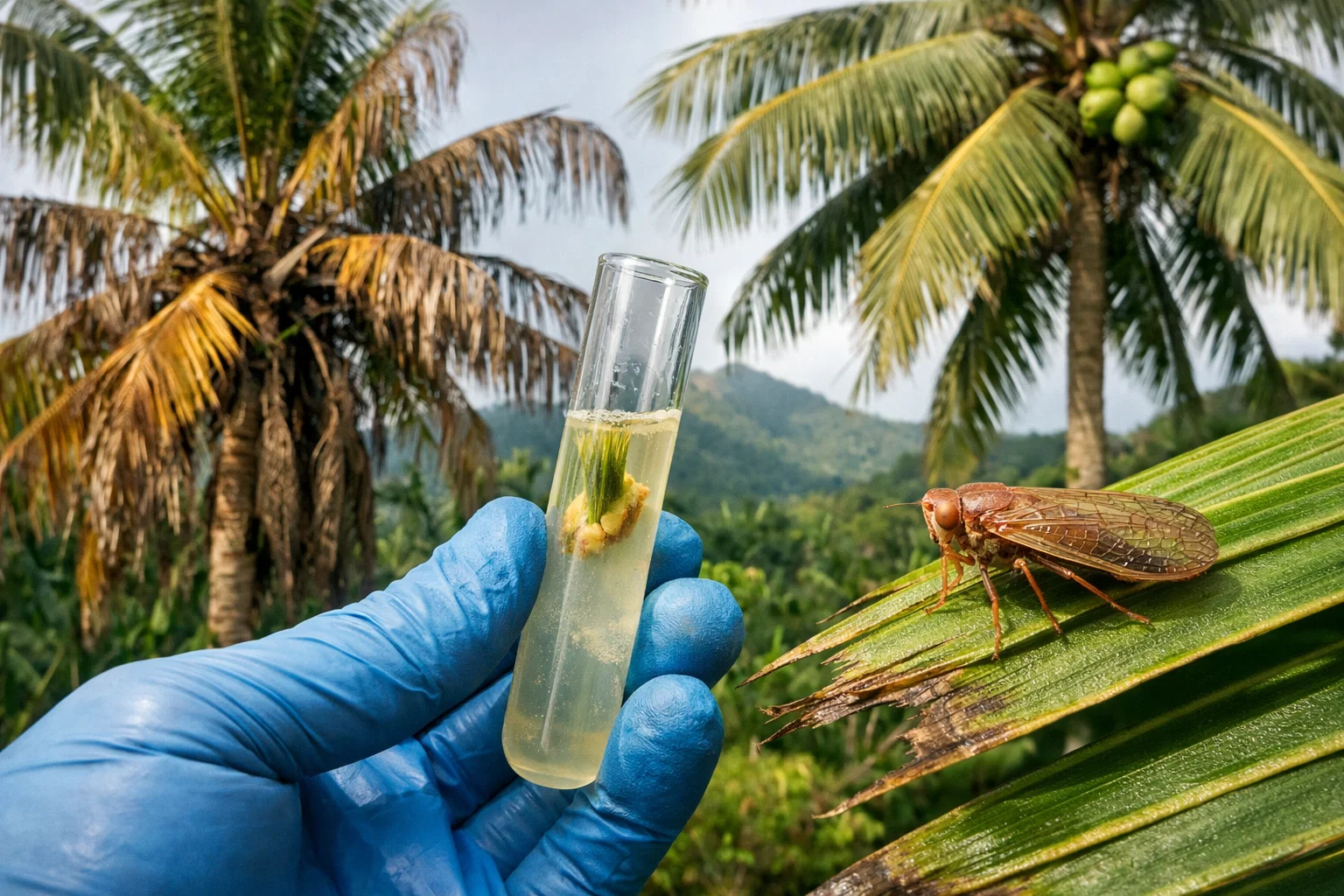

Red Palm Mite in Dominica
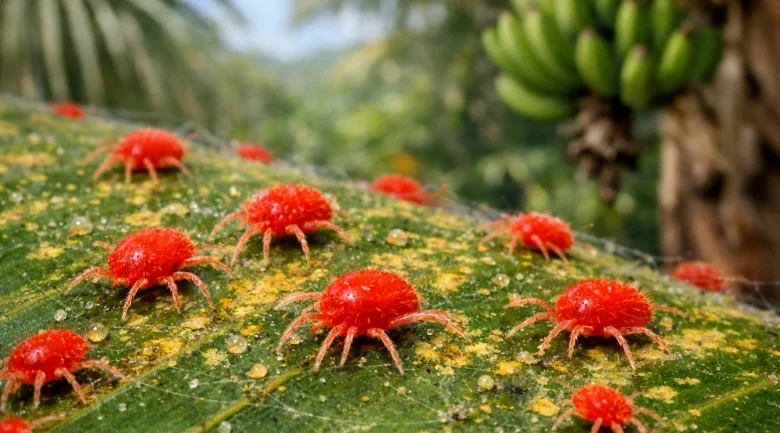
The Red Palm Mite (Raoiella indica) is an invasive arachnid pest that has caused significant ecological and economic disruption to the coconut industry and banana industry in Dominica. First identified in the Caribbean in the early 2000s, it reached Dominica’s shores shortly thereafter, spreading rapidly across the island’s lush tropical landscape. Unlike many other mites, the Red Palm Mite is easily visible to the naked eye due to its bright red coloration, and it primarily colonizes the underside of leaves, leading to severe chlorosis and reduced agricultural output.
Arrival and Spread in Dominica
The Red Palm Mite was first officially confirmed in Dominica in 2005, following its initial regional detection in Martinique (2004) and Saint Lucia. Its introduction to the Nature Isle is largely attributed to wind-borne dispersal and the movement of infested plant materials between islands.
By 2006, the mite had established itself in every agricultural region of Dominica, from the coastal coconut groves of Saint Andrew to the inland banana plantations of Saint Paul. The island’s high humidity and consistent temperatures provided an ideal environment for the mite’s rapid reproductive cycle, which can be completed in as little as 23 to 28 days.
Host Plants and Biological Impact
In Dominica, the Red Palm Mite is not limited to a single species; it targets a wide range of monocotyledonous plants that are central to the island’s economy and biodiversity.
Primary Hosts
- Coconut Palms (Cocos nucifera): The most visible victims, where heavy infestations lead to burning of the fronds.
- Bananas and Plantains (Musa spp.): The mite feeds on the underside of the leaves, interfering with the plant’s ability to photosynthesize, which is particularly damaging when coupled with Black Sigatoka.
- Ornamental Palms: Including the Royal Palm (Roystonea regia) and the Manila Palm (Adonidia merrillii), affecting the landscaping and tourism industry.
- Heliconias and Ginger Lilies: Impacting the local floriculture and cut-flower trade.
Symptoms of Infestation
Infestation typically begins on the lower, older fronds and moves upward.
- Yellowing (Chlorosis): Small yellow spots appear where the mites have sucked the chlorophyll from the plant cells.
- Necrosis: In severe cases, the yellowing turns to a rusty brown, giving the palm a scorched or burnt appearance from a distance.
- Reduced Fruit Yield: For coconuts, this can lead to smaller nuts and lower water/kernel content. In bananas, it results in smaller bunches and slower fruit maturation.
Data and Economic Significance
The economic impact of the Red Palm Mite in Dominica has been profound, particularly for small-scale farmers.
- Yield Loss: During the initial years of the outbreak, coconut production in some coastal areas of Dominica saw a decline in marketable yield of up to 50%.
- Inter-Island Trade: The presence of Raoiella indica led to strict phytosanitary regulations and temporary bans on the export of certain plant materials, including decorative palm fronds used in the floral industry, affecting Dominica’s trade within the OECS and CARICOM.
- Synergistic Damage: Agriculture officials noted that plants already stressed by the Red Palm Mite were significantly more susceptible to other pathogens, such as Lethal Yellowing or fungal infections.
Management and control measures used or recommended locally
Dominica-focused sources identify multiple pathways that are highly relevant for island biosecurity:
- Movement of infested plants/plant material is explicitly listed as a spread mechanism.
- Handicrafts fashioned from coconut leaves have been found to harbor live mites and viable eggs (a pathway specifically relevant for inter-island travel, trade, and cultural artisan products).
- Strong tropical storms/hurricanes are described as capable of distributing the mite over wide areas; scientific reporting also emphasizes dispersal via wind and the expectation that hurricanes and human activity can spread the pest.
These pathways imply that even if introduction timing is disputed (2005 vs 2008), early invasion plausibly involved a combination of traded plant material and wind-assisted spread.
Chemical control
Dominica guidance stresses feasibility constraints: chemical control is considered impractical due to the large size of most palms, implying limitations for tall, mature coconut stands typical of Dominica.
Where chemical intervention is considered (especially for nurseries/young palms), regional Caribbean evidence provides context for what has been trialed nearby:
- In Saint Lucia, field trials (2007–2008) assessed “readily available chemicals,” reporting variable performance over time (e.g., different products appearing more effective in different periods).
- In Jamaica nursery conditions, multiple reduced-risk treatments reduced RPM populations; the study notes insecticidal soap had the least negative impact on predators among tested treatments and again emphasizes rainfall–population relationships.
These are not Dominica registration recommendations. Any chemical use in Dominica should be aligned with local pesticide registration and safety oversight structures described in national pest management documentation.
Cultural and crop-management measures
The island’s public sources emphasize management more than eradication, consistent with island-wide establishment. Practical measures implied or supported by local guidance include:
- Routine scouting of leaf undersides, because mites resemble small red dots and egg masses are attached under leaves.
- Movement control and sanitation: preventing spread through infested plants and leaf materials, including crafts and transported plant parts.
- Attention to mixed coconut–banana systems where host shifting has been observed in Dominica.
Biological control and natural enemies
- Biological control agents (including predatory mites, beetles, lacewings, and other mite predators) have proven useful in the region and Eastern Hemisphere; it reports that in Dominica, natural enemies found include lacewings and two predatory mites, with ongoing efforts to identify suitable natural enemies.
- A national pest management document recommends the predatory mite Amblyseius largoensis as a potential control agent and points to entomopathogenic fungi (Beauveria bassiana, Metarhizium anisopliae) as promising biological control tools for mites, alongside increasing natural predators.
- Peer-reviewed Caribbean research examining fungi associated with RPM found Dominica samples included “mummified mites” and supports the broader approach of investigating entomopathogens and other biotic/abiotic factors as determinants of RPM density.
Practical actions for farmers and policymakers
Farmers should prioritize early detection by inspecting the undersides of coconut and banana/plantain leaves for red dots and egg clusters and by watching for characteristic yellow speckling and severe yellowing, especially on lower leaves. Movement of suspect planting material, cut palm fronds, and coconut-leaf crafts should be minimized or controlled because these pathways can harbor live mites/eggs. During drought periods, farmers should expect higher RPM pressure and increase monitoring intensity, because Caribbean evidence shows RPM can build during dry spells. Where intervention is needed on manageable-height plants, farmers should seek advice consistent with local pesticide governance and aim to conserve natural enemies (the preferred long-term strategy in multiple Dominican sources).
Policy-level actions and Government priorities:
Policymakers should strengthen inspection and risk communication around plant pathways highlighted by Dominican guidance, especially imported/transported host plants and coconut-leaf handicrafts, and integrate storm-season risk into preparedness messaging because wind and hurricanes are recognized dispersal mechanisms. Public investment should continue to prioritize biological control research and capacity building (training, diagnostics, and extension), consistent with the established national approach.
Government response, partnerships, and monitoring landscape
Dominica’s Ministry of Agriculture, Fisheries, Blue and Green Economy hosts a Red Palm Mite brochure through its publications system, providing official guidance on host plants, identification, damage, and spread pathways.
Operationally, RPM management has been led by Plant Protection and Quarantine Unit, as reflected in national public communications and contact information in official materials. The 2015 government update reports a week-long RPM management workshop aimed at laboratory technicians, extension officers, and small farmers and describes a funded project to research best management practices, including collaboration with international partners (e.g., EMBRAPA and CABI). The same update reports substantial historical spending on research into natural enemies.
Dominica’s climate/agriculture information system has also been linked to RPM work: the Dominica Meteorological Office agro-meteorological bulletin notes planned hosting of a Brazilian consultant to examine red palm mite project components, including experimental plots investigating fungal biological control and the use of agro-met data for pest dynamics.
Finally, a national pest management approach document associated with a major agriculture and climate resilience project (FAO-linked) outlines institutional roles (plant protection/quarantine, pesticide governance) and explicitly includes RPM with recommended biological control approaches, embedding RPM within a broader integrated pest management framework.
Gaps and priorities for surveillance, extension, and research
First, the chronology discrepancy (2005 vs 2008) persists in official-adjacent documents, and the public record reviewed does not provide a specimen-based clarification (e.g., an accessible diagnostic report with collection date and locality). Resolving this matters for biosecurity learning, understanding introduction pathways, early containment opportunities, and evidence quality.
Second, while “island wide” distribution is repeatedly stated, publicly accessible intensity mapping by parish/district is not available in the reviewed sources, limiting targeted extension and resource allocation. Notably, national project documentation explicitly calls for structured pest inventory and monitoring records (including location and date first spotted/seen), which would directly address this gap if implemented and made partially available for stakeholders.
Third, research suggests possible tolerance and/or different limiting factors in Dominica (lower populations or absence on some palms in one survey), but this remains an inference requiring follow-up: varietal susceptibility, predator complexes, fungal pathogens, and microclimate effects should be investigated under Dominican conditions.
Fourth, biological control is a core national strategy, yet Dominica-specific data on the effectiveness of particular predators (e.g., A. largoensis augmentation) and entomopathogenic fungi as field-deployed tools are not presented in detail in the reviewed public sources. This indicates a need for applied trials, mass-rearing feasibility studies, and extension-ready protocols adapted to Dominica’s farm structures (including tall, aging coconut stands).


References
-
1.
Red Palm Mite Threat to Coconut and Banana Plants in Dominica: DNO https://dominicanewsonline.com/news/homepage/news/agriculture/red-palm-mite-threat-to-coconut-and-banana-plants-in-dominica/
-
2.
Dominica Monitoring Spread of Red Palm Mite Affecting Palms and Coconut Trees: GIS https://news.gov.dm/news/news-items/ministry-of-agriculture-monitoring-red-palm-mite
-
3.
Raoiella indica (Red Palm Mite) https://www.cabi.org/isc/datasheet/46757
-
4.
Red Palm Mite in the Caribbean: Distribution, Host Plants and Impact on Coconut Palms https://www.fao.org/3/i3647e/i3647e.pdf
-
5.
Red Palm Mite Distribution in the Caribbean Basin (EPPO Global Database) https://gd.eppo.int/taxon/RAOIIN
-
6.
“Red Palm Mite” brochure - (Plant Protection/Quarantine) https://agriculture.gov.dm/news/publications?catid=3&id=5&m=0&task=download.send
-
7.
Official Pest Report for Dominica: “Report of Raoiella indica Hirst (red palm mite)” https://www.ippc.int/en/countries/dominica/pestreports/2005/11/report-of-raoiella-indica-hirst-red-palm-mite-dominica/
-
8.
Counting the costs of Invasive Alien Species: DNO https://dominicanewsonline.com/news/homepage/news/agriculture/counting-the-costs-of-invasive-alien-species/
-
9.
CARDI Review Issue 10 https://www.cardi.org/wp-content/uploads/2011/09/CARDI-Review-Issue-10.pdf
-
10.
Acarologia paper (Caribbean survey; notes first reported in Dominica in 2005; discusses fungi and densities) https://repositorio.unesp.br/bitstreams/7cfe1e24-1762-4639-a15f-e4c4b500ca61/download