

Jeff Joseph
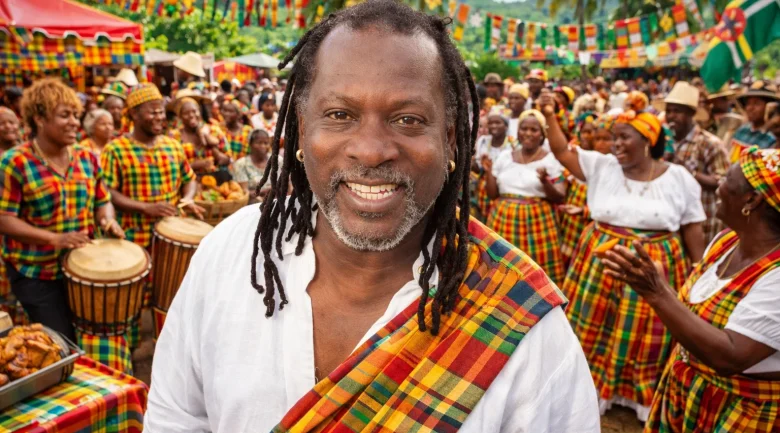
Jeff Joseph (September 30, 1953 – November 23, 2011) was a legendary Dominican singer, songwriter, and cultural icon, widely regarded as the “King of Cadence-lypso.” Over a career spanning four decades, he became a global ambassador for Caribbean music, particularly the Kadans (Cadence-lypso) and Zouk genres. He was the founder and charismatic lead singer of the seminal band Gramacks and later a founding member of the influential group Volt-Face.
Early Life in St. Joseph
Jefferson Osbert Sylvester Joseph was born on September 30, 1953, in the west coast village of St. Joseph, Dominica. Growing up in a village renowned for its vibrant Carnival traditions and a deep-seated rebel spirit, Jeff was immersed in a community that lived and breathed rhythm.
His education was split between the prestigious Dominica Grammar School and Saint Mary’s Academy. This detail is crucial because the rivalry and eventual camaraderie between these two schools gave birth to his first band. In 1972, a group of students from these institutions formed a musical collective. Because they were “Grammar” and “Macks” (St. Mary’s) students, they christened themselves Grammacks. The band was born out of local necessity; after a Roseau-based band failed to show up for a village gig in St. Joseph, Jeff and his peers vowed they would never rely on outside musicians again.
The Grammacks Revolution: 1972–1985
Under Jeff’s charismatic leadership, Gramacks became the vanguard of Cadence-lypso. At a time when the Caribbean was dominated by Jamaican Reggae and Trinidadian Calypso, Gramacks introduced a distinctively Dominican sound that incorporated the driving, synthesised beat of Haitian Kadans (Compas) with the storytelling grit of the island’s local experience.
The 1970s was a period of nationalist ferment, and Jeff Joseph’s lyrics reflected this. Singing in a mix of English, French, and Antillean Creole, he reached an audience that other Caribbean artists could not. By the mid-70s, Gramacks had signed with Barclay Records in France, a deal that transformed them from local stars into international icons.
Two specific events solidified their global status:
- The Tour de France (1977): Gramacks was invited to perform at every stage of the legendary cycling race. For many Europeans, Jeff Joseph was the first face and voice they associated with the Caribbean.
- Super Bowl XIII (1979): In a historic moment of cultural export, Jeff Joseph and Gramacks performed during the halftime show at the Orange Bowl in Miami. They played to an audience of millions, marking the highest point of global visibility for Dominican music in the 20th century.
The New York Era and Karibean Rock
By 1985, the original Gramacks lineup disbanded, and Jeff Joseph moved to New York. This move marked a stylistic shift. Immersed in the city’s funk and soul scene, he experimented with a sound he called “Karibean Rock.” During this period, he collaborated with the legendary Kool and The Gang, producing hits such as “World Music” and “Banana Sweet.” This era proved his versatility; he was as comfortable on a disco-funk track as he was on a traditional Creole Chanté Mas. Despite his success in the U.S., his heart remained in the Antilles.
Volt-Face and the Zouk Renaissance
In the 1990s, Jeff Joseph returned to the French West Indies, settling primarily in Martinique. He co-founded the group Volt-Face with Georges Décimus, a legendary bassist from the band Kassav’.
Volt-Face was instrumental in the Zouk renaissance. While Kassav’ had laid the foundation, Jeff Joseph brought a raw, high-energy stage presence that reinvigorated the genre. For five years, Volt-Face toured the world, introducing Zouk and early Bouyon influences to audiences in Africa, Europe, and Japan. Jeff’s work in Martinique earned him the title of “illustrious son” of the French Antilles, and he was later named a Goodwill Ambassador for Dominica.
A Hero’s Passing and Lasting Legacy
Jeff Joseph’s final years were dedicated to the World Creole Music Festival (WCMF). He was the festival’s most ardent promoter, travelling to Guadeloupe and Martinique to ensure that the “Creole World” remained connected.
He passed away on November 23, 2011, in a Martinique hospital following a stroke. His death triggered a national day of mourning in Dominica. He was granted an Official Funeral, a rare honour for an entertainer, reflecting his status as a “National Hero.”
Today, his influence is felt in every “Bouyon” track that comes out of Dominica. His commitment to the Creole language, at a time when it was discouraged on the radio, is credited with saving a vital part of the island’s heritage. Jeff Joseph didn’t just sing songs; he provided the soundtrack to a nation’s independence.
Jeff Joseph: Key Milestones
- 1953: Born in St. Joseph, Dominica.
- 1972: Founded Gramacks.
- 1976: Released “Woo Mi Deba,” the anthem of Cadence-lypso.
- 1979: Performed at Super Bowl XIII.
- 1988: Released “One Two Three” during his New York solo era.
- 1990s: Formed Volt-Face, a titan of the Zouk genre.
- 2011: Died in Martinique; honored with a National Day of Mourning in Dominica.


