



Future Housing Programme of Dominica
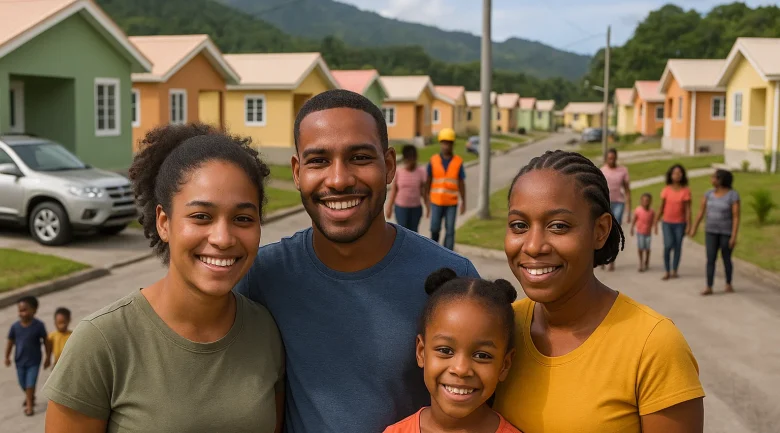
The Future Housing Programme is a government initiative in Dominica aimed at promoting new community development by enabling working-class citizens, especially young adults, to own modern, resilient homes at more affordable terms. The program was launched officially in July 2022 at Windsor Park, with the government signaling a pivot from post-disaster reconstruction toward sustainable housing growth.
Purpose, Objectives & Scope
At its core, the Future Housing Programme seeks to:
- Empower homeownership among youth and working persons (initially emphasizing under-45s in both public sector and private sectors) who often struggle with high costs and mortgage access.
- Foster community growth by creating master-planned neighborhoods with infrastructure and services.
- Build safe, climate-resilient homes, aligned with Dominica’s goal to become the world’s first climate-resilient nation.
The programme is intended to complement and go beyond post-Maria reconstruction, bridging housing gaps in new geographic locations, providing alternative home ownership routes, and offering more supply to meet rising demand.
While initial eligibility emphasizes younger citizens, government statements have indicated that expansion to citizens beyond age 45 is expected over time.
Financing, Ownership & Payment Options
Funding for the Future Housing Programme is tied to the Citizenship by Investment (CBI) scheme. The government uses CBI revenues to underwrite the construction of housing units, thereby reducing the financing burden placed directly on homebuyers.
Prospective homeowners may acquire homes through:
- Low-interest loans via participating financial institutions
- Outright purchase options (i.e. full purchase without finance)
- Payment plans contingent on eligibility assessments and income levels
These options are designed to give buyers flexibility depending on their financial capacity.
The government also subsidizes aspects of planning, land acquisition, and infrastructure development so that the constructed cost is lower than typical market rates.
Implementation, Projects & Locations
At launch, the programme promised to build units in select rural communities, starting with Cotton Hill as a pilot site, before scaling across more neighborhoods.
Other planned sites include Eggleston, Scotts Head, Trafalgar, Grand Bay, Woodford Hill, Pound, Pointe Michel, and Vieille Case. Government planning documents cite a goal of delivering 5,000 housing units across such locations within a programmatic horizon.
Acquisition and preparation of land have also been underway. For example, government has acquired three acres in Eggleston and Scotts Head, and is ahead with land regularization efforts in Pound, Vieille Case, Canefield East, Checkhall, and Massacre.
The announcement event held in July 2022 drew senior leadership, including the Prime Minister, Minister of Housing, and Minister of Public Works, signaling high-level backing.
Challenges & Critical Considerations
While ambitious, the Future Housing Programme faces several challenges:
- Affordability & Uptake: Even at subsidized rates, prospective buyers may struggle with down payments, loan servicing, and associated costs such as utilities, access roads, and permits.
- Scale & Funding: Translating CBI revenues reliably into construction requires continued investment and risk management, especially when CBI inflows fluctuate.
- Land security & tenure: Ensuring clear land titles, avoiding disputes, and handling squatters or informal settlements will complicate development.
- Infrastructure & services: Housing units must be matched with roads, water, electricity, drainage, and social services to be livable.
- Compliance & construction quality: Maintaining resilient building standards under large volume construction is essential. The risk of substandard work must be monitored.
- Geographic spread & access: Reaching remote communities or areas with challenging topography will increase costs and logistical demands.
Strategic Significance & Future Prospects
The Future Housing Programme represents the government’s transition from reactionary reconstruction toward proactive, growth-oriented housing policy. It aligns with Dominica’s Climate Resilience and Recovery Plan, which sets targets for resilient housing stock.
It also addresses generational wealth and social equity through its slogan “Empowerment Through Ownership – A Path to Generational Wealth.”
Over time, it may evolve to:
- Expand eligibility beyond younger professionals
- Introduce rental or mixed-use schemes
- Integrate with retrofit or upgrade programmes for existing housing
- Use digital systems for permit processing and resident tracking
If successfully executed at scale, the programme can alter the housing trajectory in Dominica, moving more households into secure homes, stimulating construction, and anchoring communities in resilient foundations.


