

Disaster Resilience Strategy of Dominica
Dominica’s Disaster Resilience Strategy represents a globally unprecedented commitment to transform an entire nation into a climate-hardened sanctuary by the end of the decade. This visionary roadmap was born from the wreckage of Hurricane Maria in 2017, a Category 5 event that decimated the island’s infrastructure and economy. Rather than merely rebuilding, the Dominica government codified the Climate Resilience and Recovery Plan (CRRP), setting twenty specific, measurable targets to ensure the island can withstand the increasing frequency of extreme weather.
The Strategic Framework: Three Pillars of Survival
The resilience architecture is built upon a “triple-bottom-line” approach that integrates hard engineering with financial and social mechanisms.
Structural and Physical Resilience
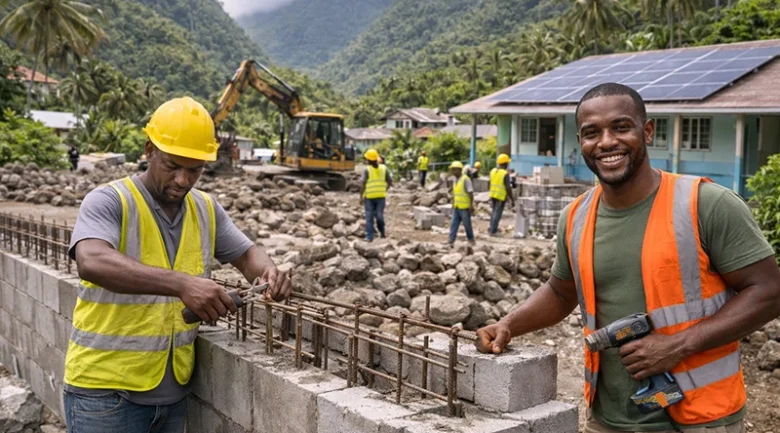
This pillar focuses on the “hardening” of the nation’s built environment. Under the current strategy, all new government infrastructure, including the Dr. Nicholas Liverpool Highway, must adhere to updated seismic and wind-resistance codes.
- Resilient Housing: The government has committed to constructing 5,000 hurricane-proof homes, funded largely by the Citizenship by Investment (CBI) Programme. These structures are built with reinforced concrete and specialised roofing systems designed to remain intact during 200 mph winds.
- Energy Security: A critical move toward resilience is the development of the Geothermal Power Plant in Laudat. By moving away from coastal diesel generators and utilising inland volcanic heat, the island ensures a stable power supply that is immune to coastal storm surges.
Financial Resilience and Risk Transfer
Dominica recognises that immediate liquidity is the greatest challenge following a disaster. The strategy employs a sophisticated risk layering approach:
- CCRIF SPC: The island maintains a high level of coverage with the Caribbean Catastrophe Risk Insurance Facility, ensuring payouts within 14 days of a major event.
- National Resilience Fund: A dedicated portion of CBI revenue is set aside to act as an internal insurance buffer for non-catastrophic but damaging weather events.
- Fiscal Buffers: Budgetary reforms have been implemented to ensure that a “rainy day” fund is maintained to support the Dominica economy during recovery periods.
Social and Community Resilience
The soft side of the strategy focuses on human survival and rapid recovery at the village level.
- Community Emergency Shelters: Over 30 regional shelters have been upgraded with independent solar power, massive water storage tanks, and telecommunications equipment that can operate when the national grid fails.
- Food Security: The agricultural sector is being re-engineered to emphasize climate-smart farming practices. This involves promoting root crops that grow underground, safe from wind, and establishing regional seed banks to ensure replanting can begin within days of a storm.
Institutional Evolution: From CREAD to Permanent Governance
A unique element of this strategy was the creation of the Climate Resilience Execution Agency of Dominica (CREAD). CREAD was designed as a high-performance, time-bound agency to lead the recovery and set the standards for all future development.
Currently, the expertise developed within CREAD is being decentralized across the various ministries. This ensures that resilience is no longer a separate project, but the default operating mode for the entire Dominica government. Every bridge, school, and health clinic now undergoes a resilience audit before a single brick is laid.
Ecological Resilience: The Forest as a Shield
Dominica’s strategy is unique in that it treats its natural resources as critical infrastructure. The vast mountainous rainforests are protected not just for biodiversity, but as a physical buffer.
- Watershed Management: By protecting the headwaters of the island’s 365 rivers, the strategy mitigates the risk of catastrophic landslides and downstream siltation that can destroy coastal communities.
- Reforestation: Following Hurricane Maria, massive reforestation efforts using deep-rooted indigenous trees like the Gommier have been prioritised to stabilise the island’s steep volcanic slopes.
The Global Blueprint for SIDS
The Disaster Resilience Strategy for Dominica serves as a beacon for other Small Island Developing States (SIDS). It demonstrates that through a combination of sovereign financing, indigenous knowledge (particularly from the Kalinago people), and cutting-edge engineering, it is possible to decouple a nation’s fate from the volatility of a changing climate.
By the year 2035, the goal is to have a nation that doesn’t just survive the next hurricane but continues to function, trade, and provide for its citizens throughout the event. This total commitment to sustainable development ensures that the “Nature Island” remains a viable and thriving home for generations to come.


References
-
1.
Dominica Climate Resilience and Recovery Plan 2020–2030 https://odm.gov.dm/wp-content/uploads/2022/02/CRRP-Final-042020.pdf
-
2.
National Resilience Development Strategy Dominica 2030 – Government of Dominica https://www.finance.gov.dm/en/publications/national-development-strategies/1-the-national-resilience-development-strategy-dominica-2030
-
3.
Dominica Climate Resilience and Recovery Plan – Climate Laws Database https://climate-laws.org/document/dominica-climate-resilience-and-recovery-plan-2020-2030_e34a
-
4.
Dominica Disaster Risk Management Development Policy Credit – World Bank https://documents1.worldbank.org/curated/en/622301654273652937/pdf/Dominica-Disaster-Risk-Management-Development-Policy-Credit.pdf
-
5.
Strengthening Resilience of Infrastructure in Dominica – GFDRR https://www.gfdrr.org/sites/default/files/2024-04/Project%20Fiche%20-%20Dominica%20%E2%80%93%20Strengthening%20Resilience%20of%20Infrastructure_0.pdf
-
6.
Country Strategy Paper: Dominica 2020–2024 – Caribbean Development Bank https://www.caribank.org/publications-and-resources/resource-library/country-documents/country-strategy-paper-dominica-2020-2024
-
7.
Dominica Climate Policy and Targets – Climate Policy Radar https://app.climatepolicyradar.org/geographies/dominica
-
8.
Planning for Climate Change in Small Island Developing States – Research Study https://www.researchgate.net/publication/360158211_Planning_for_Climate_Change_in_Small_Island_Developing_States_Can_Dominica%27s_Climate_Resilience_and_Recovery_Plan_Be_a_Model_for_Transformation_in_the_Caribbean
-
9.
Dominica Building Back Better on Lessons Learned – Bank of Saint Lucia Analysis https://www.bankofsaintlucia.com/blogs/dominica-building-back-better-on-lessons-learned
-
10.
Dominica Energy and Climate Resilience Report (CCREEE) https://cekh.ccreee.org/wp-content/uploads/2023/08/ERC_Dominica_final_002.pdf