



Didier Committee of 1975
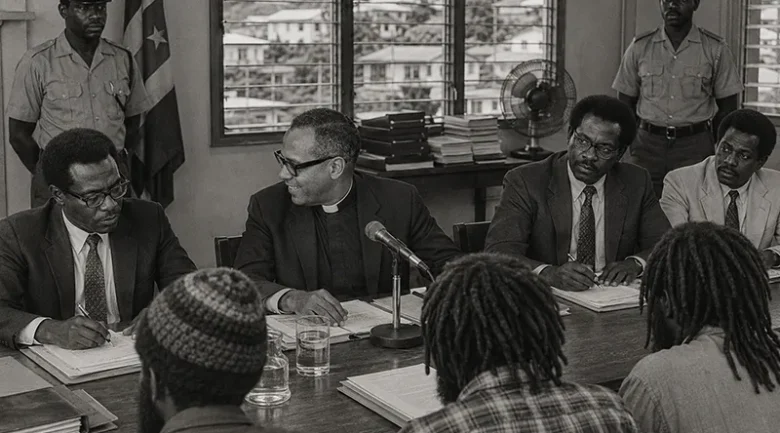
The Didier Committee of 1975 (often referred to in legal histories as the Didier Committee) was a pivotal, independent task force appointed by the government of Dominica. Its mission was to evaluate a mounting national security crisis: the state’s violent conflict with the Rastafari movement and the long-term societal fallout of the draconian Prohibited and Unlawful Societies and Associations Act of 1974, universally known as the Dread Act.
Led by a prominent Methodist minister, Reverend Atherton Didier, the commission represents a crucial moment of institutional conscience. It was a brave, level-headed attempt to steer Dominica away from state-sanctioned violence and toward human rights, even though its findings were initially met with hostile rejection by the ruling political class.
The Catalyst: The Dread Act of 1974
To understand why the Didier Committee was formed in 1975, one must look at the atmosphere of terror that preceded it. In the early 1970s, the Rastafari ideology spread rapidly through Dominica’s youth, manifesting locally as a group known as the “Dreads.” While most were peaceful, back-to-the-land cultural activists, a small minority engaged in anti-colonial, anti-Catholic rhetoric and clashed with police in the dense interior rainforests.
Panicked by this burgeoning counter-culture, Premier Patrick John and his Dominica Labour Party (DLP) administration pushed the Dread Act through the House of Assembly in late 1974. The act was arguably the most oppressive piece of legislation passed in the modern Caribbean:
- Criminalization of Appearance: It made the simple act of wearing dreadlocks or identifying as a “Dread” an arrestable offense without a warrant.
- No Bail & No Rights: Suspects could be held without charge or bail for 48 hours.
- Immunity for Murder: Most shockingly, Section 7 of the Act granted total immunity from prosecution to any citizen or police officer who shot, injured, or killed a Dread found inside a private residence.
By 1975, the law had triggered a wave of state-sanctioned violence. Dreads were being beaten, hunted in the mountains, and having their hair forcibly shaved in public.
The Mandate of the Didier Committee
Recognising that the island was on the brink of an internal civil war and facing immense international criticism from human rights groups, the government announced a brief amnesty in 1975 for Dreads living in the forests to surrender. Unsurprisingly, the Dreads did not trust Patrick John’s administration and refused to come down from the hills.
Realizing the amnesty had failed, the government appointed an eight-person independent committee chaired by Reverend A. Didier. The commission’s mandate was to impartially investigate the root causes of the Dread phenomenon, assess the validity of the government’s security fears, and provide an exit strategy from the escalating violence.
The Commission’s Findings and Recommendations
Reverend Didier and his team conducted interviews, analyzed police data, and looked past the political hysteria of the era. Their final report concluded that the state’s response was completely disproportionate to the actual threat.
The Peaceful Majority
The Didier Committee formally concluded that the vast majority of Dominica’s Dread and Rastafarian population consisted of peaceful, non-violent cultural and spiritual activists who were merely seeking an alternative lifestyle away from colonial structures. The commission noted that the government had mistakenly conflated a few isolated criminal acts with an entire social movement.
Condemnation of the Dread Act
The commission strongly advised that the Dread Act was unconstitutional, violated basic human rights, and was actively damaging Dominica’s social fabric by turning citizens against each other.
The Recommendation of Identity vs. Action
The central conclusion of the Didier Committee was that the state should stop criminalising a citizen’s appearance and instead focus on criminalising specific acts of violence. They formally recommended that the Dread Act be entirely annulled and replaced with a focused, standard anti-terrorism/anti-crime law that targeted actual criminal behaviour regardless of what the perpetrator looked like or how they wore their hair.
The Government’s Rejection and Long-Term Legacy
The immediate aftermath of the Didier Committee was a victory for political authoritarianism over judicial reason. Premier Patrick John completely rejected the committee’s findings. Winning a commanding 16 out of 21 seats in the 1975 General Elections in Dominica, John felt vindicated by the polls and chose to double down on the oppression. The Dread Act remained active, and the persecution of the Rastafarian community continued for the remainder of the decade.
However, history ultimately validated Reverend Didier’s work. When Dame Mary Eugenia Charles and the Dominica Freedom Party (DFP) swept into power in 1980, they inherited an island still recovering from the trauma of the John era. On February 16, 1981, the House of Assembly passed the Prevention of Terrorism (Temporary Provisions) Act. Section 18 of this new legislation explicitly acted upon the exact blueprint laid out by the Didier Committee six years prior: it officially repealed the Dread Act.
Summary of the Historical Pivot
| Dimension | The 1974 Dread Act Approach | The 1975 Didier Committee Blueprint (Adopted 1981) |
| Legal Focus | Target who the person is (Hair, dress, identity). | Target what the person does (Acts of violence). |
| Human Rights | Suspended bail, legalized citizen-on-citizen violence. | Restored constitutional protections and due process. |
| State Strategy | Blind eradication of a cultural minority. | Isolation of actual criminal elements from a peaceful majority. |
The Didier Committee of 1975 stands as a monument to institutional courage in Dominican history. At a time when it was deeply unpopular to stand up for the marginalized Rastafarian community, Reverend Didier and his committee provided a rational, legally sound path toward peace that eventually formed the bedrock of the country’s post-independence civil liberties.


References
-
1.
The War on Dreads in Dominica: From Democracy to Papadocracy 1 https://www.academia.edu/44917135/THE_WAR_ON_DREADS_IN_DOMINICA_FROM_DEMOCRACY_TO_PAPADOCRACY_1