


Active Volcanoes in Dominica
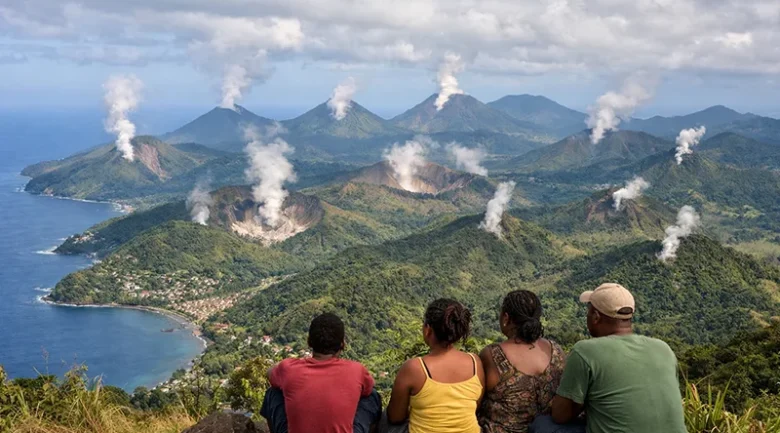
Active Volcanoes define the geological identity and rugged topography of the Commonwealth of Dominica, which has the highest concentration of potentially active volcanic centres per square kilometre of landmass in the world. While most islands in the Lesser Antilles arc possess only one or two live systems, Dominica is home to nine distinct volcanic centres. A volcano is classified as active in this context if it has erupted within the last 10,000 years and retains the structural and geothermal characteristics necessary for future activity.
Monitoring these systems is a collaborative effort between the University of the West Indies Seismic Research Centre (UWI-SRC) and the local Office of Disaster Management (ODM), ensuring that the Nature Island remains prepared for any shift in magmatic pressure.
The Nine Potentially Active Volcanic Centres
The volcanic architecture of Dominica consists of a central spine of stratovolcanoes and caldera complexes. Each center has a unique eruptive history and current level of geothermal manifestation.
- Morne aux Diables: Situated at the far northern tip of the island, this centre is characterised by active fumaroles and hot springs near the village of Penville.
- Morne Diablotin: The island’s highest peak (1,447m). While its last major eruption occurred approximately 30,000 years ago, it is considered potentially active due to persistent seismic swarms beneath its massive flanks.
- Morne Trois Pitons: A dominant central peak that produced the layer under the capital that geologists specifically call the Roseau Tuff. It was one of the largest eruptions in the Caribbean in the last 200,000 years.. Its national park boundaries also house the world’s second-largest boiling lake.
- Micotrin (Morne Macaque): This complex includes twin domes. It is a highly restless area, with Micotrin having erupted as recently as 1,100 years ago.
- Wotten Waven Caldera: This is a major hydrothermal centre. It is home to the world’s second-largest boiling lake, a flooded fumarole. It experienced a phreatic (steam) explosion as recently as 1997.
- Morne Watt: A significant peak in the southeast, closely associated with the thermal activity of the Valley of Desolation. This area experienced a phreatic (steam) explosion as recently as 1997.
- Morne Anglais: Overlooking the Giraudel and Bellevue Chopin areas, this volcano remains part of the island’s monitored volcanic spine.
- Grande Soufrière Hills: Located in the southeast, this centre features intense sulfur venting and coastal thermal springs near the village of Tête Morne.
- Morne Plat Pays Volcanic Complex: Dominating the southern tip of the island, this complex is seismically active and includes the Morne Patates dome, which last erupted roughly 500 years ago.
Hydrothermal Systems and the Boiling Lake
Dominica’s volcanic energy is most visible through its hydrothermal systems. The Valley of Desolation is a volcanic wasteland where the Earth’s crust is thin enough to allow sulfurous gases and superheated steam to escape directly from the underlying magma chamber.
The Boiling Lake serves as a natural pressure valve for the Wotten Waven/Micotrin system. It is a cauldron of greyish-blue water, usually enveloped in a cloud of vapour, where the water temperature at the edges reaches approximately 82°C to 92°C. The lake is known to drain periodically, an event that signals a change in the local plumbing system and requires immediate analysis by the UWI-SRC to determine whether the drainage is caused by a blockage or a shift in magmatic gas pressure.
Monitoring and National Alert Levels
Living in a Small Island Coastal State with nine active volcanoes requires a sophisticated early-warning system. The Seismic Research Centre maintains a network of seismometers, GPS stations, and tiltmeters across the island to detect “volcanic unrest,” such as earthquake swarms or ground inflation.
The government utilizes a color-coded Volcano Alert Level system to communicate risk to the public:
| Alert Level | Designation | Interpretation |
| Green | Normal | Volcanic activity is at background levels. No immediate threat. |
| Yellow | Restless | Activity is significantly above the historical level. Increased monitoring required. |
| Orange | Highly Elevated | Eruption likely within 24 hours. Pre-evacuation of high-risk zones begins. |
| Red | Eruption Imminent | Eruption is in progress or expected momentarily. Full evacuation of affected districts. |
Volcanic Hazards and Infrastructure Resilience
The primary hazards associated with Dominica’s volcanoes are pyroclastic flows (superheated clouds of ash and gas), lahars (volcanic mudflows), and tephra fall (ash rain). Because the island’s interior is so steep, these hazards would likely follow the paths of the 365 rivers, directly impacting the coastal communities.
In response, national infrastructure is built with volcanic hazard maps in focus:
- Geothermal Energy: The government is tapping into the volcanic heat of the Wotten Waven/Laudat area to provide clean, renewable energy for the entire island, turning a geological risk into an economic asset.
- The International Airport Project: Construction in the Northeast considers the proximity to Morne aux Diables and Morne Diablotins, ensuring that runway designs can withstand potential seismic shifts.
- Educational Integration: Through the District Education Officers (DEOs), volcanic awareness is embedded in the school curriculum. Students participate in annual Volcano Awareness Week activities, ensuring that the next generation of Dominicans understands the Ridge-to-Reef connection between the mountain peaks and the coastal sea.


References
-
1.
Dominica Office of Disaster Management (ODM): Volcanoes https://odm.gov.dm/volcanoes-2/
-
2.
Smithsonian Global Volcanism Program - Dominica https://volcano.si.edu/volcanolist_countries.cfm?country=Dominica
-
3.
ResearchGate: Dominica Geological Map & Studies https://www.researchgate.net/figure/Dominica-Island-Simplified-version-of-Dominica-geological-map-showing-the-deposit-extent_fig1_335170978
-
4.
ScienceDirect: Geothermal Integration in Dominica https://www.sciencedirect.com/science/article/abs/pii/S2213138821009243
-
5.
Journal of Geophysical Research: Boiling Lake Dynamics https://agupubs.onlinelibrary.wiley.com/doi/full/10.1029/2008jb005773
-
6.
Caribbean Volcanoes: Dominica Bibliography https://caribbeanvolcanoes.com/dominica-bibliography/
-
7.
Think Hazard: Dominica Volcanic Risk Report https://thinkhazard.org/en/report/71-dominica/VA
-
8.
Dominica Geothermal Development - Environmental Impact Assessment https://www.caribank.org/sites/default/files/publication-resources/DGDC-ESIA-Non-Technical-Summary.pdf
-
9.
Dominicans advised to educate themselves about volcanoes https://dominicanewsonline.com/news/homepage/news/dominicans-advised-to-educate-themselves-about-volcanoes/
-
10.
Letting off steam: How Dominica's volcanoes will boost its green energy https://www.bbc.com/news/articles/c4gezw5n579o
-
11.
Volcanic Unrest Causing Earthquakes https://emonewsdm.com/volcanic-unrest-causing-earthquakes/