




Peoples Democratic Movement (PDM)
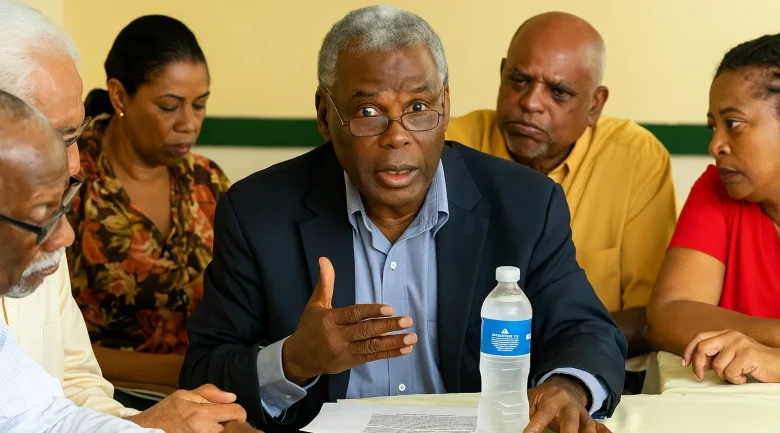
The People’s Democratic Movement (PDM), founded by Dr. William “Para” Riviere, emerged in Dominica in April 2006 as a response to deep-rooted concerns over the direction of the nation’s political leadership and developmental progress. On the 30th anniversary of Dominica’s independence, the PDM formally introduced its presence to the public through its website, outlining a bold and reflective critique of post-colonial stagnation and successive governments’ failure to prioritise the people’s real needs. Framing a grassroots initiative, the PDM positioned itself as a visionary alternative to the entrenched political status quo.
Foundational Philosophy and National Assessment
PDM’s core message stems from an honest assessment of Dominica’s trajectory since independence in 1978. The party asserts that Dominica remains economically vulnerable, underdeveloped, and heavily reliant on external forces despite formal sovereignty. The PDM contends that the nation’s vast natural resources, fertile soil, rainforests, hydro and geothermal energy, rivers, and eco-tourism assets remain underutilised. Moreover, the skills and talent of its people, both on the island and in the diaspora, have not been mobilised toward sustainable national development.
Rather than blaming colonial legacies alone, the PDM argues that poor governance and inadequate leadership since independence have deepened national underperformance. Their critique highlights the disconnect between visible infrastructure projects and tangible improvements in citizens’ quality of life. According to PDM, political leaders have focused more on popularity and electoral gain than long-term strategic planning or people-centred governance.
Four Pillars of the PDM Vision
The PDM’s developmental blueprint rests on four interrelated pillars. First is the conviction that people, not infrastructure or ideology, should be placed at the centre of the development process. Secondly, the movement emphasises national unity across political, class, and religious divides, as well as between those living in Dominica and those living abroad. Thirdly, this unity should be forged through an articulated and inclusive National Plan for Development, supported by detailed sector plans. Finally, implementing such plans must be entrusted to a disciplined, competent, and principled team of men and women who prioritise service over self-interest.
In PDM’s view, this leadership model has never been applied in Dominican post-independence era. Instead, governance has been shaped by clientelism, unaccountable leadership, and short-term political calculations. Electors have been divided by party lines and often manipulated rather than consulted. Calls for national unity are seen as superficial gestures made in moments of political vulnerability, rather than rooted in any actionable framework.
Launch, Purpose, and Public Engagement
The party’s launch in 2006 was not simply political; it was a call for civic reawakening. The Coordinators’ Report provides a foundational narrative of the party’s formation, aiming to foster transparency and encourage dialogue. The PDM website was created to facilitate engagement with Dominicans on the island and those in the wider Caribbean, Africa, and the global diaspora. The party welcomes public feedback on its preliminary positions and insists that its policies remain open to review and constructive criticism.
Through this platform, PDM invited citizens to contribute to shaping the party’s vision and to help build a better Dominica. The party believed that national transformation must come from within and be guided by leadership that understands both the historical burdens of slavery and colonialism and the urgent need for modern, inclusive nation-building.
PDM’s message remains: development is not merely about physical infrastructure or international accolades, it is about raising the standard of living for every Dominican through responsible governance, unity, and the sustainable use of the island’s abundant natural resources.


