


Hoffman Affair
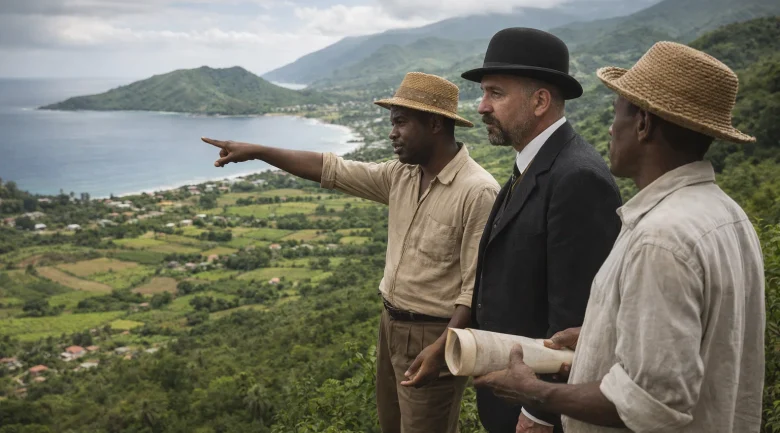
The Hoffman Affair, which lasted from 1968 to 1970, remains a critical juncture in the country’s political development. It was a crisis that transcended simple policy disagreement, evolving into a fundamental struggle over national sovereignty, land rights, and the meaning of independence in the post-colonial Caribbean. By analyzing the intricate details of the proposed land lease, the clandestine nature of the negotiations, and the subsequent explosion of grassroots resistance, one can trace the direct lineage of the island’s radical political consciousness.
The Context: Development at Any Cost
In 1967, the Commonwealth of Dominica transitioned from a direct British colony to an Associated State. Under the leadership of Premier Edward Oliver LeBlanc, the newly formed government faced immense pressure to modernise an economy dangerously reliant on a single crop: bananas. The global trend at the time, often termed Industrialization by Invitation, encouraged Caribbean leaders to offer massive tax concessions and land grants to foreign capitalists in exchange for infrastructure and jobs.
It was within this desperate economic climate that a German industrialist named Hoffman entered the picture. Hoffman presented himself not merely as an investor but as a saviour who could transform the sleepy northern town of Portsmouth into a global hub of commerce. However, the scale of his vision and the secrecy surrounding it would soon ignite a firestorm of controversy.
The Secret Proposal: A State Within a State
The core of the Hoffman Affair was a proposal for a 99-year lease of approximately 25,000 acres of land in the island’s northern and northeastern regions. To put this in perspective, the proposed lease covered nearly 15% of theCommonwealth of Dominica’s landmass. The plan focused heavily on the Cabrits Peninsula and the surrounding areas of Portsmouth, which Hoffman intended to develop into a Free Port and an autonomous industrial zone.
The specific terms of the draft agreement, which were initially kept hidden from the public and even some members of the Cabinet, were staggering:
- Tax Immunity: The development zone would operate outside the island’s standard tax laws, creating a fiscal vacuum in which the government would have little to no revenue from industrial activities.
- Autonomous Governance: The proposal hinted at a level of administrative autonomy that would effectively create a “state-within-a-state.” Hoffman and his associates would have significant control over customs, immigration, and even security within the zone.
- Mineral and Resource Rights: The lease granted Hoffman sweeping rights to any minerals or resources found within the 25,000-acre tract, further alienating the nation’s natural wealth.
- Nominal Rent: Perhaps the most insulting aspect for the local population was the proposed nominal rent for such a vast and strategic portion of the country, which many viewed as a modern-day form of land alienation.
The Vanguard of Exposure: The Manicou Movement
The Hoffman Affair might have proceeded in silence were it not for the intervention of the Manicou Movement. This was a small, intellectual collective composed of radicalised students, teachers, and activists who operated under the cover of night, much like the manicou (opossum) for which they were named.
Led by figures such as Bill Riviere and bolstered by the ideological influence of Rosie Douglas, the Manicou Movement engaged in what they called investigative pamphleteering. They obtained leaked copies of the draft agreement and began distributing cyclostyled newsletters that translated the complex legal jargon into plain language for the common citizen. They framed the Hoffman deal not as a development project, but as a neocolonial land grab that threatened to re-enslave the population by removing their access to the soil.
The Manicou pamphlets were the first to ask the critical questions: Who is Hoffman? Why is the deal secret? And why is the government surrendering the Cabrits National Park, a site of immense historical and military significance, to a foreign national for a century?
The Public Backlash and the Threat of a General Strike
As the details of the “Hoffman Deal” filtered from the urban centres of Roseau to the rural villages, a rare unity emerged across the Dominican social spectrum. The resistance was not confined to radical youth; it included the Civil Service Association, the Catholic Church, and even conservative landowners who feared the destabilising effects of such a massive foreign enclave.
The opposition was centred on three primary fears:
- The Loss of Heritage: The Cabrits was a symbol of the island’s defence against colonial powers. Surrendering it to a German industrialist felt like an erasure of national history.
- Economic Displacement: Local farmers feared they would be evicted from their ancestral lands to make way for factories and warehouses.
- Sovereignty: The idea that a foreigner could hold autonomous power over a large portion of the island was seen as a direct insult to the Associate Statehood they had just achieved.
By 1970, the tension reached a breaking point. The Manicou Movement and the newly formed Movement for a New Dominica (MND) organised massive marches of consciousness. Faced with the threat of a general strike that would have paralysed the banana industry and the civil service, Premier LeBlanc was forced to retreat. In a dramatic political turn, the government announced the cancellation of the Hoffman negotiations.
The Legacy: Birth of a Radical Nation
The Hoffman Affair was the baptism by fire for the radical political movements that would define the 1970s. Its collapse signalled the end of the Old Guard style of closed-door politics and ushered in an era of transparency and grassroots accountability.
The affair’s legacy is visible in several key areas of modern Dominican life:
- The Movement for a New Dominica (MND): The success of the opposition to Hoffman provided the MND with the momentum it needed to challenge the status quo, eventually leading to the Black Power and Dread era.
- Land Sovereignty: The affair established a deep-seated public suspicion of large-scale foreign land acquisitions. To this day, any proposal involving significant land alienation is met with intense public scrutiny.
- The Protection of the Cabrits: The fight for the Cabrits eventually led to its designation as the Cabrits National Park in 1986, ensuring that the site remains in the hands of the people of Dominica.
- Political Radicalisation: Figures like Rosie Douglas and Pierre Charles, who cut their teeth on the Hoffman protests, would go on to lead the country as Prime Ministers, bringing with them a commitment to regional integration and Pan-Africanism.
In 2026, the Hoffman Affair is remembered as the moment when the people of the Commonwealth of Dominica first exercised their collective power to define the terms of their own development. It remains a foundational lesson in the necessity of protecting the “patrimony of the people” against the allure of quick, but extractive, foreign capital.


References
-
1.
The 1970s: Radical Media and Political Change – Dominica History https://dominicahistory.org/start/index.php/the-1970s/