


Fraser’s Dolphin in Dominica
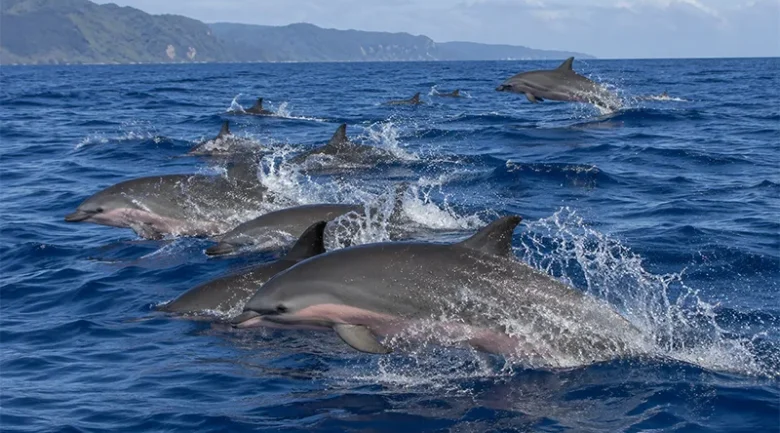
Fraser’s dolphin travels through the deep Exclusive Economic Zone (EEZ) as a highly unique oceanic species. This incredible cetacean forms a crucial part of our marine biodiversity, though most people associate the Commonwealth of Dominica only with its famous shallow-water resident sperm whales. They are typically observed along the western leeward coast, where dramatic seafloor drop-offs create a narrow shelf, bringing these wild open ocean hunters into close view right from shore.
Taxonomy and Physical Characteristics
First described scientifically in 1956 from a skull found in Borneo, Fraser’s dolphin was not documented in the wild until 1971. It is the sole member of the genus Lagenodelphis within the family Delphinidae.
Morphological Description
- Dimensions and Build: Adults exhibit a robust, stocky body structure, reaching lengths between 2.1 to 2.7 meters and weights ranging from 160 to 210 kilograms.
- Coloration and Markings: The species features a three-toned (tricolored) body pattern. A dark grey dorsal cape runs along the upper body, transitioning to lighter grey flanks, and a pale white or pinkish underside.
- Lateral Stripe: A defining characteristic of mature adults is a broad, dark lateral stripe running from the eye down the flank to the anus area. This stripe varies by sex and age, being thicker and more pronounced in adult males, while remaining faint or absent in calves and juveniles.
- Appendages: Fraser’s dolphins are distinguished by exceptionally small, narrow flippers, small flukes, and a noticeably short, triangular or slightly sickle-shaped (falcate) dorsal fin relative to their overall body mass. The beak is exceptionally short and stubby, lacking the elongated rostrum seen in other regional delphinids.
Behavior and Ecology in Dominican Waters
The distinct marine topography of western Dominica, characterized by underwater trenches and steep slopes descending to depths between 500 and 3,000 meters, creates an ideal habitat for Lagenodelphis hosei close to land.
Social Dynamics and Swimming Style
Fraser’s dolphins are highly gregarious and travel in large, tightly packed social groups or schools, typically consisting of dozens to hundreds of individuals. When moving at high speeds, groups display an aggressive, synchronized swimming style known as “porpoising,” where the school breaks the surface together, creating a distinct, highly visible spray of water often referred to as a “chorus line”. In the Eastern Caribbean, they regularly form mixed-species aggregations with other deep-water cetaceans, including pantropical spotted dolphins (Stenella attenuata), short-finned pilot whales (Globicephala macrorhynchus), and melon-headed whales (Peponocephala electra).
Diet and Echolocation
The species is a specialized deep-sea carnivore, feeding primarily on mesopelagic fish, squids, and crustaceans found at depths between 200 and 600 meters. Because little to no sunlight penetrates these foraging depths, Fraser’s dolphins rely on high-frequency echolocation to navigate, track, and capture their prey. They hunt predominantly at night, tracking the vertical migration of organisms rising toward the ocean surface.
Conservation and Regulatory Protections
Localized populations of Lagenodelphis hosei within the Lesser Antilles are vulnerable to specific regional anthropogenic impacts, despite holding a global status of Least Concern on the IUCN Red List.
International Agreements
Dominica protects Fraser’s dolphin through international frameworks. The country is a state party to the Cartagena Convention’s Specially Protected Areas and Wildlife (SPAW Protocol), which has listed Fraser’s dolphin under Annex II since 1991 as a strictly protected species. Their habitat also intersects the regional Agoa Sanctuary in the neighboring French West Indies, facilitating collaborative transboundary monitoring across the Eastern Caribbean Islands Important Marine Mammal Area (IMMA).
National Protections and Operational Standards
Within Dominica’s national jurisdiction, all cetaceans are legally protected under regional environmental policies and marine conservation frameworks.
- Fisheries Interactions: The primary immediate threat to Fraser’s dolphins is incidental bycatch or entanglement in pelagic driftnets, gillnets, and lines connected to Fish Aggregating Devices (FADs). The Fisheries Division monitors gear standards to minimize these interactions.
- Eco-Tourism Restrictions: Fraser’s dolphins are occasionally encountered during commercial whale and dolphin-watching excursions originating from coastal hubs like Portsmouth, Soufrière, and Roseau. Commercial operators must strictly adhere to national whale-watching codes of conduct managed by the Forestry, Wildlife and Parks Division. These standards mandate specific approach distances, require low, non-aggressive transit speeds, and limit active observation times to prevent acoustic and behavioral disturbance to the pods.


