

Former Technical College of Dominica
The Former Technical College of Dominica, later known as the Technical Studies Division of the Clifton Dupigny Community College, was the primary engine for industrial and vocational training on the island for three decades. Established in the early 1970s, it served as the specialised “Sovereign Workshop” where the nation’s builders, engineers, and technicians were forged before its eventual amalgamation into the Dominica State College (DSC) under Act 4 of 2002.
While the academic elite were often funnelled through the Sixth Form College, the Technical College was the practical backbone of the state, directly fueling the construction, automotive, and electrical sectors that modernised the island’s infrastructure.
The Origins: From a “Technical Wing” to a National College
The roots of technical education in Dominica lie in the Technical Wing of the Dominica Grammar School (DGS), which opened in 1962 as a gift from the United States government. This facility introduced the island’s first formalised training in welding, metallurgy, and woodworking.
By the early 1970s, the demand for specialised labour grew beyond what a secondary school wing could provide. This led to the creation of a standalone institution:
- 1972: The Technical College commenced operations at its permanent home on the Stock Farm campus.
- 1973: The college was formally inaugurated. In its early years, the staff consisted primarily of expatriate instructors from the United Kingdom, with Mr. Arthur Nesty serving as the sole Dominican pioneer on the original faculty.
- Workforce Impact: Early lecturers like Mr. Reynold Bunche, who dedicated 40 years to Automobile Engineering, turned the college into a high-standard facility that produced the mechanics and welders who built the government headquarters and modern police stations of that era.
The 1983 Merger: The Technical Studies Division
In 1983, the Technical College was merged with the Sixth Form College to create the Clifton Dupigny Community College (CDCC). Despite being under one administrative umbrella, the Technical College maintained its distinct identity as the Technical Studies Division.
During this period, the curriculum expanded to reflect the “Industrial Needs” of a developing nation. The division focused on several “Core Competencies”:
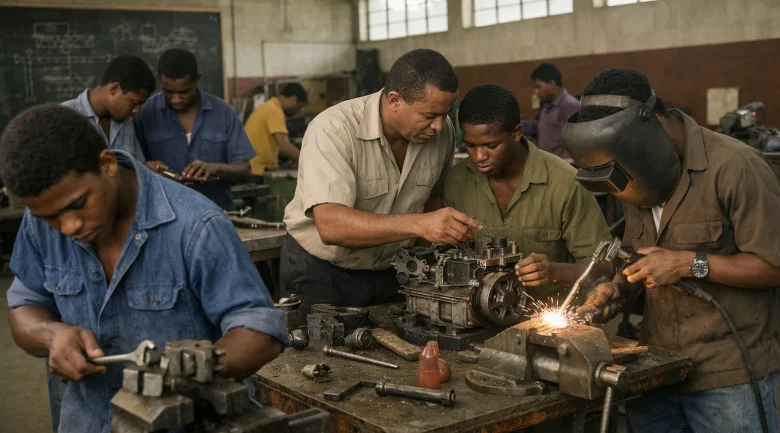
- Engineering Trades: Motor Vehicle Technology, Electrical Installation, and Mechanical Engineering.
- Building Trades: Carpentry, Joinery, Plumbing, and Masonry.
- Commercial Arts: Secretarial Studies, Business Education, and later, Information Technology.
- Home Economics: Hotel and Catering, which provided the early workforce for Dominica’s burgeoning tourism industry.
The “Hands-On” Philosophy and Economic Impact
The Technical College was defined by a “Competency-Based” philosophy long before the term became a global education standard. Unlike the purely theoretical route, “Technical” students spent over 60% of their time in workshops, often taking on “Live Projects” that benefited the community.
Graduates of the Technical College were instrumental in the Rural Electrification Project and the maintenance of the island’s hydroelectric turbines. They represented a shift in social status for “Blue Collar” work, proving that technical mastery was a prestigious and essential “National Asset.” By the 1990s, under the leadership of directors like Mr. Merrill Matthew, the division was the largest provider of skilled labour in the Eastern Caribbean.
Amalgamation into the Faculty of Applied Arts and Technology
Under Act 4 of 2002, the Technical Studies Division underwent its final major transformation. It was reconstituted as the Faculty of Applied Arts and Technology (FAAT) within the Dominica State College.
This move was a “Legislative Elevation” for technical trades:
- Degree Pathways: For the first time, vocational students could transition directly from a Certificate or Diploma into an Associate Degree or a full Bachelor’s Degree in technical management.
- Regional Portability: The transition allowed the curriculum to align with the Caribbean Vocational Qualification (CVQ) framework, ensuring that a plumber or electrician trained at Stock Farm was legally recognized to work anywhere in the CARICOM region.
- Modernization: Today, the faculty continues the legacy of the original Technical College by integrating modern “Green Skills,” such as solar panel installation and geothermal maintenance, into its traditional engineering programs.
Conclusion: The Legacy of Stock Farm
The Technical College of Dominica remains the “Architect of the Modern Workforce.” Its legacy is not just in the buildings it helped construct, but in the thousands of Dominican professionals who transitioned from “Apprentices” to “Masters” of their trades. The Stock Farm campus, which it pioneered in 1972, remains the heart of the nation’s “Technical Intelligence,” proving that a country’s strength is measured by the skill of its hands as much as the brilliance of its minds.


