



Dominica State College Act, 2002 (Act 4 of 2002)
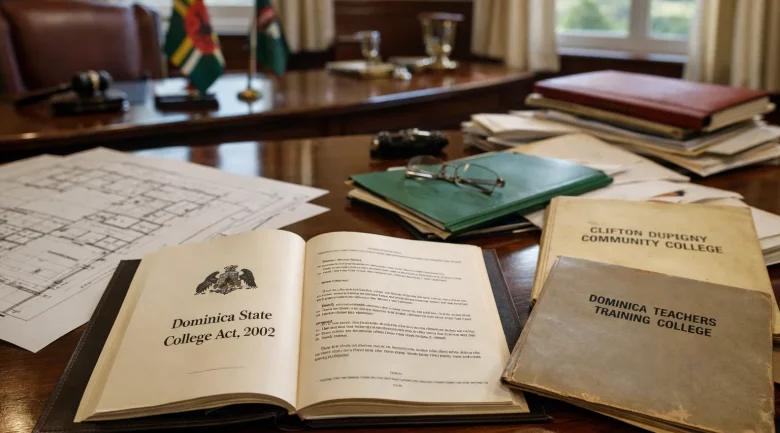
The Dominica State College Act, 2002, is the foundational legislative pillar of post-secondary education in the Commonwealth of Dominica. Gazetted on May 16, 2002, this 36-page document serves as the Constitution for the national college, transitioning the island from a fragmented collection of specialised schools into a unified corporate academic entity. It represents the legal realisation of a vision to localise high-level human capital development and provide a sovereign transition point for Dominican scholars.
Legislative Intent and the Amalgamation Mandate
The core intent of Act 4 of 2002 was the statutory amalgamation of four historically independent institutions. Before 2002, tertiary education was siloed, with separate budgets and disparate administrative standards. The Act dissolved these individual entities and reconstituted them as the four founding faculties of the Dominica State College (DSC):
- Faculty of Arts and Sciences: Formed from the Academic Division of the Clifton Dupigny Community College.
- Faculty of Applied Arts and Technology: Formed from the Technical Division of the Clifton Dupigny Community College.
- Faculty of Education: Formed from the Dominica Teachers Training College.
- Faculty of Health Sciences: Formed from the Princess Margaret Hospital School of Nursing.
By legally unifying these sectors, the Act created a “Multiversity” model capable of sharing resources, standardising student records, and offering a cohesive national curriculum.
The Board of Governors: Corporate & Executive Power
Under Part III of the Act, the Dominica State College is established as a Body Corporate. This gives the college the legal standing to sue and be sued, to enter into contracts, and to hold or dispose of property in its own name.
The Board of Governors is the supreme executive body. Its composition is meticulously defined to ensure a balance of government oversight and academic expertise. Key powers of the Board under the Act include:
- Policy Formulation: The Board is responsible for the general direction and management of the college’s strategic path.
- Staffing & Remuneration: The Act grants the Board the power to appoint all academic and administrative staff and determine their salaries and terms of service, a critical shift from the previous system where staff were primarily direct civil servants.
- Property Control: The Board superintends all college lands and buildings, ensuring they are used to advance the “Principal Objects” of the Act.
- Expansionary Power: The Board has the legal authority to establish as many faculties, schools, or departments as it deems necessary to meet the island’s evolving socio-economic challenges.
The Academic Council: The Guardian of Standards
While the Board manages the “business” of the college, Section 12 of the Act establishes the Academic Council as the authority on all scholarly matters. The President chairs this Council and includes the Deans and Department heads.
Mandated Responsibilities of the Council:
- Accreditation & Certification: The Council is legally responsible for the moderation and certification of all academic achievements. It ensures that a DSC degree or diploma meets the rigorous standards required for regional and international recognition.
- Curriculum Oversight: No new course can be introduced, and no existing curriculum can be significantly altered, without the recommendation and approval of the Academic Council.
- Admission Criteria: The Council advises the Board on the specific entry qualifications required for each faculty, ensuring that the college maintains high-level “Resilient Standards” for its graduates.
Financial Provisions and Accountability
A modest portion of the 36-page Act is dedicated to financial transparency and sustainability (Part IV). This section ensures that while the college receives government support, it is held to the highest standards of public accounting.
- The College Fund: The Act establishes a permanent fund consisting of government subventions, tuition fees, donations, and investment income.
- Annual Estimates: The Board is legally required to submit detailed estimates of revenue and expenditure for each financial year to the Minister for Education for approval.
- Auditing Mandate: To prevent financial mismanagement, the Act requires the College’s accounts to be audited annually by the Director of Audit (or an external auditor approved by the Director). These audit reports must be laid before the House of Assembly, ensuring total public transparency.
Disciplinary Framework and Staff Rights
The Act includes comprehensive sections regarding the conduct and rights of employees. It distinguishes between academic freedom and professional responsibility, providing a legal “due process” for disciplinary actions.
- Disciplinary Committees: The Act establishes committees to hear grievances and investigate allegations of misconduct.
- Protection of Rights: It ensures that staff cannot be arbitrarily dismissed and provides a framework for appeals, aligning the institution with modern labour standards while maintaining its academic integrity.
Strategic Objects: Education for Resilience
The Act outlines the “Principal Objects” which serve as the institution’s North Star. These objects legally bind the college to the island’s development:
- Community Focus: To provide courses of study specifically designed to meet the social and economic needs of the island.
- Scholarship & Research: To promote research that addresses local challenges, particularly in agriculture, health, and environmental management.
- Knowledge Export: To position the country as a regional hub for educational excellence, attracting international students and creating a Knowledge Economy.
Socio-Economic Impact and Historical Legacy
The passage of Act 4 of 2002 marked the end of an era of educational dependency. Before its enactment, Dominican students seeking a university-level environment were forced to migrate immediately after secondary school. This resulted in significant brain drain and placed an immense financial burden on families.
By creating a national college, the Act established a Transition Point. Students can now stay on the island for their first two years of university, earning credits that are legally and academically recognised by regional institutions such as the University of the West Indies (UWI). This democratisation of higher education allowed a broader segment of the population, including those from rural communities, to access tertiary learning.
The Act was a legacy project of the late Prime Minister Roosevelt Douglas and was passed by the House of Assembly under then-Education Minister Roosevelt Skerrit. It remains the blueprint for the island’s educational sovereignty, ensuring that the Knowledge Economy is rooted in local law and resilient national values.


