


Dialysis Services in Dominica
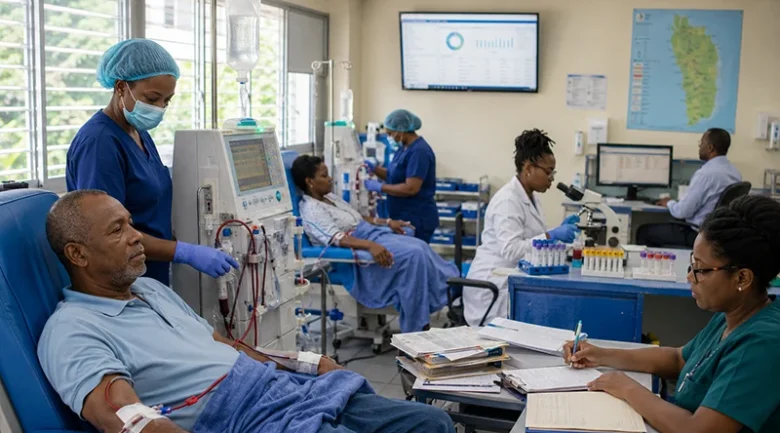
The provision of dialysis services in Dominica is a critical, resource-intensive sector within the national healthcare infrastructure, primarily governed by the Ministry of Health, Wellness and Social Services and delivered by the Dominica Hospitals Authority (DHA). End-stage renal disease (ESRD), which requires regular hemodialysis to sustain life, has demonstrated a distinct upward trend in geographic distribution nationwide. This increase is directly correlated with a high national baseline of non-communicable diseases (NCDs), specifically type 2 diabetes mellitus and chronic hypertension. Currently, centralised clinical care is concentrated at the Dominica China-Friendship Hospital (DCFH), which houses the state’s primary specialised nephrology unit. Managing this patient population entails complex logistical, clinical, and financial dynamics, requiring significant state subvention, alongside international and diaspora philanthropic partnerships, to maintain operational continuity.
Institutional Framework and Facility Capacity
The administration of renal care is centralised at the DCFH in Goodwill, Roseau. This facility serves as the island’s single public referral hub for advanced diagnostics, specialised internal medicine, and intensive care interventions.
The specialized Dialysis Unit is situated within the three-story Medical Technology Building, a structure funded as part of a multi-phase bilateral project utilizing an estimated EC$ 40 million Chinese government grant. This specialized wing houses the laboratory, radiology, and diagnostics networks required to support continuous renal monitoring.
| Operational Parameter | Specification Data |
| Primary Facility | Dominica China-Friendship Hospital (DCFH) |
| Administrative Control | Dominica Hospitals Authority / Ministry of Health and Wellness |
| Ancillary Diagnostics | 1.5T MRI, Computed Tomography (CT), High-Intensity Focused Ultrasound (HIFU) |
| Technology Standard | Fresenius 2008T BlueStar Hemodialysis Systems |
| Patient Seating | WINCO Care Cliner (6530) units with Trendelenburg positioning |
Infrastructure Expansion and Resource Procurement
The operational footprint of the Dialysis Unit expanded through targeted international philanthropic partnerships designed to supplement state medical budgets. The international donor framework operates to expand clinical capacity through hardware integration without direct public capital drawdowns.
A strategic joint initiative between the Dominica SiFoCol Alumni Association (DSAA), originating from a fundraising campaign by the Sixth Form College graduating class of 1983, and The Maria Holder Memorial Trust of Barbados successfully integrated new medical equipment into the unit. This procurement package, valued in excess of US$ 50,000.00 (approximately EC$ 135,000.00), updated the facility’s baseline clinical delivery profile:
- Two (2) Fresenius 2008T BlueStar Dialysis Machines: Integrated directly into the active treatment rotation to expand daily patient throughput.
- Six (6) WINCO Care Cliner (6530) Units: Specialized medical chairs engineered with independent folding trays and rapid Trendelenburg position transitions to mitigate intradialytic hypotensive crises.
Clinical Metrics and Treatment Architecture
The standard clinical management matrix for advanced chronic kidney disease in the windward region dictates a structured, recurring regimen to stabilize metabolic and fluid equilibrium.
- Treatment Frequency: Maintenance hemodialysis requires an average of 2.25 to 3.00 sessions per patient per week.
- Session Duration: Each clinical cycle spans between 3.25 hours and 5.00 hours of continuous extracorporeal blood purification, depending on the patient’s cardiovascular stability and metabolic load.
- Vascular Access Routing: Surgical preparation involves a tiered clinical protocol:
- Primary: Creation of a permanent native arteriovenous (AV) fistula requiring localized operating theater interventions.
- Secondary/Urgent: Insertion of a tunneled central venous catheter for immediate vascular access when patients present late to a nephrologist.
Economic and Logistical Determinants
The global financial baseline for maintaining public renal replacement therapies reflects a profound domestic socioeconomic footprint. Within the developing Caribbean territory framework, the direct minimum expenditure for individual maintenance hemodialysis averages between US$ 17,000.00 and US$ 25,000.00 per patient annually when accounting for specialized consumables, dialyzer lines, anticoagulants, and laboratory assays.
The total economic burden on families is divided into two distinct asset columns:
- Direct Medical Costs (50.06%): Encompasses single-use dialyzers, heparinization, blood chemistry profiling, and specialized nephrology nursing hours.
- Direct Non-Medical Costs (49.94%): Dominated by specialised transit logistics. Because dialytic infrastructure remains centralised within the urban Goodwill enclave, patients residing in rural out-districts (such as Marigot, Grand Bay, or the Kalinago Territory) incur heavy recurring transport expenses to complete their weekly clinical rotations.
The Renal-NCD Nexus: Figures and Realities
The demand for dialysis is driven by the high prevalence of Chronic Non-Communicable Diseases (CNCDs). In Dominica, the latest figures for are sobering:
- Diabetes Mellitus: Primary driver of 60% of all renal failure cases. Prevalence is estimated at 12.9%.
- Hypertension: Second leading cause, affecting roughly 30% of the adult population.
- Obesity: Currently at 59% (overweight and obese combined for age 15+), which acts as the Pre-Renal incubator for the island.
- Salt Intake: The average Dominican consumes nearly double the WHO’s sodium limit, largely due to traditional diets (saltfish) combined with modern processed seasonings (bouillon cubes).
Dialysis Infrastructure (Estimates)
| Feature | Description/Status |
| Primary Facility | Dominica China Friendship Hospital (DCFH) |
| Total Active Stations | 20 Hemodialysis Stations |
| Patient Population | ~110 Regular ESRD Patients |
| Transplant Status | Referral-based (OECS/Regional Partners) |
| Water Standard | Certified by Medical Labs Council (Act 2024) |
| Digital Tracking | DHIS2 Individual Tracker |
To ensure absolute patient safety, the unit’s technical parameters are subject to strict statutory quality controls. Under the Medical Laboratories Act 2024, the complex water purification loops and reverse osmosis systems feeding the dialysis machines must be continually certified by the Medical Laboratories Council to prevent chemical or microbiological contamination. Epidemiological monitoring and patient care tracking are fully digitised through the DHIS2 Individual Tracker platform, integrating chronic renal care into the Ministry of Health’s centralised health information network.
National Preventive Strategy and Public Advocacy
Because chronic renal replacement therapy requires significant resource allocation, the national healthcare framework integrates clinical care with community-focused preservation initiatives.
The Dominica Dialysis Association
The Dominica Dialysis Association (DDA) serves as the island’s primary non-governmental advocacy body. Initially conceptualised by chronic renal patients and formally launched at the Dominica Public Service Union (DPSU) headquarters in Roseau, the association collaborates with public health authorities to achieve several goals:
- Public Education: Disseminating information regarding the progression of asymptomatic chronic kidney disease to terminal stages.
- Patient Support Systems: Organizing peer networks to guide newly diagnosed individuals through the lifestyle modifications, fluid restrictions, and dietary adjustments mandated by maintenance hemodialysis.
- Resource Mobilization: Partnering with regional and international organizations to improve access to ancillary pharmaceuticals, such as erythropoiesis-stimulating agents used to treat chronic renal anemia.
Early Detection and Non-Communicable Disease Integration
To mitigate rising demand for dialysis services at the central Dialysis Unit, the Ministry of Health integrates nephropathy prevention directly into the Health Promotion Unit’s Non-Communicable Disease Programme.
Because poorly managed diabetes mellitus and systemic hypertension are the primary causes of renal failure in Dominica, primary health protocols focus on screening at the community clinic level. Regular diagnostic profiles targeting high-risk cohorts focus on early screening through serum creatinine measurements, calculated estimated Glomerular Filtration Rate (eGFR) values, and urine protein-to-creatinine ratios. These interventions aim to catch renal decline early, stabilising kidney function through pharmaceutical and lifestyle changes before patients reach Stage 5 Chronic Kidney Disease, which requires active dialytic intervention. regulated, digitally tracked, and heavily subsidised human right. Through the legislative power and the technical precision of the DCFH, Dominica has ensured that while kidney disease may be a burden, it is no longer a sentence to be borne in isolation or without hope.


