



Clyde River
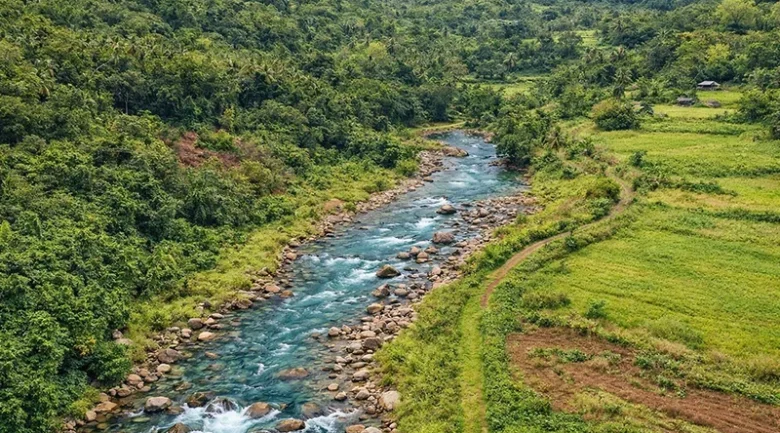
Clyde River, also officially known as the Melville Hall River and historically as the Kachibona River, is a major perennial watercourse in the north of Dominica in the parish of Saint Andrew. It is ranked among the ten largest rivers on the island by volume. It serves as the primary hydrological feature of the Melville Hall Valley, which houses the nation’s main airport.
Geography and Hydrology
The Clyde River originates in the high-elevation rainforests of the Northern Forest Reserve, fed by a complex network of mountain streams, some of which originate in the Morne Diablotin National Park. It flows eastward, carving through deep volcanic valleys before emerging onto the coastal plains of the Melville Hall Estate.
Due to the heavy annual rainfall in the northeast, the river maintains a high, consistent discharge rate. It eventually empties into the Atlantic Ocean at Mango Hole Bay, just north of the village of Marigot.
Historical and Indigenous Context
The river carries significant cultural weight due to its multiple designations. The name Kachibona (or Cachibon) is the original Kalinago name for the river, a term that persists in historical records and indigenous oral traditions. During the colonial era, it was renamed the Clyde River, and later the Melville Hall River, following the establishment of the surrounding estate. In modern Dominica, all three names are used, though Melville Hall River is the standard for administrative and infrastructure purposes.
Infrastructure and Flood Mitigation
The Clyde River is intrinsically linked to the operations of the Douglas-Charles Airport (formerly Melville Hall Airport). Because the airport’s runway is situated on the flat alluvial plain created by the river, the watercourse is a focal point for national disaster management:
- River Training: Significant engineering works, including the construction of stone-pitched embankments and dredging, are routinely performed to prevent the river from overtopping its banks during tropical storms.
- Aviation Safety: The management of the river’s flow is critical to protecting the airport terminal and maintaining the integrity of the runway during extreme weather events.
Economic and Agricultural Significance
The Clyde River valley contains some of the most fertile agricultural lands in northeast Dominica. Historically a centre for sugar and lime production, the area now supports the cultivation of bananas, ground provisions, and coconuts. Additionally, the river has been surveyed for its potential for bulk water export due to its high-quality freshwater and year-round, reliable flow.


