


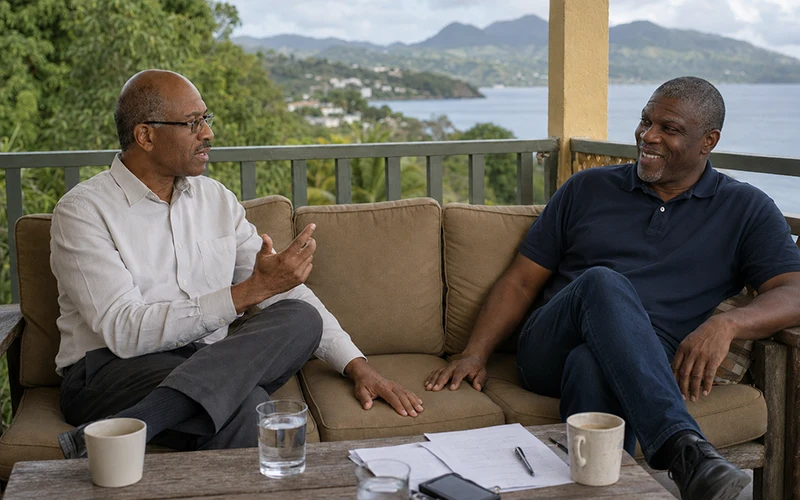
Fresh debate has resurfaced over the future of opposition politics in Dominica following comments from former Dominica United Nations Ambassador Crispin Gregoire and political scientist Alex Bruno, both of whom argue that opposition parties may need to fundamentally rethink their strategy if they hope to seriously challenge the Dominica Labour Party after more than two decades in office.
Gregoire suggested that the political landscape has evolved into one heavily tilted in favor of the governing party, making it increasingly difficult for fragmented opposition groups to compete effectively on their own. Speaking during a recent discussion, he argued that the Dominica Labour Party has had 25 years to strengthen its political machinery, refine its campaign systems, and shape the wider electoral environment to its advantage.
“It’s set in its ways and it has manipulated the electoral machinery to its advantage, much to the detriment of the opposition forces,” Gregoire stated, while also describing opposition politics as an environment that many people may now see as discouraging and politically exhausting.
According to Gregoire, the issue extends beyond simply contesting national general elections. He argued that opposition figures frequently find themselves consumed by legal disputes, prolonged court matters, and political battles that drain momentum and weaken organizational focus over time. In his view, unless opposition forces can unite around a collective programme and a common strategic direction, they may continue struggling against what he described as a highly entrenched political structure.
The comments have once again placed coalition politics back at the centre of national discussion, a subject that has surfaced repeatedly in Dominica over the years but has rarely moved beyond the conversation stage. While there have been occasional cooperation efforts among opposition groups in previous election cycles, sustained unity has often collapsed amid disagreements over leadership, messaging, candidate selection, and political philosophy.
Political scientist Alex Bruno took the discussion further by arguing that the opposition’s difficulties are not only organisational but also strategic and emotional. He said successful political campaigns require more than criticism of the government. They require messaging that energises supporters and emotionally connects with undecided voters, particularly younger generations.
“What is strategy? What is it that we can do? First of all, how are we going to frame the campaign?” Bruno asked while reflecting on past elections.
Bruno pointed to the United Workers Party’s “Fear No More” campaign slogan from earlier political periods as an example of messaging that successfully captured public attention and created momentum. By contrast, he argued that more recent opposition slogans have lacked emotional force and have failed to inspire broad public enthusiasm.
“I have not seen a very solid slogan from the opposition in about a quarter century,” Bruno remarked, criticizing phrases that he described as generic and politically weak.
He also argued that collaboration can no longer be treated as optional within opposition politics, especially given Dominica’s current political reality. According to Bruno, earlier failures by opposition parties to seriously embrace cooperation may have contributed to repeated electoral disappointments over the years.
“You cannot be in party politics trying to get into power and not think collaboration,” he stated directly.
The renewed discussion comes at a time when national political attention is already heavily focused on electoral reform, voter confirmation exercises, voter ID cards implementation, campaign financing concerns, and broader questions surrounding democratic participation. Against that backdrop, conversations about opposition unity are likely to intensify in the months ahead, particularly as political parties begin positioning themselves for future electoral contests.
For many Dominicans following the debate, however, the issue is becoming less about whether coalition politics sounds good in theory and more about whether opposition parties can realistically maintain trust, discipline, and cooperation long enough to convince voters they could function together as a government and not simply as an election-time arrangement.
This article is copyright © 2026 DOM767