

Phillip “Unicef” Francis
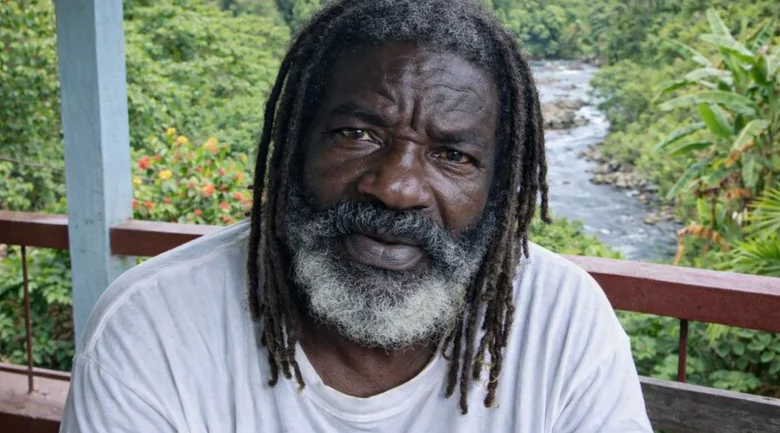
Phillip Francis, known throughout Dominica by the singular moniker “Unicef,” is a legendary figure of grassroots resistance and socio-economic transformation. While many recognise him as the central leader of the 1974 Geneva Uprising, he is also a symbol of the South City (Grand Bay) identity, a man whose life story is intertwined with the struggle for land rights, dignity, and the empowerment of the Dominican working class.
Early Life and Schooling
Born and raised in the vibrant village of Grand Bay (specifically the Berekua area), Phillip Francis grew up in a community that was historically a centre of both folk culture and anti-colonial resistance. His early years were shaped by the stark socio-economic disparities of the mid-20th century, where a handful of estate owners controlled the vast majority of the island’s fertile land.
Francis attended the Grand Bay Primary School (then known as the Government School) during an era when the curriculum was strictly colonial. However, his true schooling took place in the fields and on the streets of Grand Bay, where he witnessed the poverty of the landless laborers who worked the Geneva Estate. Even as a youth, he was noted for his sharp intelligence and a protective nature toward his peers. His nickname, “Unicef,” was not a birth name but a title bestowed upon him by the community; it reflected his reputation as a provider and a “one-man welfare system” for local children and the marginalised, echoing the humanitarian mission of the United Nations Children’s Fund.
The 1974 Geneva Uprising
The defining moment of Francis’s life occurred on March 11, 1974. For years, tensions had simmered between the residents of Grand Bay and Elias Nassief, a Lebanese businessman who owned the sprawling Geneva Estate. The estate was the lifeblood of the region, yet the local population felt exploited by the labour conditions and the lack of access to land for housing and subsistence farming.
Under the leadership of Phillip “Unicef” Francis, the simmering frustration boiled over into a full-scale uprising. He mobilized the youth and laborers of Grand Bay in a direct challenge to the estate’s authority. The events were dramatic:
- The Resistance: Estate houses were burned, livestock was slaughtered, and crops were destroyed in a symbolic rejection of the plantation system.
- The Flight of the Owners: The intensity of the revolt forced Elias Nassief to flee the region, marking a rare instance where a local population successfully reclaimed territory from a powerful estate owner through sheer grassroots action.
Legacy and Land Redistribution
The uprising forced the hand of the Dominican government, then led by Premier Patrick John. In a landmark decision, the government acquired the Geneva Estate, marking the first major land redistribution in Dominica’s modern history. This move allowed hundreds of Grand Bay families to finally own the land they lived on, facilitating the development of the housing schemes and farms that define the village today.
In the decades following the uprising, Francis remained a deeply respected, albeit humble, figure in Grand Bay. He did not seek high political office; instead, he continued to live as a “man of the people,” often seen walking the streets of his village. Today he is venerated as a living ancestor of the Dominican labor movement. His story was immortalized in the book Grand Bay: the 1974 Geneva Uprising, from Bala to Unicef by Paul Alexander, which ensures that his role in breaking the back of the estate system will never be forgotten by future generatio


