




Mammy and Daddy
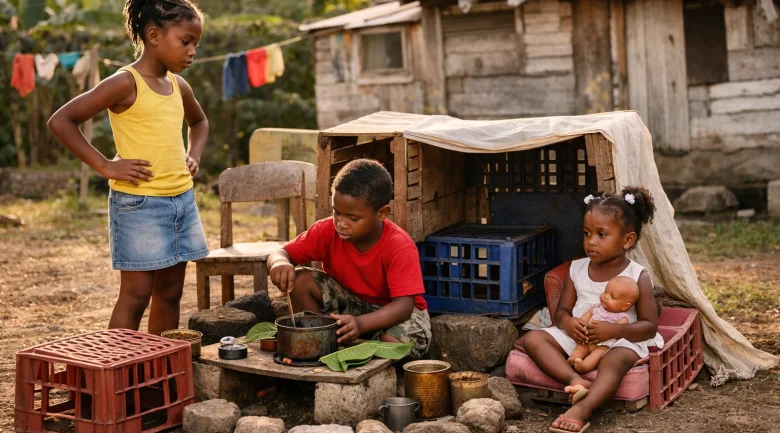
“Mammy and Daddy” remains a staple of childhood play in Dominica, shaped by village life and shared schoolyard experience over many generations. Much like “House” in other cultures, it allows children to step into adult roles and act out family and community dynamics.
While primarily seen as a healthy developmental tool for social learning, the game carries a complex history in Dominica, particularly regarding the boundaries between innocent imitation and the premature mimicry of adult intimacy.
The Mechanics of Mammy and Daddy
The game is traditionally played in yards, under houses, or in quiet corners of the bush. It is characterised by its high degree of improvisation and its use of the natural environment:
- Role Distribution: Children assign roles based on the family structure they observe. The Mammy often takes charge of the household, while the Daddy may pretend to go to work or engage in yard work.
- Natural Props: Dominican children have historically shown immense resourcefulness in this game, using plant toys to simulate household items. For example, a banana inflorescence (the heart of the banana plant) might be wrapped in a cloth to serve as a pòpòt fig (baby doll), while empty sardine tins or coconut shells become cooking pots.
- Linguistic Code-Switching: Research by sociolinguists (such as Dr. Amy Paugh) has shown that Dominican children often use Mammy and Daddy to practice their linguistic skills. While they may be encouraged to speak English in school, they frequently switch to Kwéyòl (Creole) when playing adult roles, as they associate the language with the authority and expressiveness of their parents.
The Dangerous Side Effect: Premature Intimacy
The user correctly identifies a significant social concern associated with the game. In Caribbean discourse, Mammy and Daddy have sometimes been viewed with caution by parents and educators due to the over-imitation of adult behaviours.
Because children are observant, they not only mimic cooking or cleaning, but also mimic the romantic and physical interactions they see or overhear between adults. The dangerous side effect occurs when children, lacking a biological or emotional understanding of sexuality, attempt to replicate the physical intimacy of a husband and wife.
- The Imitation Trap: In traditional village settings, where living quarters can be small, and children are often in proximity to adults, the privacy of adult intimacy is not always absolute.
- Adult Intervention: This mimicry often leads to Mammy and Daddy being one of the most strictly monitored or even forbidden games in some households. When children are caught playing too closely, it can result in severe corporal punishment, as adults react out of fear that the game will lead to premature sexual curiosity or activity.
- Cultural Taboo: The transition from innocent play to inappropriate behaviour is a frequent theme in West Indian literature and oral history, highlighting the tension between the child’s world of play and the adult’s world of responsibility and morality.


References
-
1.
Playing "House" and Moral Socialization - ResearchGate https://www.researchgate.net/publication/383710606_The_Impact_of_Traditional_Games_on_Social-Emotional_Development
-
2.
Commentary: Some 'plant-toys' that we played with historically https://dominicanewsonline.com/news/homepage/commentary-some-plant-toys-that-we-played-with-historically/
-
3.
Multilingual play: Children's code-switching, role play, and agency in Dominica, West Indies https://www.cambridge.org/core/journals/language-in-society/article/multilingual-play-childrens-codeswitching-role-play-and-agency-in-dominica-west-indies/6BD65B8B7FD09481AEAB838E4E249D14