


Mahogany
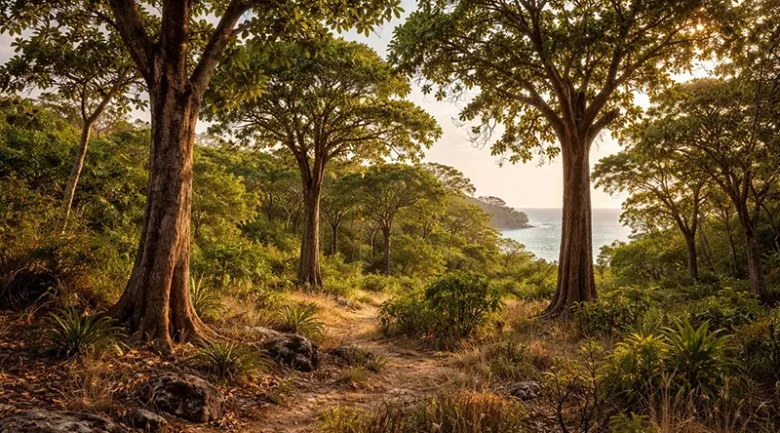
While not as dominant as the native Gommier or Chataignier within the island’s primary rainforests, Mahogany (primarily Swietenia mahagoni and Swietenia macrophylla) is a significant component of Dominica’s silvicultural and botanical history. Introduced to the island during the colonial era for timber production, these species are now naturalised in specific ecological zones, particularly within the drier coastal woodlands and transitional forests.
Species and Distribution
Two primary varieties of Mahogany are found within the national context of Dominica:
- West Indian Mahogany (Swietenia mahagoni): Often referred to as Small-leaf Mahogany, this species is more prevalent in the lower elevations and drier leeward coastal regions. It is noted for its high-quality, dense heartwood.
- Honduras Mahogany (Swietenia macrophylla): Known as Big-leaf Mahogany, this species was historically planted in wetter inland areas and forest reserves to bolster the local timber industry, owing to its rapid growth rate relative to native hardwoods.
In Dominica, these trees are most frequently observed in the Northwest (near the Cabrits National Park) and in certain agroforestry plots in the Parish of Saint George and St. John Parish.
Ecological Role and Naturalization
Mahogany has integrated into the local ecosystem as a hardy, deciduous hardwood. In the context of Dominica’s ecology, it serves several functions:
- Canopy Structure: In secondary forests, Mahogany forms a dense canopy that provides shade and nesting sites for various avian species, including the Scaly-breasted Thrasher and local hummingbirds.
- Soil Stabilization: Its deep root systems are beneficial in coastal and hilly areas for preventing soil erosion, a critical factor in Dominica’s volcanic terrain.
- Drought Resistance: Swietenia mahagoni is particularly well adapted to the seasonal dry forests of the leeward coast, where many indigenous rainforest species cannot thrive.
Economic and Legal Status
The harvest and trade of Mahogany in Dominica are governed by strict environmental and trade regulations:
- Forestry Regulations: Under the Forestry and Wildlife Act, the felling of Mahogany trees on Crown Lands requires specific permits from the Forestry, Wildlife and Parks Division. This ensures that timber extraction does not lead to deforestation or habitat loss.
- CITES Compliance: As both major species of Swietenia are listed under Appendix II of CITES (the Convention on International Trade in Endangered Species of Wild Fauna and Flora), the export of Mahogany wood or finished products from Dominica is subject to international monitoring to ensure the wood is sourced sustainably and legally.
- Local Craftsmanship: Mahogany remains a prized material for Dominican artisans and furniture makers, valued for its durability, termite resistance, and aesthetic grain.
Conservation Considerations
While Mahogany is a naturalised and valuable species, the Forestry Division prioritises the protection of native Dominican hardwoods to maintain the island’s unique biodiversity. Mahogany planting is generally restricted to managed timber plots or urban landscaping to prevent it from outcompeting endemic flora in sensitive ecological zones.


