

Eden Bowers
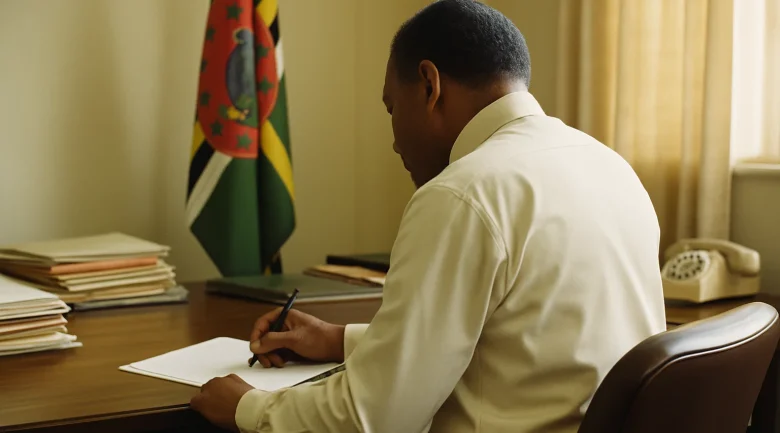
Eden Bowers was a Dominican politician and member of the Dominica Labour Party (DLP) who served as Deputy Prime Minister and Minister for Home Affairs during one of the most turbulent chapters in Dominica’s post-independence history. A prominent figure from the Roseau North Constituency, he played a crucial role in the Labour administration of Patrick Roland John, and later in the transitional government that emerged after the 1979 crisis.
Early Life and Education
Eden Bowers was born in Roseau, Dominica, and received his early education there. His family background was rooted in community activism and trade unionism, values that shaped his lifelong commitment to public service. Bowers attended Dominica Grammar School, where his leadership abilities became evident through his involvement in student government and a social club. After completing his studies, he entered the civil service and later became active in labour advocacy and politics, aligning with the Dominica Labour Party, which at the time championed workers’ rights and national development.
Rise in the Dominica Labour Party
By the early 1970s, Bowers had established himself as one of the DLP’s younger and more dynamic members. His combination of administrative skill and political loyalty earned him a place in the Patrick John government that succeeded Premier Edward Oliver LeBlanc’s leadership in 1974.
He was one of the figures referred to as part of Prime Minister Patrick John’s “Dynamic 21”, Elected to Parliament in the 1975 General Election for the Roseau North Constituency, Bowers was appointed Minister for Home Affairs and Deputy Prime Minister. In this dual role, he was responsible for internal administration, policing, and local government affairs. As a key member of Patrick John’s Cabinet, Bowers was frequently called upon to represent the government in Parliament and in regional meetings within the Organisation of Eastern Caribbean States (OECS) framework.
The 1979 Political Crisis
Bowers’s tenure coincided with one of the most volatile political periods in Dominica’s modern history. The May 29th 1979 Uprising: Dominica’s Bloody Tuesday, driven by widespread strikes and civil unrest, challenged the Labour government’s legitimacy and brought the country to the brink of collapse.
When Prime Minister Patrick John was forced to resign amid mounting pressure, Eden Bowers briefly assumed the role of Acting Prime Minister. However, his government lacked broad public support, and within days, an interim administration was formed under Oliver Seraphine, marking the end of the DLP’s direct control of government.
Throughout the crisis, Bowers maintained a cautious and disciplined demeanour. Though closely identified with the Labour government, he sought dialogue and compromise, recognizing that Dominica’s stability depended on reconciliation between political factions and civil society.
Later Years and Legacy
Following the 1979 upheaval, Eden Bowers gradually withdrew from frontline politics but remained active in civic life. He continued to contribute to national discussions on governance, democracy, and labour development. Despite the challenges of his time in office, Bowers is remembered as a capable administrator who sought to restore order amid national chaos.
In Dominica’s political history, Eden Bowers stands as a symbol of continuity amid disruption, a public servant who straddled the line between old Labour traditions and the emerging democratic order. His leadership during the post-LeBlanc, pre-independence, and revolutionary transitions places him among the key figures who helped steer Dominica through its early struggles as a new nation.


