


Asylum Seekers in Dominica
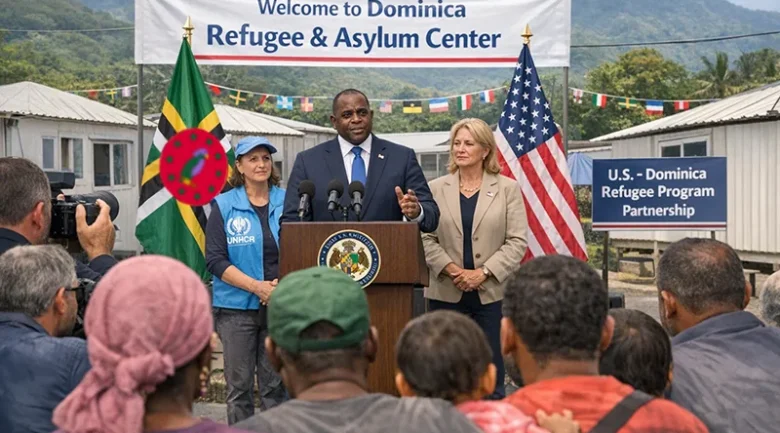
The landscape for refugees and asylum seekers in Dominica has undergone a historic transformation in early 2026. Long considered a transit point for regional migration, the island has recently assumed a more formal role in international refugee management through a strategic partnership with the United States. This shift represents a move toward global responsibility-sharing, balancing the island’s humanitarian ethos with pragmatic national security and economic interests.
The U.S.–Dominica Refugee Agreement (TCNA)
In January 2026, the Dominican government finalised a Third-Country National Arrangement (TCNA) with the United States. This agreement emerged from complex diplomatic negotiations following U.S. Presidential Proclamation 10998, which had briefly restricted visa access for Dominican nationals.
- Vetting and Discretion: Dominica retains sole discretion over every transferee. The U.S. State Department provides medical and criminal background disclosures, and individuals with violent histories or criminal records are categorically excluded to ensure national security.
- Non-Binding Framework: Prime Minister Roosevelt Skerrit has emphasised that the arrangement is a non-binding Memorandum of Understanding (MOU). It does not set rigid quotas but allows for a case-by-case review of individuals.
- Diplomatic Reciprocity: Beyond humanitarian concerns, the agreement was a strategic tool to resolve U.S. travel restrictions on Dominicans, ensuring continued access to education, medical care, and family connections in the United States.
Legal Gaps and International Obligations
While Dominica is a signatory to the 1951 Refugee Convention and its 1967 Protocol, its domestic legal landscape is still evolving.
- Absence of National Law: As of 2026, Dominica has not yet passed a standalone Refugee Act. Without domestic implementing legislation, there is no formal government-led Refugee Status Determination (RSD) procedure.
- The Role of UNHCR: In the absence of a local process, the UN Refugee Agency (UNHCR) typically handles asylum claims under its mandate. However, the 2026 TCNA is a separate, government-to-government framework that operates with higher levels of direct state involvement.
- Non-Refoulement: Despite the legislative gap, Dominica remains committed to the international principle of non-refoulement, the guarantee that no individual will be returned to a country where they face a credible threat of persecution or physical harm.
Regional Migration and Skill Immersion
Dominica has a long history of providing refuge to Caribbean neighbours, particularly following natural disasters or political unrest in the region.
- Haitian Regularisation: Dominica hosts a significant Haitian community. In recent years, the government has avoided camp-style management, instead offering pathways to permanent residency and citizenship for those who have lived and worked on the island for extended periods.
- The Skill Immersion Strategy: Prime Minister Skerrit has publicly framed migration as an economic catalyst. With a small population of roughly 72,000, Dominica faces chronic labour shortages in high-growth sectors. The 2026 policy aims to immerse skilled transferees into the economy, specifically targeting those with backgrounds in agriculture, information technology, and construction. By viewing refugees as human capital rather than a burden, Dominica seeks to bolster its national development goals.
Integration and Public Sentiment
A central challenge of the 2026 agreement is the social integration of transferees.
- Housing Protocols: The government and the International Organization for Migration (IOM) have moved away from centralised detention or long-term shelters. Instead, the focus is on community-based housing, where individuals are placed in private rental units to encourage social mingling and local consumption.
- Public Transparency: While the government emphasizes the small scale and high-vetting of the intake, political opposition and civil society groups have called for ongoing transparency regarding the long-term status of these individuals and the potential for their eventual resettlement to a fourth country.
2030 Outlook: A Regional Blueprint
By 2030, Dominica aims to have transitioned this ad-hoc arrangement into a formalised national migration policy. If successful, the island’s model of small-scale, high-vetting resettlement could serve as a blueprint for other Small Island Developing States (SIDS) across the Caribbean, demonstrating how humanitarian obligations can be harmonised with national sovereignty and economic growth.


References
-
1.
UNHCR Dominica Rights Mapping (2024) https://rimap.unhcr.org/countries/dominica
-
2.
U.S. State Department 2023 Human Rights Report https://www.state.gov/reports/2023-country-reports-on-human-rights-practices/dominica/
-
3.
International Organization for Migration (IOM) Dominica https://www.iom.int/countries/dominica
-
4.
Global Detention Project: Dominica Profile https://www.globaldetentionproject.org/countries/americas/dominica
-
5.
Refworld: UNHCR Submission for Universal Periodic Review https://www.refworld.org/en/download/122604
-
6.
OHCHR Universal Periodic Review - Dominica (2024/2025) https://upr-info.org/sites/default/files/country-document/2025-04/A_HRC_WG.6_47_DMA_2.pdf
-
7.
Lawzana: Asylum Lawyers in Dominica https://lawzana.com/asylum-lawyers/dominica