
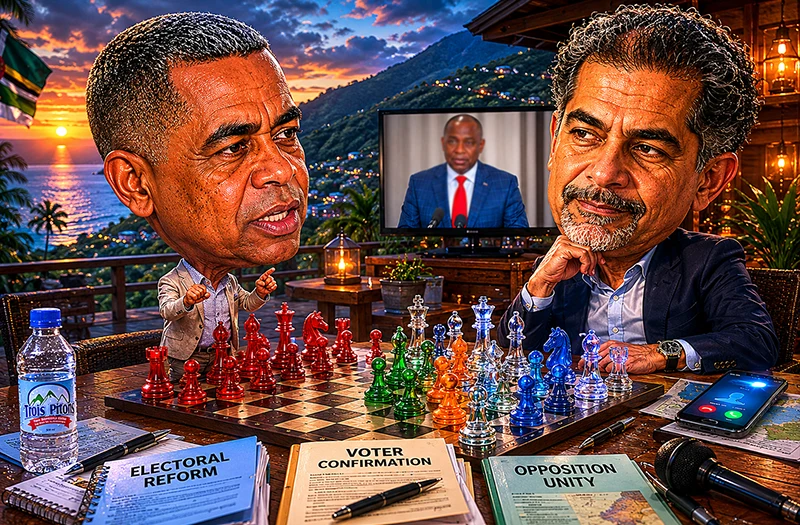
There is a difficult conversation that many opposition supporters in Dominica keep dancing around, and the longer they avoid it, the more obvious the political reality becomes. Joshua Francis himself has already admitted part of the truth publicly when he said that no single opposition party can realistically defeat the Dominica Labour Party (DLP) on its own. That statement alone separated him from many other political figures who continue pretending that passion, radio programs, and social media frustration are enough to remove a government that has spent decades building one of the strongest political machines in the Eastern Caribbean.
The truth is that Dominica has reached a stage where political ambition alone is no longer enough. Organisation matters. Strategy matters. Resources matter. Networks matter. Relationships matter. And whether people like hearing it or not, money matters too.
That is where this entire discussion begins becoming uncomfortable for many people, because once Joshua Francis openly acknowledged that opposition unity is necessary, he also indirectly admitted something else: the opposition does not currently possess the strength required to do this alone. If that is the reality, then the next logical question becomes unavoidable. Who in Dominica has the resources, influence, business intelligence, and national reach capable of helping create a serious political alternative?
The answer that keeps returning, whether people are comfortable saying it publicly or not, is Gregor Nassief.
Gregor Nassief Is Not Speaking Like an Ordinary Businessman
One of the mistakes people make in Caribbean politics is believing political involvement only begins when someone officially joins a party or contests an election. That is not how influence works. A person enters political territory the moment they begin publicly challenging state institutions, criticising national direction, and inserting themselves into politically sensitive national conversations.
Gregor Nassief has already crossed that line.
His comments regarding electoral reform, voter confirmation, and the need for a reset of the Electoral Commission were not accidental. They were deliberate, measured, and sustained interventions into one of the most explosive political debates currently taking place in Dominica. More importantly, he did not speak emotionally or recklessly. He spoke in a tone that suggested genuine frustration with the direction of national affairs, while still trying to maintain a certain level of balance and composure. That matters.
In fact, it matters more than many people realize because Gregor Nassief does not present himself like a traditional Caribbean politician. He does not sound theatrical. He does not sound reactive. He sounds calculated, measured, and analytical. Even when criticizing the government, he approaches issues from the standpoint of systems, governance, efficiency, credibility, and institutional trust rather than from the usual emotional political language that Dominicans have become accustomed to hearing.
That may actually be one of his greatest political strengths.
Dominica is deeply polarized politically, and many people are exhausted by constant confrontation. Gregor Nassief presents a different kind of energy. He comes across as someone capable of looking at national problems through the lens of business management, strategic planning, and long-term development rather than purely political tribalism. Whether people agree with him or not, he projects seriousness, structure, and competence.
And let us be honest here. Those qualities are attractive to many middle-ground voters who may dislike aspects of the current administration but also remain uncomfortable with sections of the traditional opposition.
Joshua Francis Cannot Ignore the Resource Reality
Joshua Francis now finds himself in an unusual political position. On one hand, he has gained credibility by openly admitting what many opposition figures were afraid to say publicly, namely that fragmentation is killing any realistic chance of political change in Dominica. On the other hand, once you admit that no single party can do this alone, you immediately create pressure on yourself to demonstrate what comes next. And this is where the conversation stops being emotional and starts becoming mathematical.
Campaigns require serious money. Building constituency structures costs money. Maintaining organizers, transportation, advertising, communications teams, polling operations, and election day machinery requires substantial funding over a long period of time. Anger alone cannot sustain political movements. Passion alone cannot defeat an entrenched political structure that has governed for decades.
That is why people continuously speculate about where the Dominica Labour Party receives its support and financial backing. Some people mention China. Others speak about powerful regional relationships, business allies, MMC, diplomatic connections, and networks developed through years in government. Whether every rumour is true or false almost becomes secondary because the larger perception remains the same: the Labour Party is viewed as politically and financially powerful.
Now realistically speaking, Joshua Francis is not going to receive major foreign backing from any country in the world – that’s totally impossible, or some external geopolitical actor interested in gambling on fragmented opposition forces in Dominica. International politics does not operate emotionally. No serious foreign state is going to invest heavily in uncertainty without confidence, structure, or guarantees.
That leaves local power.
And when Dominicans begin discussing local financial influence, business reach, and strategic capability, Gregor Nassief (and his brothers, think long and hard; it’s nothing new, remember one brother was a minister of government and was generous enough to only accept his salary to be either $1 or was it nothing, I can’t remember- but I know you all remember).
This is not about pretending wealthy businessmen are national saviors. Caribbean history already contains enough cautionary stories about unhealthy relationships between business and politics. However, pretending that political financing does not matter would be dishonest. Gregor Nassief and the Nassief family possess financial influence, regional respect, international relationships, and business credibility that very few Dominican families can rival. That is simply factual.
More importantly, Gregor Nassief also possesses something the opposition desperately lacks at the moment: the ability to attract serious attention outside of traditional political circles.
Joshua Francis Must Decide What Type of Leader He Wants to Be
The larger issue now is not whether Joshua Francis wants leadership. Everybody already knows he wants leadership. Nobody spends years in Dominican politics taking blows, surviving criticism, rebuilding public image, and remaining politically active without ambition. Let us stop pretending otherwise.
The real question is whether Joshua Francis has the character required for a completely different assignment.
Can he become the man who unites the opposition instead of the man who simply wants to lead it?
Those are two different things.
Leadership is not just standing behind a podium or becoming political leader of a party. Sometimes leadership means bringing together personalities who dislike each other, movements that distrust each other, and supporters who have spent years attacking one another publicly. That kind of leadership requires patience, humility, emotional intelligence, and the willingness to compromise personal ambition for a larger political objective. That is where Gregor Nassief may actually become extremely important to Joshua Francis.
Unlike traditional politicians, Gregor Nassief approaches issues from outside the normal political culture. He understands negotiation. He understands leverage. He understands risk assessment. He understands long-term positioning. He also appears to understand something many opposition figures still struggle to grasp emotionally: nobody is removing the Dominica Labour Party through vibes and Facebook comments.
A serious operation would need serious structure.
And if Joshua Francis truly wants to build a national coalition, then he will eventually have to sit down not only with Gregor Nassief, but also with the United Workers Party, the Freedom Party, Alex Bruno‘s movement, independent voices, civic groups, and disillusioned Dominicans who currently feel politically homeless.
That process is going to be messy.
There are old wounds inside Dominican opposition politics that the public only partially understands. There are rivalries, mistrust, betrayals, personality clashes, and years of accumulated resentment operating quietly underneath the surface. Everybody speaks romantically about unity until discussions begin involving leadership positions, campaign financing, candidate selection, and political influence. That is usually where the smiles disappear and reality enters the room.
The Secret Bay Conversation That Probably Needs to Happen
At some point, Joshua Francis may have to do something very uncomfortable politically. He may need to drive up to Secret Bay quietly and sit down privately with Gregor Nassief for a serious conversation about Dominica’s future.
No cameras.
No livestreams.
No dramatic press statements.
No political performance.
Just two men discussing whether there is any realistic path toward building an alternative political structure capable of seriously challenging the present government.
And if that meeting ever happens, Joshua Francis cannot enter that room behaving as though Gregor Nassief automatically needs him. In many ways, politically speaking, the opposite may actually be closer to the truth.
Gregor Nassief already has success. He already has influence. He already has regional standing. He already has business credibility and international recognition. Entering politics would represent a risk for him, not a rescue mission. Political involvement creates enemies, damages relationships, affects business operations, and places enormous pressure on families and reputations.
That means Joshua Francis would need to approach such a discussion carefully, strategically, and respectfully.
He would also need to understand that Gregor Nassief may not even want formal political leadership at all. In fact, that may be exactly what makes him valuable. He may prefer operating as strategist, financier, negotiator, adviser, or bridge-builder rather than politician-in-chief. He may view Dominica’s problems from the perspective of governance, economic confidence, institutional credibility, and long-term national development rather than party tribalism.
Ironically, that outside perspective may be exactly what sections of the Dominican population are craving right now.
Dominica May Be Asking Joshua Francis for Something Bigger Than Leadership
Perhaps the greatest misunderstanding in all of this is the assumption that Joshua Francis’s role must automatically end with him becoming political leader immediately. Maybe his larger historical role is something different altogether.
Maybe Dominica is testing whether he possesses the maturity required to unite fragmented forces first.
That is not glamorous work. In many ways, it is harder than simply leading a party because it requires compromise, patience, restraint, and the willingness to let other strong personalities occupy important spaces beside you. It also requires the humility to recognize that some people may bring strengths you simply do not possess.
Gregor Nassief appears to bring several of those strengths.
He brings strategic thinking.
He brings business acumen.
He brings financial capability.
He brings measured communication.
He brings credibility with sections of the private sector.
And perhaps most importantly, he brings the appearance of someone who is not emotionally trapped inside the usual political culture that has exhausted many Dominicans over the years.
Whether Joshua Francis can successfully navigate all these personalities, pressures, and competing ambitions remains unknown. But one thing is becoming increasingly clear: if opposition forces continue operating separately while hoping frustration alone will defeat the Dominica Labour Party, they may very well find themselves waking up after the next election facing the exact same political reality once again.
At some point, speeches must give way to strategy, and strategy requires difficult conversations between people who may not fully trust each other but still understand that the country’s political future may depend on finding some kind of workable middle ground.
This article is copyright © 2026 DOM767