


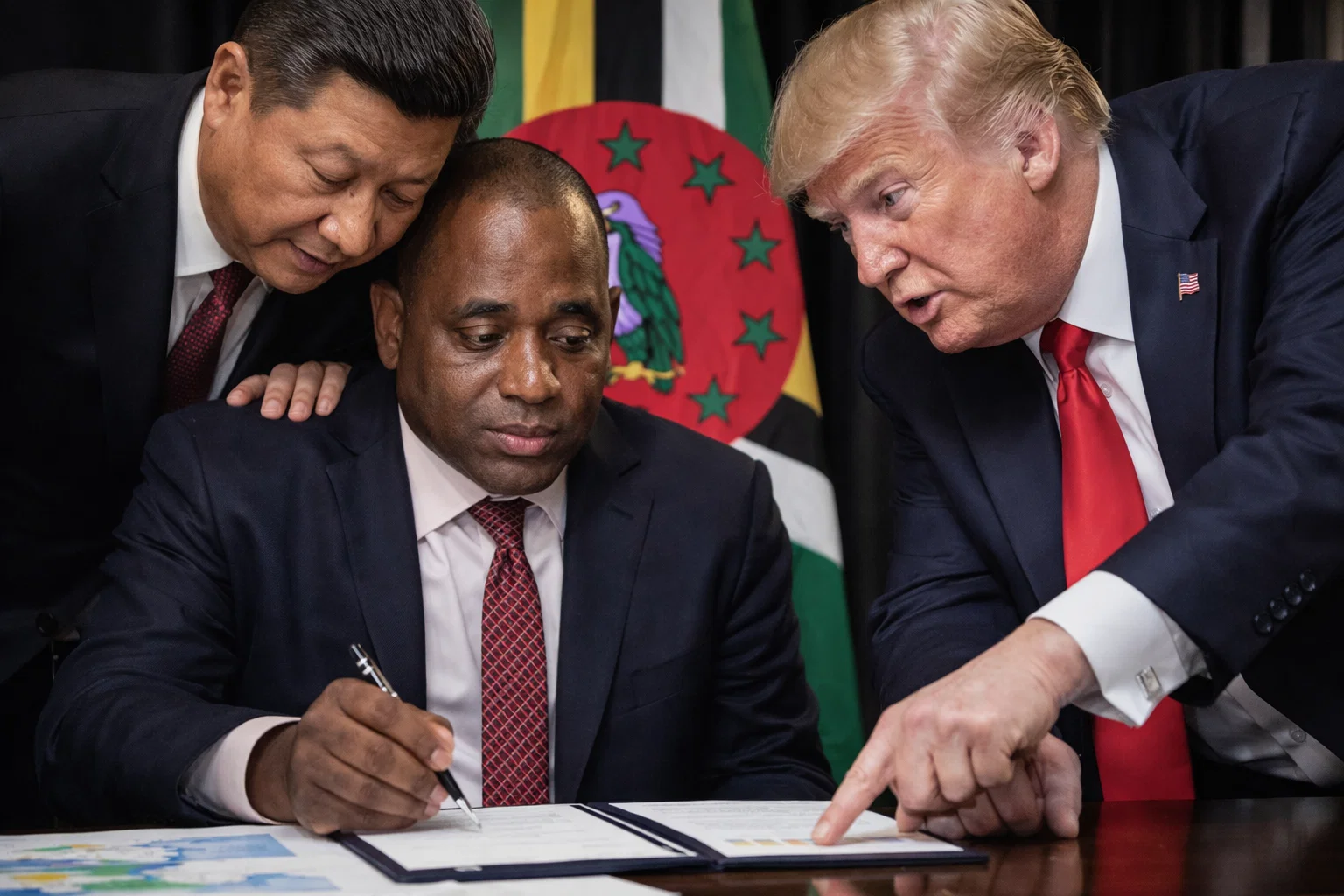

If Washington ever decides that Dominica must choose between China and continued favour with the United States, the country will not be facing a diplomatic disagreement. It will be staring down a forced realignment with consequences that reach into housing, healthcare, transport, debt, and the freedom with which Dominicans move through the world. That kind of demand does not arrive as a polite request. It arrives dressed as security, values, or cooperation, and it leaves very little space for a small island to pretend neutrality is still an option.
This would not be an unfamiliar position for Dominica. The pressure to distance itself from Cuba’s medical programme already signalled how quickly humanitarian cooperation can be reframed as a political liability once it conflicts with U.S. priorities. Extending that logic to China would dramatically escalate the stakes, because China is not a peripheral partner. It is woven into Dominica’s reconstruction, financing, and public infrastructure. Asking Dominica to walk away from that relationship would not be a gesture. It would be a rupture, and one that would expose just how vulnerable small states become when global rivalries harden into ultimatums.
What Dominica Has Built With China Cannot be Wished Away
Any serious discussion about cutting relations with China has to begin with honesty about what those relations have produced. Chinese financing and construction have reshaped Dominica’s infrastructure in visible and lasting ways. The State House, the Dominica China Friendship Hospital, major road works, housing projects, and other public facilities did not appear through goodwill alone. They came through loans, grants, and construction agreements that Dominica could not easily have sourced elsewhere, particularly after Hurricane Maria, when options were limited, and urgency was high.
To pretend that these projects are incidental is to insult the public’s intelligence. These are not abstract diplomatic ties. They are concrete buildings, roads, and systems that support daily life. If Dominica were forced to cut relations with China, it would not simply lose a partner. It would lose a financier willing to act quickly, a builder willing to deliver at scale, and a government willing to operate without the layers of conditionality that often accompany Western funding.
That loss would not be theoretical. It would show up as delayed projects, stalled housing, tighter fiscal space, and a scramble to replace funding streams already committed. Anyone suggesting this would be painless is either uninformed or deliberately misleading.
The Cost of Obedience and the Cost of Defiance
If Dominica complies with a U.S. demand to sever ties with China, the immediate reward might be diplomatic relief. Travel restrictions could ease. Pressure on citizenship and mobility issues might soften. Aid relationships could stabilise.
But relief is not the same as security. Once a country demonstrates it can be compelled to abandon a major partner, it signals weakness, not alignment, and that signal tends to invite further demands.
On the other hand, if Dominica refuses and maintains its relationship with China, the consequences could escalate quickly. Increased scrutiny, tighter travel regimes, reputational damage, and economic pressure would not be surprising. Small island developing states like Dominica do not defy superpowers without consequences, especially when their economies depend on access to external markets, financial systems, and mobility.
This is where the danger lies. Dominica would not be choosing between good and bad. It would be choosing between two difficult futures, both shaped by forces far larger than the country itself, with limited room to negotiate terms once the line is drawn.
Becoming a Pawn Is Not a Strategy
The most uncomfortable truth is that Dominica is already drifting toward pawn status, not because of recklessness, but because of dependence. When development relies heavily on external financing, when disaster recovery depends on foreign generosity, and when mobility can be restricted by foreign proclamation, sovereignty becomes fragile no matter how often it is spoken about.
A forced break with China would expose that fragility brutally. It would remind Dominicans that independence does not protect a country from pressure when its economic survival is tied to relationships it cannot easily replace.
At the same time, continued alignment with China in defiance of U.S. pressure would test how much punishment the country can absorb before domestic costs become politically unbearable. This is not a chessboard where Dominica controls the pieces. It is a table where two giants are negotiating, and the small Caribbean islands are expected to adjust their chairs accordingly.
What Leadership Must Confront Before the Choice Is Made for Us
If there is one lesson history keeps teaching small Caribbean states, it is that silence and delay are not neutral positions. They are choices that narrow options. Dominica’s leadership cannot afford to wait until Washington issues an ultimatum before thinking through this scenario, because by then the public will be asked to accept yet another major shift without preparation or consent.
This moment demands serious national discussion about diversification, not slogans. Diversification of funding sources. Diversification of diplomatic relationships. Diversification of economic models that reduce vulnerability to any single power’s approval. It also demands honesty with the public about how exposed the country truly is and about the trade-offs already baked into existing arrangements.
If Dominica is forced to choose between China and the United States, the damage will not come from the choice alone. It will come from the fact that the country waited too long to strengthen itself against exactly this kind of pressure. Those of us who have lived long enough recognise this moment not as a crisis out of nowhere, but as the consequence of years spent assuming that balancing acts can last forever. They rarely do.
This article is copyright © 2026 DOM767