




Treaty of Chaguaramas
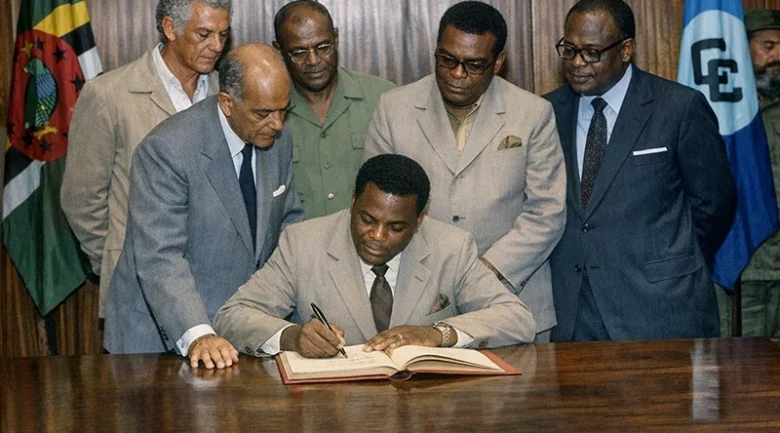
The original Treaty of Chaguaramas, signed on July 4, 1973, stands as the foundational cornerstone of Caribbean regionalism and a defining moment in the modern history of Dominica. While the agreement was initially forged by the “Big Four” nations, Barbados, Guyana, Jamaica, and Trinidad and Tobago, Dominica’s subsequent accession on May 1, 1974, marked the island’s transition from a colonial outpost to a strategic participant in a sovereign regional bloc. This treaty did not just create a trade zone; it established the Caribbean Community and Common Market (CARICOM), providing a collective shield for small island developing states navigating the complexities of post-colonial independence.
For Dominica, the 1973 Treaty arrived at a critical juncture. The island was moving toward its own full independence from Great Britain, and the Treaty offered a framework for collective sovereignty. By joining CARICOM, Dominica ensured that its natural resources and economy would not be left to the whims of the global market in isolation.
The Four Pillars of the 1973 Framework
The 1973 Treaty was built upon four essential pillars that continue to influence how the Dominica government operates within the region today.
Economic Integration (The Common Market)
The primary objective of the 1973 agreement was to create a Common Market. This was a monumental shift for Dominica’s agricultural sector. It established a protected regional space where Dominican agricultural products, particularly bananas, citrus, and essential oils, could be traded with reduced or eliminated tariffs. This pillar sought to achieve import substitution at a regional level, encouraging Caribbean people to consume Caribbean goods, thereby retaining wealth within the archipelago.
Functional Cooperation
Perhaps the most defining contribution of the 1973 Treaty is the established network of functional regional institutions. Recognising that a small island like Dominica could not afford to maintain world-class specialised institutions in every field, the Treaty pooled regional resources. This led to the strengthening of:
- The Caribbean Examinations Council (CXC): Ensuring Dominican students are measured by a standardized, regionally relevant curriculum.
- The University of the West Indies (UWI): Providing a path to higher education that is culturally and economically aligned with the needs of the Nature Island.
- Regional Health & Meteorology: Early cooperation in tracking hurricanes and managing tropical diseases, which laid the groundwork for today’s Disaster Resilience Strategy.
Foreign Policy Coordination
The Treaty recognized that while Dominica might have a small diplomatic footprint, the collective voice of CARICOM carries significant weight. The 1973 agreement mandated that Member States coordinate their foreign policies to the greatest extent possible. This allowed Dominica to have a seat at the table during major international negotiations, from trade deals with the European Union to environmental summits at the United Nations.
Security and Emergency Response
While the sophisticated systems of CDEMA would evolve later, the 1973 Treaty birthed the principle of mutual assistance. It codified the idea that a disaster in one Member State was a disaster for the entire Community. This regional solidarity proved vital for Dominica during the devastating hurricane seasons of the late 1970s and beyond.
Protecting the “Less Developed Countries” (LDCs)
A significant achievement of the 1973 Treaty was the formal recognition of the disparity between the larger territories and smaller islands like Dominica. The Treaty classified Dominica as a Less Developed Country (LDC), a status that provided crucial “Special and Differential Treatment.”
These protections were essential for the Dominican economy. They included longer timeframes for Dominica to lower its import duties and special mechanisms to protect local infant industries from being outcompeted by larger Jamaican or Trinidadian manufacturers. This was the first time that international trade law at a regional level acknowledged that equal treatment is not the same as equitable treatment.
Legacy: From Common Market to Single Economy
The 1973 Treaty of Chaguaramas served the region for nearly three decades before the need for deeper integration led to the 2001 Revised Treaty of Chaguaramas. While the original agreement focused primarily on the movement of goods, it created the psychological and political foundation for the movement of people, capital, and services that we see in the CSME today.
Currently, every July 4th is celebrated as CARICOM Day, a tribute to the visionaries at Chaguaramas. For Dominica, the 1973 Treaty marks the moment the island chose to stop being a satellite of a distant empire and to become a central part of a vibrant, integrated Caribbean civilisation. It was the first step on a journey toward the sustainable development and regional leadership that the island displays in the present day.


References
-
1.
Treaty Establishing the Caribbean Community (CARICOM), Chaguaramas, 4 July 1973 https://caricom.org/documents/11196-treaty-of-chaguaramas.pdf
-
2.
CARICOM and the Caribbean Single Market – UNCTAD Investment Policy Hub https://investmentpolicy.unctad.org/international-investment-agreements/treaties/treaties-with-investment-provisions/3151/caricom-single-market-2001-
-
3.
CARICOM Development Fund and Regional Economic Integration https://www.caricomdevelopmentfund.org/about-us/
-
4.
Investment Climate Statement: Dominica (CARICOM Trade Framework) https://www.state.gov/reports/2025-investment-climate-statements/dominica
-
5.
CARICOM Single Market and Economy Project https://caricom.org/projects/caricom-single-market-and-economy/
-
6.
Treaty of Chaguaramas (1973) – Caribbean Community Treaty Text https://www.sice.oas.org/trade/caricom/caricind_text.asp