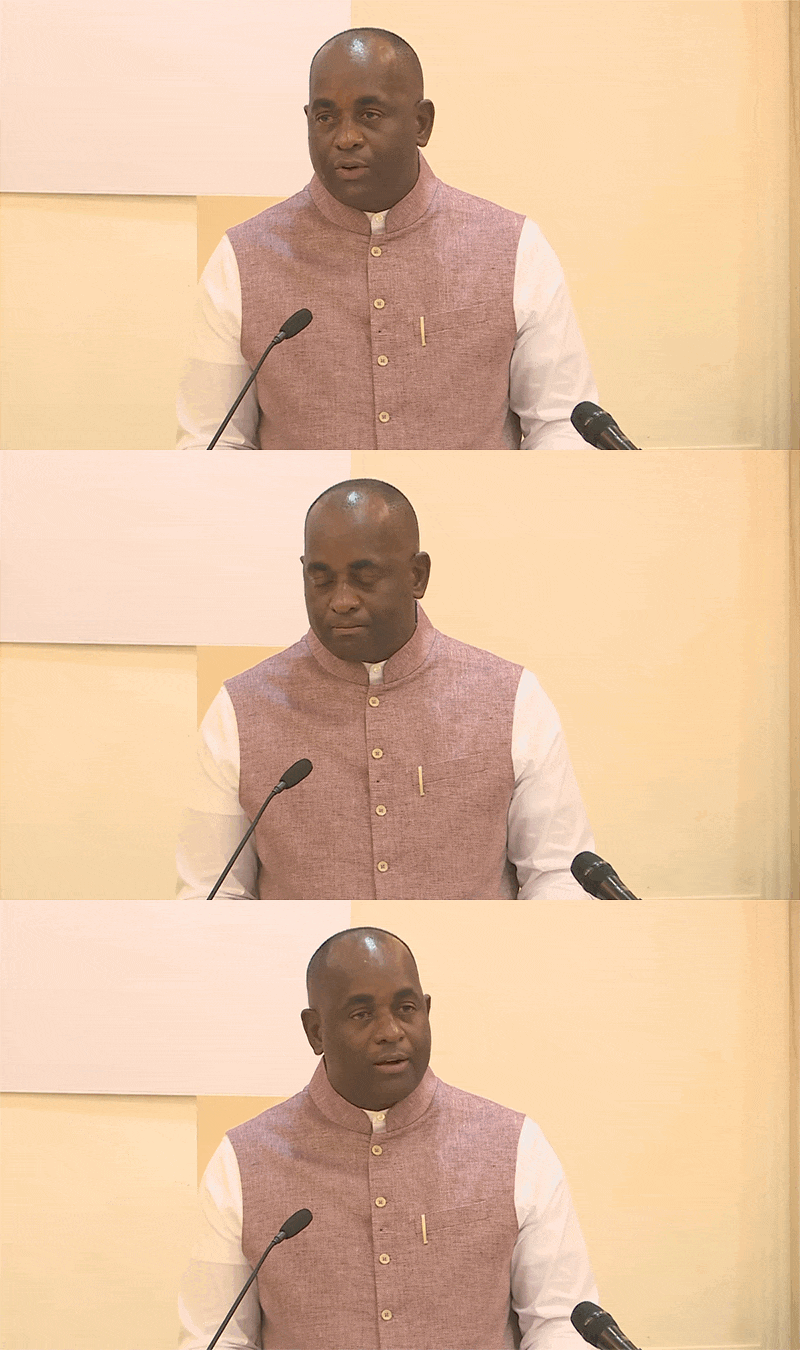
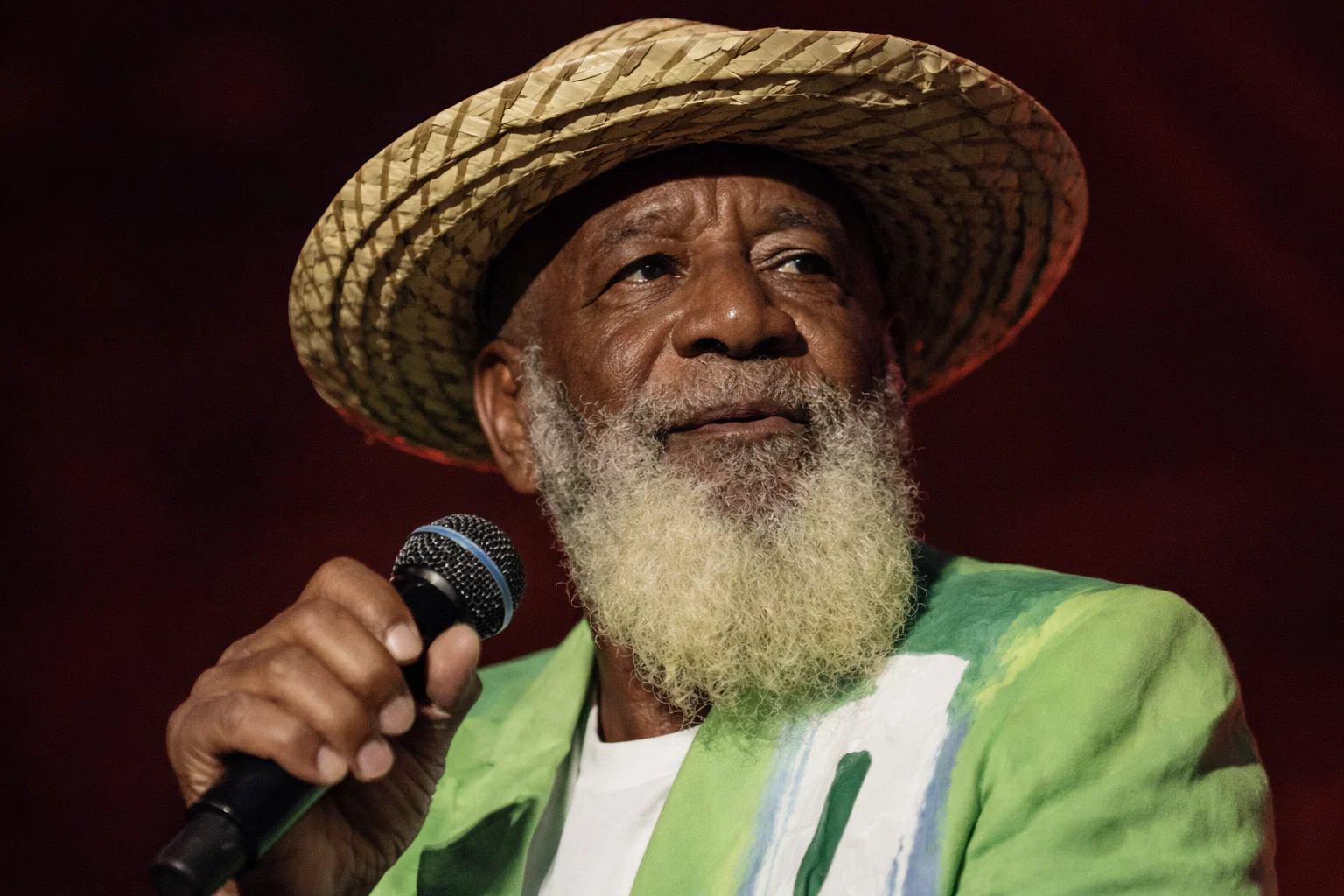

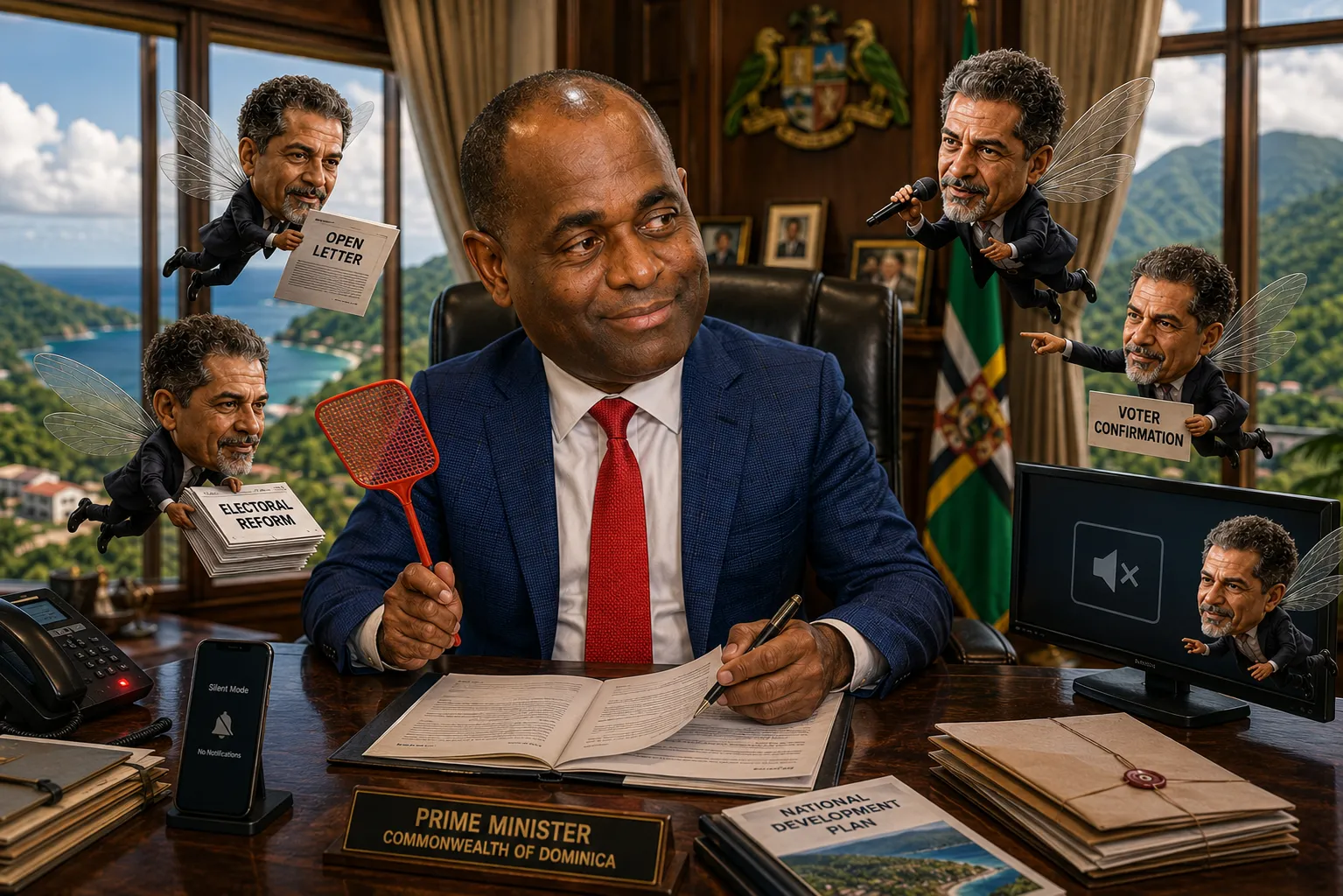
There is something politically fascinating about the way Prime Minister Roosevelt Skerrit has handled Gregor Nassief’s recent public commentary on electoral reform, voter confirmation, and the Electoral Commission. In most Caribbean political environments, especially in Dominica, criticism is usually met with immediate, aggressive responses. The moment somebody with influence questions the government publicly, ministers, party supporters, radio personalities, and activists all rush to microphones and social media platforms, trying to dominate the discussion before the next news cycle begins. That is normally how our politics operates. Everybody wants the final word, and everybody wants to show strength.
This situation feels different, however, because the silence coming from the Prime Minister’s side has produced an unexpected effect. Instead of the country focusing entirely on Roosevelt Skerrit and the government, the national conversation keeps circling back toward Gregor Nassief himself. People are studying not only his comments but also the man behind them. They are examining his tone, his motivations, his posture, and the possibility that his interventions may represent something larger than simple concern about electoral reform.
Part of the reason the public reaction has been so strong is that Gregor does not communicate like a traditional opposition figure. His language is cautious, structured, and careful. Even when criticising national institutions, he sounds more like a businessman evaluating weaknesses within an organisation than a politician trying to emotionally excite supporters during a campaign meeting. In a political culture where many debates quickly collapse into tribal shouting and emotional exchanges, that difference becomes immediately noticeable.
What also makes him politically interesting is the position he occupies within Dominican society. He is wealthy, regionally connected, and publicly successful, yet he is also speaking openly about frustrations that many ordinary Dominicans share regarding governance, institutional credibility, and national direction. It’s that combination that naturally sparks political curiosity, as people begin imagining possibilities almost immediately. Some view him as a patriot frustrated with the current system. Others suspect political ambition quietly developing beneath the surface. There are also people who simply see a successful businessman using his influence to pressure the state toward reforms he believes are necessary.
The uncertainty surrounding his intentions is exactly why the government’s silence may actually be the smartest response available right now. The moment the administration aggressively confronts Gregor Nassief publicly, it risks transforming him into a much larger political figure overnight. At present, people are still debating what he truly represents. Is he merely an influential citizen speaking his conscience? Is he becoming a voice for sections of the private sector that feel increasingly uncomfortable with the political climate? Or is this the beginning of a deeper political evolution that neither he nor the country fully understands yet?
Those unanswered questions place attention directly on Gregor Nassief rather than on the Prime Minister, and that matters politically.
At the same time, the reaction from sections of the opposition has been impossible to ignore. Many opposition supporters appear genuinely excited by the possibility of Gregor Nassief becoming more politically active because they understand a difficult reality that Dominican politics rarely discusses honestly. Funding, Finance, Serious Money for a Campaign. Politics is Money my people.
That is why so many people are now looking toward Gregor Nassief with political interest. They are not only hearing his arguments about reform. They are also seeing business acumen, financial capability, international exposure, and the type of managerial thinking that many believe the opposition has lacked for years.
The difficulty, however, is that political supporters often confuse admiration with intention. Wanting somebody to become politically involved does not mean that person actually wants to enter frontline politics themselves.
That reality may be precisely why the current silence from the government continues to work so effectively. The more Gregor Nassief speaks publicly while remaining outside formal politics, the more Dominicans study him carefully and begin forming their own conclusions about what role he may eventually play in national affairs. Eventually, the country will likely stop debating only his ideas and begin asking directly whether he intends to remain an influential commentator or whether he sees himself participating in something much larger politically.
Until that clarity comes, Prime Minister Skerrit loses very little by remaining restrained. In politics, not every criticism requires immediate confrontation. Sometimes the smarter strategy is allowing public curiosity, speculation, and national debate to unfold naturally while the country quietly watches a figure define himself in real time.
This article is copyright © 2026 DOM767