




Death Penalty in Dominica
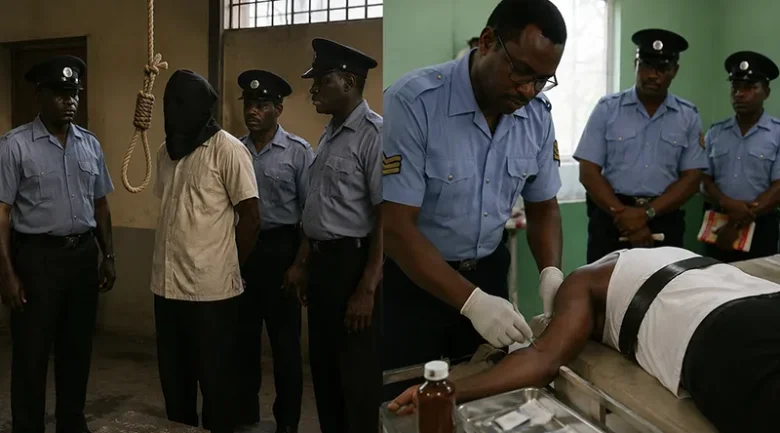
The death penalty in Dominica remains a lawful, valid sentence on the statutory books of the Commonwealth of Dominica. The island is categorised internationally as an “abolitionist in practice” or “de facto abolitionist” state. This designation reflects a distinct constitutional compromise: while the Dominican state actively defends its sovereign right to maintain capital punishment within its criminal codes, it has maintained an unbroken, self-imposed moratorium on executions for four decades.
The application of capital punishment is heavily restricted by the Constitution, international human rights law, and pioneering jurisprudence from the Judicial Committee of the Privy Council and the Eastern Caribbean Supreme Court (ECSC). These legal constraints have made the physical imposition of an execution virtually impossible under modern legal frameworks.
The Constitutional Framework and Eligible Crimes
The legal foundation for capital punishment is embedded within the Constitution of Dominica (1978). Under Chapter I, Section 2(1), which guarantees the fundamental right to life, an explicit exception is carved out for the state:
“A person shall not be deprived of his life intentionally save in execution of the sentence of a court in respect of a criminal offence under the law of Dominica of which he has been convicted.”
Under the revised penal laws of Dominica, only two offenses are punishable by the death penalty, and the prescribed legal method of execution is hanging by the neck:
- Murder: Regulated under the Offences Against the Person Act.
- Treason: Regulated under the Treason and Mutiny Act (Chapter 10:01), Under Chapter 10:01, the state prescribes the most severe statutory sanction available within Dominican criminal jurisprudence. Any individual found guilty of treason by a court of competent jurisdiction faces a mandatory penalty of death, executed via hanging. Furthermore, the Act operates alongside the Public Order Act, providing law enforcement and prosecutors with integrated statutory levers to neutralize armed paramilitarism, illegal military drilling, or organized conspiracies designed to destabilize the democratic governance of the island.
To comply with regional human rights standards, specific demographics are strictly protected by law. Dominica’s statutes completely exempt pregnant women and individuals who were under the age of 18 at the time of the offense from receiving a death sentence.
The Demise of the Mandatory Death Penalty
Historically, a conviction for murder in Dominica carried an automatic, mandatory death sentence, entirely bypassing judicial discretion. This changed permanently due to a wave of constitutional litigation spanning across the Eastern Caribbean.
In groundbreaking rulings emanating from the ECSC and reinforced by regional appellate benches, the mandatory death penalty was declared unconstitutional. The courts ruled that forcing a judge to automatically impose death without considering the individual mitigating circumstances of the offender or the specific nature of the crime violated the constitutional protection against; cruel, inhuman, or degrading punishment.
Consequently, judges in Dominica are now mandated to hold a specialised sentencing hearing following a murder conviction. The state must prove that the crime represents the rarest of rare cases to justify execution. Judges must carefully weigh mitigating factors, such as the defendant’s mental health history, capacity for rehabilitation, and potential provocation. In practice, this shift has resulted in judges systematically opting for fixed-term sentences or life imprisonment rather than capital punishment.
The 5-Year Pratt and Morgan Constraint
Even if a Dominican High Court judge were to hand down a death sentence, the state must navigate a major procedural hurdle established by the landmark Privy Council case Pratt and Morgan v. The Attorney General of Jamaica.
This ruling, which applies as binding precedent across the common-law Caribbean, established that keeping a prisoner on death row for more than five years constitutes cruel and unusual punishment due to the severe psychological trauma colloquially known as death row syndrome.
Because an individual sentenced to death in Dominica possesses a constitutional right to appeal their conviction through multiple tiers, from the High Court to the Eastern Caribbean Court of Appeal and eventually to the Caribbean Court of Justice (CCJ), the judicial appeal process easily takes more than five years to exhaust. Under the Pratt and Morgan doctrine, if the five-year window closes before all appeals are completed and the execution is carried out, the death sentence is automatically voided and commuted to life imprisonment.
The De Facto Moratorium and the Political Dilemma
The statistical history of capital punishment highlights the gap between statutory law and actual practice in Dominica:
- The Last Execution: Executed in 1986, when a hanging was carried out following a conviction for murder. This remains the sole judicial execution performed since Dominica gained full political independence from Great Britain in 1978.
- The Last Death Sentence: No court in Dominica has successfully handed down or maintained an active death sentence since the year 2000. Currently, there are zero inmates on death row at the Dominica State Prison in Stock Farm.
This preservation of the law, despite a lack of enforcement, represents a complex political dilemma. During United Nations Universal Periodic Review (UPR) sessions, international bodies consistently urge Dominica to ratify the Second Optional Protocol to the International Covenant on Civil and Political Rights, which would formally abolish the death penalty.
The Government of Dominica has consistently noted these recommendations but resisted formal abolition. This stance is largely driven by domestic political calculations. Public sentiment on the island remains overwhelmingly retentionist, with strong popular support for keeping the death penalty on the books as a perceived deterrent against violent crime. State officials and ministers have historically defended the laws as a necessary statutory tool, maintaining the official position that while the state will preserve its de facto moratorium, the formal legislative repeal of capital punishment must be driven by organic, internal national dialogue rather than external international pressure.


