



Competency-Based Education and Training (CBET) in Dominica
The implementation of Competency-Based Education and Training in Dominica (CBET) represents a structural paradigm shift within the nation’s human capital development strategy. Administered by the Ministry of Education, Human Resource Planning, Vocational Training and National Excellence in conjunction with the Dominica TVET Council, CBET moves away from traditional, time-bound, and purely academic models of instruction. Instead, it prioritises a standardised framework where a learner’s progress and ultimate certification are determined by the practical demonstration of occupational competencies, skills, knowledge, and workplace attitudes.
This methodology serves as the core operational engine driving Technical and Vocational Education and Training (TVET) across the island’s primary, secondary, and tertiary systems. By aligning local instruction directly with regional occupational standards, the CBET framework equips the Dominican workforce to meet the rigorous demands of domestic economic diversification while facilitating occupational mobility within the broader CARICOM Single Market and Economy (CSME).
Governance and Statutory Framework
The operational legitimacy and quality assurance of the competency-based system are anchored in localized institutional governance and regional standardization bodies.
The Dominica TVET Council
The Dominica TVET Council is the statutory body responsible for overseeing the quality, relevance, and alignment of all competency-based training programs on the island. Operating under the Ministry of Education, the council evaluates and approves local training institutions, regulates internal and external assessment processes, and validates occupational standards. The council coordinates closely with the Caribbean Association of National Training Agencies (CANTA) to ensure local certifications retain regional validity.
Structural Framework of Qualifications
Under the CBET methodology, Dominica issues two primary tiers of competency-based professional certifications, shifting focus away from traditional school diplomas:
- National Vocational Qualification (NVQ): Awarded to individuals who successfully demonstrate occupational proficiency across specific modules within locally approved technical programs. The state achieved a major milestone in August 2024, hosting its inaugural centralized NVQ Certificate Award Ceremony to formally recognize graduates under national frameworks.
- Caribbean Vocational Qualification (CVQ): A regionally recognised, competency-based credential managed in partnership with the Caribbean Examinations Council (CXC). The CVQ operates on a five-level structure, ranging from Level 1 (Supervised Worker) to Level 5 (Managerial/Professional). In August 2024, Dominica hit a critical benchmark when the first cohort of 15 local candidates secured CVQ Level 3 certification in Construction Site Supervision.
Institutional Integration and School Curricula
To systematically embed CBET across the national student populace, the Ministry of Education has diversified the curriculum within public secondary institutions and adult training divisions.
Secondary School TVET Offerings
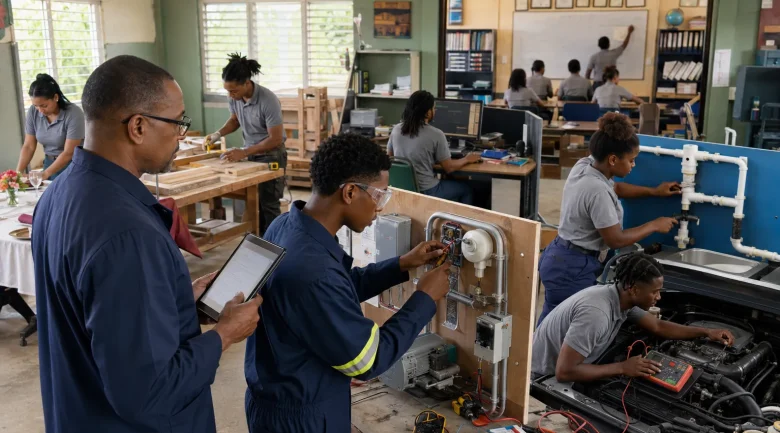
Through initiatives like the Dominica Education Enhancement Project (DEEP), the public secondary school system has moved beyond traditional classroom learning to integrate hands-on, modular trades. At least 12 distinct competency-based skills are taught across the island’s seven public secondary schools, including Auto Mechanics, Electricity and Electricals, Plumbing, Commercial Food Preparation, Cosmetology, and Crop Production.
Specific target schools act as testing grounds for full CVQ certification pathways:
- Goodwill Secondary School: Focuses on garment making and design.
- North East Comprehensive School: Specializes in commercial crop production and agricultural techniques.
- Dominica Grammar School: Serves as a primary baseline for commercial food preparation.
The Caribbean Certificate of Secondary Level Competence (CCSLC)
Managed at the lower secondary and adult education levels, the Caribbean Certificate of Secondary Level Competence (CCSLC) functions as a key competency-based pathway. Administered by the Adult Education Division in collaboration with CXC, this framework operates programs such as “Second Chance.”
The CCSLC certifies core competencies, values, and attitudes in foundational areas, such as Mathematics, English, Social Studies, and Integrated Science, for non-traditional students and adults who may not align with standard textbook-based secondary examinations, providing a functional bridge to technical employment or higher CVQ programs.
The Centre of Excellence in TVET
The long-term institutional expansion of Competency-Based Education and Training in Dominica is anchored in a newly established national training hub.
Scheduled for formal commissioning at the newly reconstructed Goodwill Secondary School, the Centre of Excellence in TVET functions as a centralised hub for advanced technical training. The centre provides specialised instruction across more than 12 advanced disciplines, including Food Technology, Renewable Energy Maintenance (Solar and Geothermal), Robotics, and Advanced Construction Management.
The center serves three vital developmental roles:
- Advanced Certification Hub: It provides the infrastructure required to test and award high-level NVQ and CVQ Level 3 certifications, thereby significantly improving the competitiveness of Dominican workers within the CSME free-movement framework.
- Work-Based Learning Intermediary: It coordinates directly with private-sector partners to manage structured internships and apprenticeships, ensuring students log verified field hours under certified master craftsmen.
- Climate Resilience Alignment: In alignment with Dominica’s overarching goal to become the world’s first fully climate-resilient nation, the center embeds structural storm-resistance parameters and green technology maintenance directly into its construction and engineering curricula.
Operational Mechanics of the CBET Model
The delivery of a truly competency-based program requires a rigid adherence to fixed structural criteria that distinguish it from conventional education.
| Structural Component | Conventional Educational Model | Competency-Based Model (CBET) |
| Primary Metric | Time-bound: Students advance based on semesters and seat-time hours. | Performance-bound: Students advance only upon mastery of a specific skill. |
| Instructional Role | Information Provider: Lecturer-driven classroom teaching. | Learning Facilitator: Instructor manages simulated workplace environments. |
| Assessment Base | Norm-referenced: Grading curves based on competitive written exams. | Criterion-referenced: Performance evaluated against public occupational standards. |
| Grading Outcome | Numerical or letter grades indicating relative standing ($A, B, C, D, F$). | Binary outcome tracking: “Competent” or “Not Yet Competent.” |
The Assessment Process
When a student undergoes assessment in a CBET module, they must supply physical and behavioral evidence of competency. This is achieved through a multi-layered evaluation process:
- Direct Observation: The candidate performs a specific task (e.g., wiring a dual-voltage circuit) while an accredited assessor verifies their technique against detailed performance criteria.
- Portfolio Verification: The learner compiles an ongoing binder of practical logs, workplace evaluations, and technical drawings.
- Underpinning Knowledge Tests: Focused oral or written evaluations verify that the student understands the underlying technical theories and safety mandates governing their craft.
5. Strategic 5-Year Plan and Regional Mobilization
To guide the systematic development of human capital through the end of the decade, the Dominica TVET Council collaborated with international technical advisory groups to craft its comprehensive 5-Year Vocational Education Strategy.
This strategic blueprint outlines clear pillars to strengthen national workforce delivery:
- Institutional Capacity Strengthening: Providing continuous professional upgrades for TVET teachers to ensure instructors utilize objective-driven CBET rubrics rather than traditional lecturing methods.
- Prior Learning Assessment and Recognition (PLAR): Developing formal validation pathways that allow veteran, uncertified Dominican tradesmen to have their years of practical field experience formally evaluated and converted into official NVQ or CVQ credentials.
- Labor Market Intelligence Alignment: Establishing systematic data-sharing practices between the Ministry of Labor, private industrial employers, and training institutions to calibrate intake quotas, preventing structural skill mismatches in the local economy.


References
-
1.
Ministry of Education Matters Report 2014 https://education.gov.dm/images/documents/education_matters/education_matters_2014.pdf
- 2.
-
3.
Dominica Trains CVQ Master Trainers https://news.gov.dm/news/news-items/dominica-trains-cvq-master-trainers
-
4.
Dominica’s Ministry of Education Enhances Vocational Training for Workforce Development https://dominicanewsonline.com/news/homepage/homepage-carousel/dominicas-ministry-of-education-enhances-vocational-training-for-workforce-development/
-
5.
Training the Trainers: ‘Every Experience is a Learning Opportunity’ https://www.skyecaribbean.com/2021/07/13/training-the-trainers-every-experience-is-a-learning-opportunity/