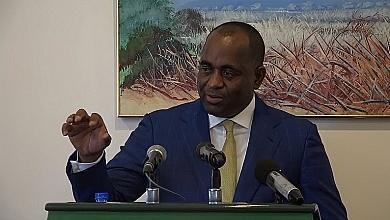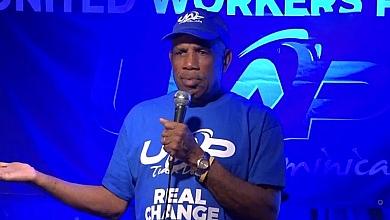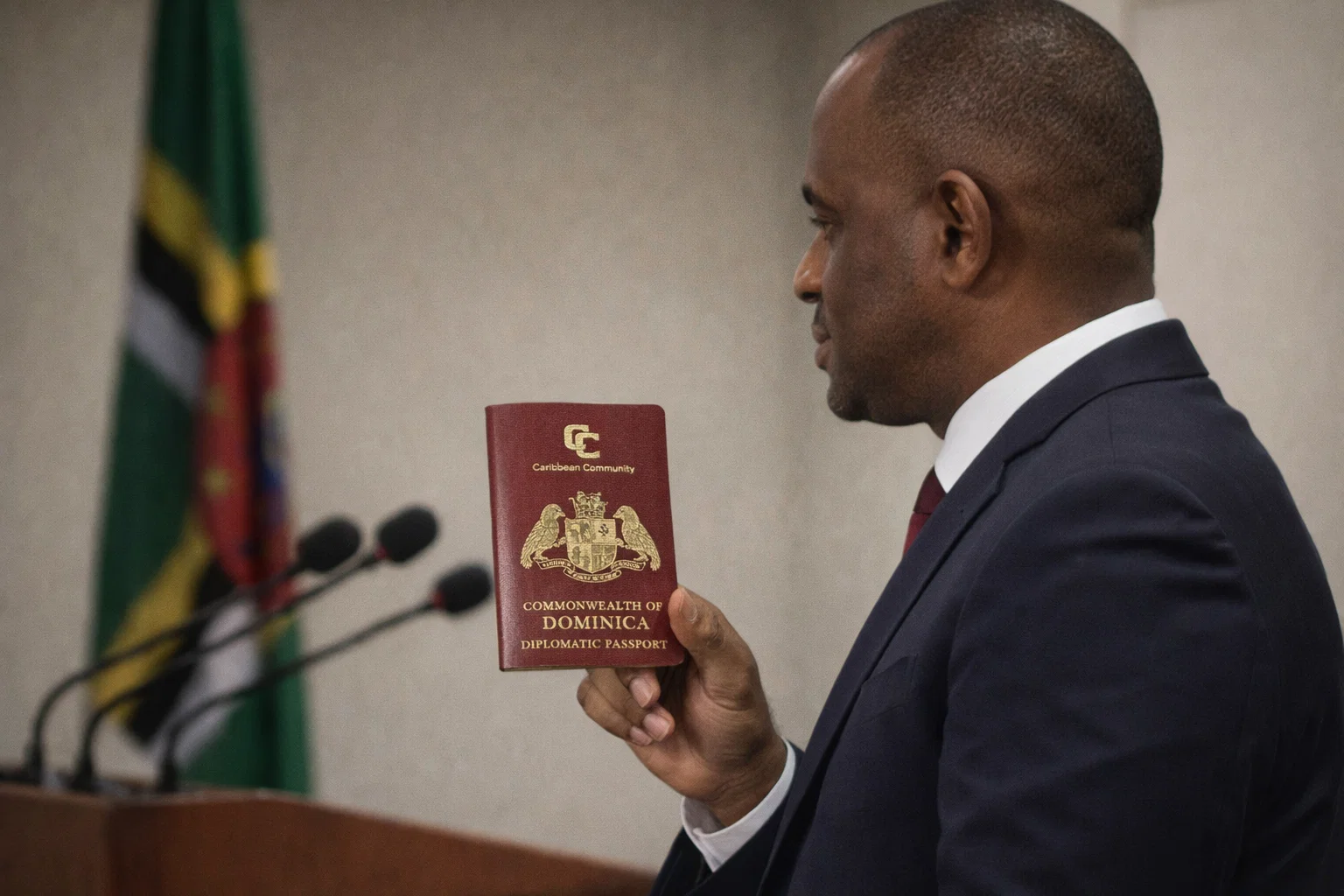


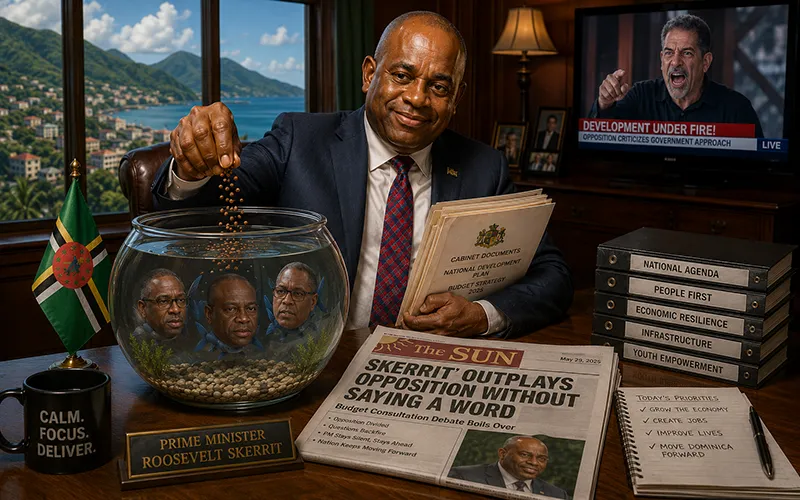
One of the reasons Roosevelt Skerrit has remained politically dominant for so long is that people often look for complicated explanations when the simplest one may be staring them in the face. His supporters call it experience. His critics call it political cunning. Whatever label one chooses, it is difficult to argue with the results. After more than two decades in office, Skerrit has survived leadership challenges, opposition campaigns, economic difficulties, natural disasters, and countless predictions of his political downfall. Nobody stays in power that long by accident. That is why the recent appearance of Lennox Linton at the government’s budget consultation exercise deserves closer attention, not because the event itself was extraordinary, but because of what happened afterwards.
On the surface, there is nothing controversial about Lennox Linton participating in a budget consultation. In fact, one could make a strong argument that his attendance was entirely consistent with positions he has championed for years. Throughout his political career, Linton repeatedly criticized governments for failing to consult broadly and for excluding alternative voices from important national discussions.
If a consultation process was opened and he was invited to contribute ideas, accepting that invitation could easily be viewed as a matter of principle rather than politics. Viewed objectively, there is a perfectly reasonable case to be made that a citizen, regardless of political affiliation, should participate when given an opportunity to contribute to national development.
Yet politics is rarely judged through the lens of pure logic. Politics is driven by optics, perception, symbolism, and timing. The average voter does not sit down with a legal pad to evaluate constitutional principles or democratic theory. People react to what they see. They absorb impressions, connect the dots, and then they create narratives. The image that emerged from the consultation was not simply that of a former opposition leader attending a policy discussion. The image many people took away was Lennox Linton sitting at a government consultation while the current opposition leader, Thomson Fontaine, was nowhere near the centre of the story. Whether that interpretation is fair is almost beside the point. The fact that people are discussing it at all is what matters.
That is where the political complications begin for Fontaine. Leadership in politics is not only about holding a title. It is about occupying space in the public imagination. It is about being recognised as the person setting the agenda, carrying the message, and defining the direction of a movement.
Fontaine already faces the difficult task of rebuilding confidence in the opposition while managing internal divisions and competing personalities. The last thing any opposition leader wants is for attention to drift back toward a former leader whose political relevance many assumed had diminished.
Yet that appears to be exactly what has happened. Following the consultation, much of the discussion has centred on Lennox, his intentions, his future role, and what his participation means, rather than on the budget itself.
This is where Skerrit’s role becomes particularly interesting. Notice what he did not do: He did not publicly embrace Lennox. He did not attack him. He did not praise him. He did not create a grand national moment around opposition participation. In fact, he barely needed to say anything at all. Nevertheless, the political conversation somehow moved away from government policy and settled comfortably inside the opposition’s internal affairs.
Instead of debating the administration’s economic priorities, many people found themselves discussing Lennox Linton’s relevance, Thomson Fontaine’s leadership, and whether there is a deeper story unfolding within the belly of the United Workers Party.
That outcome may be entirely accidental. It is possible that the government simply held a consultation, Lennox attended, and the public reacted in a way nobody anticipated.
However, if there is one lesson Dominican politics has taught over the years, it is that Roosevelt Skerrit understands the value of letting events work for him rather than constantly forcing them. Experienced politicians know that not every battle requires a direct confrontation. Sometimes it is more effective to create a situation where your opponents begin debating one another. Sometimes the best political move is to remain almost invisible while everyone else does the talking for you.
The temptation in some opposition circles is to immediately jump toward theories of a secret alliance or an emerging political friendship between Skerrit and Linton. That interpretation may be emotionally satisfying for some people, but the available facts do not support it. The history between the two men is long, contentious, and filled with public disagreement.
A more plausible explanation is that Lennox Linton increasingly sees himself as a national figure rather than solely a party figure. He may genuinely believe that if he has ideas worth contributing, he should contribute them regardless of who occupies office. Many people will respect that position. Others will view it with suspicion. The important point is that the ambiguity itself has become politically significant.
What makes the situation difficult for Fontaine is that ambiguity creates uncertainty, and uncertainty is rarely helpful to a political leader trying to establish authority. Once people begin asking whether Lennox remains the most influential opposition voice in the country, Fontaine is forced into a contest he never asked to enter.
He cannot easily criticise Lennox without appearing insecure. He cannot ignore the discussion completely because the questions continue circulating. He cannot stop people from comparing the two men because public perception operates independently of party strategy.
In that sense, the challenge is not created by anything Lennox has said about Fontaine. The challenge stems from Lennox’s continued ability to command attention.
Perhaps the greatest irony in all of this is that the budget consultation itself may prove less important than the political conversation that followed it. A routine policy discussion has evolved into a broader debate about leadership, influence, relevance, and the future direction of the opposition. Whether Lennox intended to create that debate is impossible to know. Whether Skerrit anticipated it is equally difficult to prove. What is clear, however, is that the Prime Minister once again finds himself watching the opposition discuss itself while he remains largely outside the argument.
That alone should make people pause and think. After all, one does not remain politically dominant for more than twenty years simply by winning elections. Longevity at that level usually comes from understanding something deeper about politics itself: people often create their own problems when given enough room, and sometimes the most effective strategy is to quietly step aside and let them do it.
If that is what happened here, then Roosevelt Skerrit may have achieved something many politicians spend years trying to accomplish. He managed to become less important to the conversation while ensuring that everyone else became more important.
This article is copyright © 2026 DOM767